
By Joy Omagha Idam
Yenagoa, the capital of Bayelsa State, on Monday, March 23, 2026, became the focal point of Nigeria’s football administration as it hosted the Nigeria Football Federation (NFF) Extraordinary General Assembly.
The high-level meeting, held at the DSP Alamieyeseigha Banquet Hall within Government House, brought together major stakeholders across the country’s football ecosystem to deliberate on key reforms aimed at strengthening the sport.
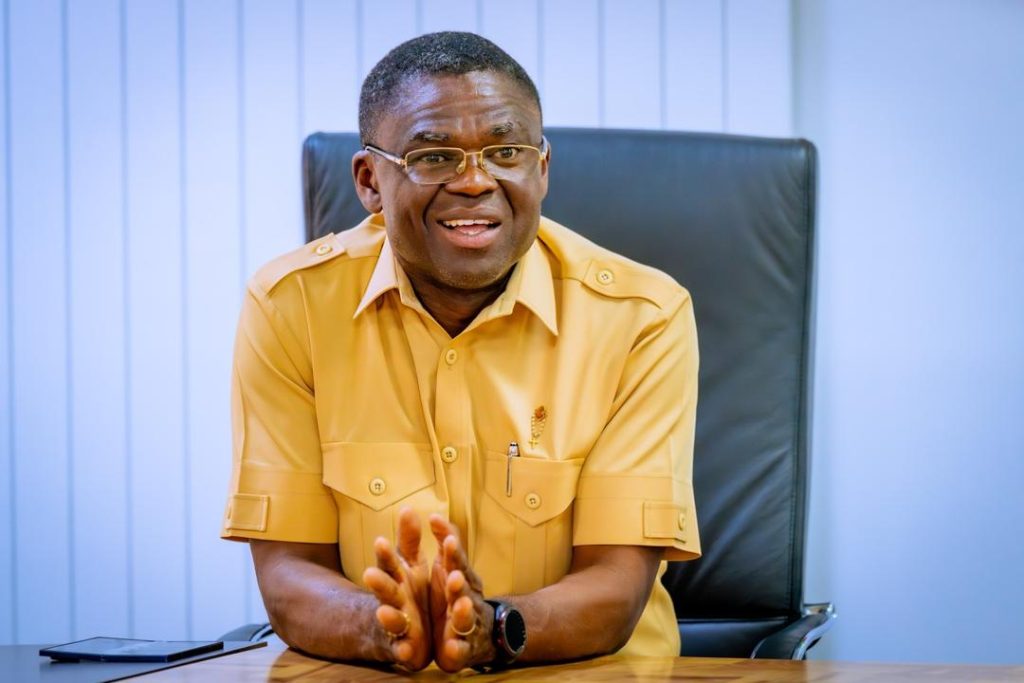
Declaring the assembly open, Bayelsa State Governor, Senator Douye Diri, delivered a keynote address in which he commended the Director General and Chief Executive Officer of the National Institute for Sports (NIS), Comrade Philip Shaibu, for his transformative leadership.
Governor Diri observed that sports administration in Nigeria has experienced notable progress, emphasizing that the NIS—previously underrecognized—has gained renewed relevance and visibility within a short period under Shaibu’s stewardship.
He remarked that the institute’s rapid evolution reflects a broader improvement in the management of sports in the country and urged other administrators and political appointees under President Bola Ahmed Tinubu to adopt similar forward-thinking approaches.
The assembly attracted prominent figures in the sports sector, including the Chairman of the National Sports Commission, Mallam Shehu Dikko; the Commission’s Director General, Hon. Bukola Olopade; Chairman of the Senate Committee on Sports, Senator Abdul Ningi; and Chairman of the House of Representatives Committee on Sports, Hon. Kabiru Amadu.
Also present were Chairmen and Secretaries of all 36 State Football Associations and the Federal Capital Territory, alongside members of the NFF Executive Committee and Management. Representatives of various leagues, as well as the Coaches Association, Referees Association, and Players’ Union, were in attendance, highlighting the broad representation at the gathering.
In his welcome remarks, NFF President Ibrahim Musa Gusau set the tone for deliberations by stressing the need for unity and sustained reforms to move Nigerian football forward.
Key issues slated for discussion at the Extraordinary General Assembly include proposed amendments to the NFF Statutes, the Electoral Code, and the Standing Orders of the General Assembly. The congress is also expected to address important appointments, such as members of the NFF Electoral Committee, Electoral Appeals Committee, and the federation’s Independent Auditor.
The presence of officials from FIFA and the Confederation of African Football (CAF), who are attending as observers, further underscores the importance of the assembly on the global stage.
Stakeholders remain optimistic that decisions reached at the meeting will strengthen governance frameworks and set Nigerian football on a more progressive path.