
By Joy Omagha Idam
Nigeria has reaffirmed its unwavering commitment to promoting peace, security, democratic governance, and regional integration across Africa as the Honourable Minister of State for Foreign Affairs, Ambassador Sola Enikanolaiye, received a high-level delegation of the African Union (AU) Peace and Security Council (PSC) in Abuja.
The delegation, led by the Chairperson of the AU Peace and Security Council for June 2026 and Nigeria’s Permanent Representative to the African Union, Ambassador Nasir Aminu, alongside the AU Commissioner for Political Affairs, Peace and Security, Ambassador Bankole Adeoye, visited the Ministry of Foreign Affairs following the Third Annual Joint Consultative Meeting between the AU Peace and Security Council and the ECOWAS Mediation and Security Council held in Abuja.
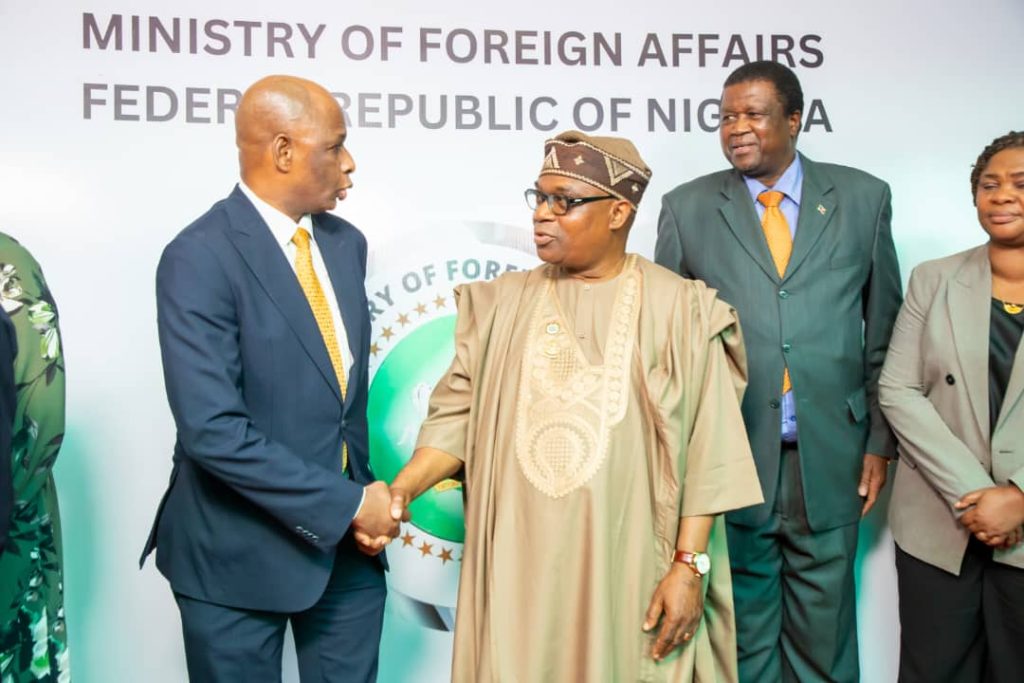
Welcoming the delegation, Ambassador Enikanolaiye expressed appreciation for their goodwill following his appointment and reaffirmed Nigeria’s dedication to advancing the African Union’s vision of peace, security, democracy, good governance, and continental integration.
He described the AU Peace and Security Council as a vital institution for conflict prevention, peacebuilding, and political governance, noting that Nigeria places high priority on its work. According to the Minister, the growing collaboration between the AU Peace and Security Council and ECOWAS has become an effective mechanism for addressing Africa’s evolving security challenges through coordinated regional and continental responses.
The Minister stressed that Nigeria would continue to strengthen diplomatic engagement with the African Union while supporting initiatives that enhance cooperation between the AU, Regional Economic Communities (RECs), and Regional Mechanisms in tackling insecurity across the continent.
Highlighting the continent’s security concerns, Ambassador Enikanolaiye observed that Africa continues to grapple with terrorism, violent extremism, transnational organised crime, unconstitutional changes of government, and humanitarian crises. He called for stronger governance structures, closer institutional collaboration, and more effective conflict prevention strategies to achieve sustainable peace.
The Minister also condemned the recent xenophobic attacks against African nationals in South Africa, particularly Nigerians, describing the incidents as unacceptable and contrary to the principles of African unity and solidarity.
He disclosed that, under the directive of President Bola Ahmed Tinubu, the Federal Government had evacuated affected Nigerians through government-funded repatriation flights to ensure their safe return home. He urged the African Union to prioritise the issue within its peace and security agenda, stressing that every African should be able to live and work safely anywhere on the continent.
Ambassador Enikanolaiye further advocated the full implementation of the African Union’s free movement agenda while encouraging member states to address migration challenges through inclusive governance, economic opportunities, and sustainable development.
On the financing of African peace operations, the Minister reiterated Nigeria’s longstanding position that Africa must reduce dependence on external funding by developing sustainable and innovative financing mechanisms.
He cited the ECOWAS Community Levy as a successful model that could be replicated at the continental level to strengthen the operational capacity of the African Union Peace and Security Council. He also reaffirmed Nigeria’s support for the implementation of United Nations Security Council Resolution 2719 (2023) on financing African Union-led peace support operations while urging African countries to increase their domestic contributions.
Earlier, Ambassador Nasir Aminu informed the Minister that the Third Annual Joint Consultative Meeting reviewed emerging security threats across Africa, assessed ongoing peace initiatives, and explored practical measures to strengthen cooperation between continental and regional institutions. Discussions also focused on sustainable financing for peace support operations and the implementation of Resolution 2719.
Speaking on behalf of the African Union Commission, Ambassador Bankole Adeoye commended Nigeria’s longstanding leadership in promoting peace, stability, and regional integration across the continent.
He praised Nigeria’s active contributions within the AU Peace and Security Council and reaffirmed the Commission’s commitment to working closely with ECOWAS, member states, and other Regional Economic Communities to address Africa’s growing security challenges. He also emphasised the need for stronger domestic financing, enhanced institutional coordination, and greater political commitment to achieve African ownership of peace operations and advance the AU’s “Silencing the Guns” initiative.
At the end of the meeting, both parties reaffirmed their shared commitment to advancing peace, democratic governance, security, and sustainable development across Africa. They also agreed to sustain regular consultations and deepen collaboration between the African Union, ECOWAS, and member states in responding to emerging security challenges on the continent.