
By Remi Johnson
Fifty years after Nigeria took the historic decision to create a new Federal Capital Territory, Abuja stands today as a symbol of the country’s political identity, ambition and search for a truly national capital.
The decision came in 1976, sixteen years after independence, when the military government of General Murtala Mohammed created the Federal Capital Territory and announced the relocation of the nation’s capital from Lagos to Abuja.
The choice was driven by the desire to establish a capital that would be centrally located, accessible to Nigerians from different parts of the country and free from some of the geographical and administrative limitations associated with Lagos.
Abuja was therefore not conceived merely as another city. It was designed as a national project, a planned capital that would embody Nigeria’s unity and provide the infrastructure, institutions and environment expected of the seat of government.
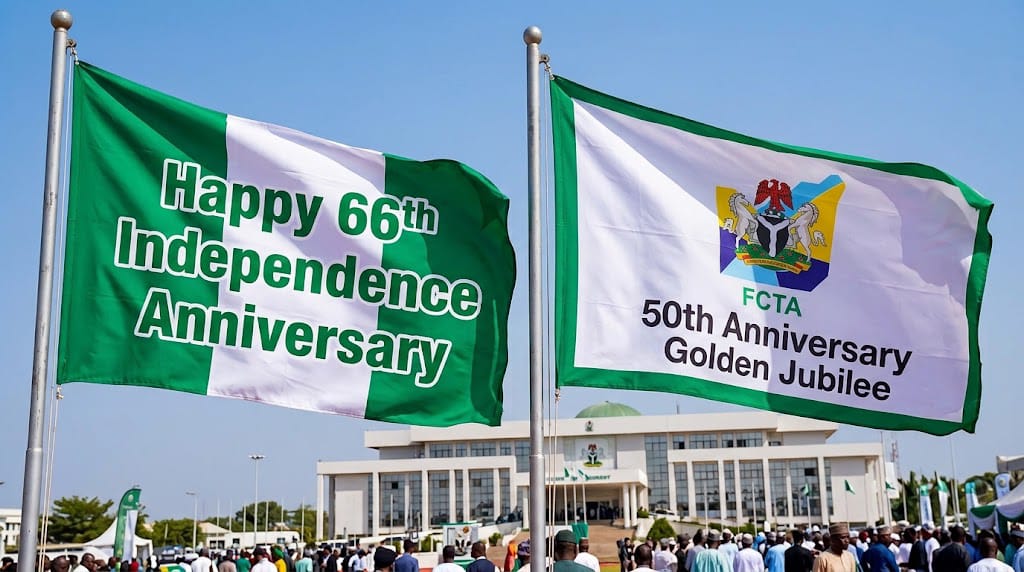
Fifty years later, as Nigeria marks its 66th independence anniversary and the FCT celebrates its golden jubilee, the question is no longer whether Abuja has become a capital city; the more important question is whether it has fulfilled the vision for which it was created.
The answer, perhaps, lies somewhere between achievement and unfinished business.
From the government district, the National Assembly, the Supreme Court and other federal institutions to diplomatic missions, businesses, residential districts, massive ongoing infrastructure development and an expanding metropolitan population, Abuja has undoubtedly developed into the political heart of Nigeria.
But the city that emerged from the vision of the 1970s is no longer the city it was designed for.
The Abuja Master Plan, prepared in 1979, provided the framework for the development of the Federal Capital City. It was intended to guide land use, transportation, infrastructure, residential communities, public facilities and the overall physical development of the capital.
Five decades later, however, Abuja is dealing with challenges that its original planners could hardly have anticipated at today’s scale.
Population growth, expansion into satellite communities, traffic congestion, housing pressures, drainage and flooding, pressure on public utilities and concerns over land-use changes have created new demands on the capital.
Little wonder, the Federal Capital Territory Administration is currently pursuing a review of the Abuja Master Plan, with transportation, urban mobility, infrastructure, satellite towns and sustainable development forming part of the planning conversation.
That development itself tells an important story; the Abuja Master Plan has not necessarily failed; rather, Abuja has grown beyond many of the assumptions upon which the original plan was based.
The challenge before the authorities is therefore how to preserve the principles of a planned capital while adapting them to the realities of a modern, rapidly expanding city.
Perhaps this is the gap that the Nyesom Wike-led administration, under President Bola Ahmed Tinubu, is frantically working to bridge.
Since the appointment of Nyesom Wike as Minister of the Federal Capital Territory, the administration has placed considerable emphasis on infrastructure development across the capital.
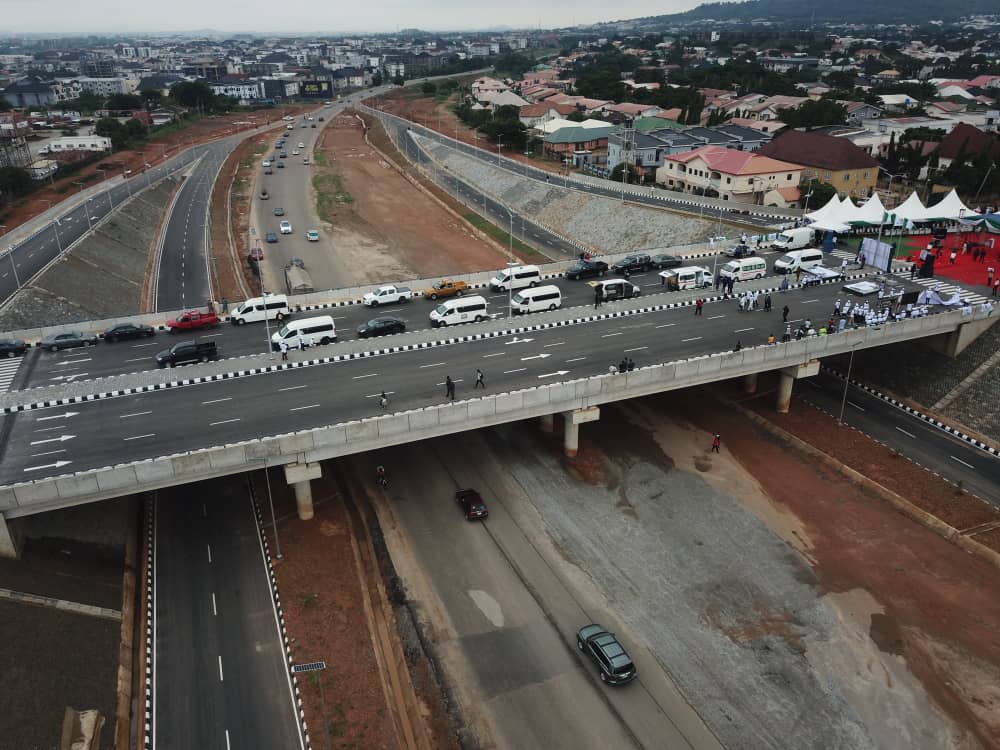
Roads, bridges, water projects, judicial infrastructure and projects linking the city centre with satellite communities have formed a major part of the current development programme.
In 2026 alone, the FCT Administration embarked on 31 days of project commissioning, including major road and institutional infrastructure, with the Federal Government describing Abuja’s ongoing modernisation as part of its broader infrastructure agenda.
Wike has often stated that a capital whose population and physical boundaries have expanded dramatically needs road connectivity to support growth and development.
According to Wike, “A road linking a satellite community to the city is not merely a transportation project. It can determine access to employment, education, healthcare, commerce and government services.”
He noted that the recent efforts to extend water infrastructure beyond the central city to satellite communities were a testament to the fact that Abuja is becoming a capital city that works for all.
Yet, the success of Abuja over the next fifty years will also depend on whether urban planning can keep pace with population growth; whether housing can remain accessible to ordinary residents; whether satellite towns receive adequate infrastructure; whether green areas and designated land uses are protected; and whether transportation, drainage, sanitation and other public services develop alongside physical expansion.
These are some of the issues now informing the review of the Abuja Master Plan, particularly the need to address rapid population growth, development-control capacity, planning distortions, illegal land-use conversion and the application of an integrated urban development strategy for the Federal Capital City and satellite towns.
So, has Abuja fulfilled the purpose for which the FCT was created?
After 50 years, the capital has achieved the fundamental objective of becoming the seat of Nigeria’s Federal Government and a recognisable national centre.
But the continuing need to upgrade infrastructure, review the Master Plan and respond to rapid urban growth demonstrates that the Abuja project is far from finished.
For the Tinubu administration, the test will ultimately extend beyond the number of projects commissioned. It will be whether those projects form part of a coherent, long-term strategy that makes Abuja more connected, more functional, more sustainable and capable of serving a growing population.
Fifty years ago, Nigeria created Abuja with the hope of building a capital that would belong to all Nigerians. Today, that dream stands in concrete, steel, roads, bridges, institutions and expanding communities.
But it also lives in an unfinished plan, a reminder that a lot of work still needs to be done by both the current and successive administrations to achieve a great capital that everyone would be proud of, including generations to come.
As Nigeria celebrates 66 years of independence and Abuja marks 50 years of its existence as the nation’s Federal Capital, the story of Abuja is therefore not one of a dream achieved or abandoned. It is a dream still unfolding.
The first fifty years built the capital Nigeria imagined; the next fifty must intentionally build, review, reform, and consolidate what has been achieved to ensure that Abuja becomes the capital city our past leaders, patriots, and indeed all Nigerians truly yearned for.