
Accra Summit Links Environmental Pressure to Security, Migration and Livelihoods Across West Africa
By Joy Omagha Idam
Ghana has urged the Economic Community of West African States (ECOWAS) to move towards a more coordinated regional strategy for confronting the growing intersection between climate change, environmental degradation, population displacement and insecurity.
The call was made at the opening of the second 2026 Parliamentary Seminar and Second Extraordinary Session of the ECOWAS Parliament in Accra, where Ghanaian authorities and parliamentarians highlighted the need for stronger regional cooperation in responding to environmental and humanitarian pressures.
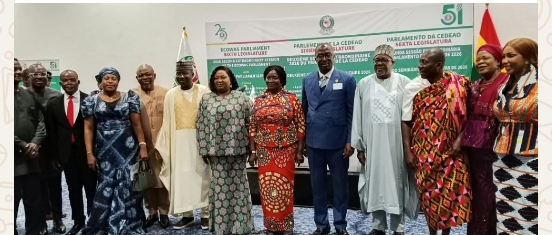
Representing Ghana’s President, John Dramani Mahama, at the opening ceremony, Vice-President Professor Jane Naana Opoku-Agyemang said the scale and interconnected nature of the challenges required ECOWAS member states to work beyond national boundaries.
She stressed the importance of strengthening early-warning mechanisms, improving assistance to communities hosting displaced populations and enhancing cooperation among countries before localised pressures develop into larger humanitarian emergencies.
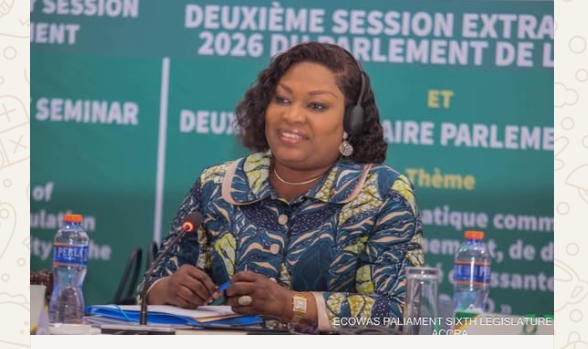
According to her, West Africa requires systems capable of identifying emerging risks early and mobilising appropriate responses before they escalate.
Professor Opoku-Agyemang also presented climate change as an issue extending beyond environmental concerns, noting its implications for development, livelihoods and regional security.
She pointed to population movements across the Sahel and neighbouring coastal countries, observing that insecurity, environmental pressures and disrupted livelihoods can create consequences that extend beyond the communities where they originate.
Early Warning and Regional Preparedness
The Ghanaian Vice-President said her country was collaborating with ECOWAS to improve early-warning capacity through better data sharing, closer institutional coordination and stronger links between national and regional response structures.
She called for increased attention to climate financing and investments capable of strengthening communities against environmental shocks.
Among the areas identified were resilient agriculture, water-resource management, coastal protection and clean-energy development.
While acknowledging the existence of ECOWAS frameworks covering areas such as free movement, disaster-risk reduction, climate action and early warning, she emphasised the need to translate those frameworks into practical programmes supported by adequate resources.
Parliament Places Climate Security on the Agenda
The Speaker of the ECOWAS Parliament, while declaring the session open, similarly drew attention to the impact of climate change on forests, coastal areas and livelihoods across the region.
She argued that national and regional climate commitments would have greater practical value when reflected in legislation, government budgets and measurable programmes.
The Speaker also called on parliamentarians to ensure that climate-resilience policies take account of their wider humanitarian, economic, social, migration and security implications.
Recent flooding along parts of the West African coastline, she noted, demonstrates how environmental events can have consequences that extend into humanitarian and security concerns.
She therefore urged participants to develop practical recommendations aimed at protecting vulnerable populations and reducing conditions that could contribute to conflict.
Ghana Seeks Stronger Environmental Legislation
The Ghanaian Parliament also advocated stronger legislation in areas including environmental governance, climate adaptation, disaster preparedness and natural-resource management.
It called for greater protection for refugees, displaced persons and communities hosting them, while encouraging investment in economic opportunities for women and young people.
Climate-smart agriculture, renewable energy and entrepreneurship were identified among the areas capable of creating opportunities while supporting adaptation to environmental changes.
Second Deputy Speaker of the Ghanaian Parliament, Mr. Andrew Asiamah, who represented the Speaker, stressed that environmental challenges could not be effectively addressed by individual countries acting in isolation.
He noted that rivers, ecosystems and environmental activities often extend across national borders, making regional cooperation essential.
Asiamah also underscored the importance of financing, cautioning that regional policies would require adequate resources if they were to move beyond commitments and produce tangible results.
ECOWAS Parliament and the People
The Head of the Ghanaian Delegation to the ECOWAS Parliament, Mr. Kweku Ricketts-Hagan, said the regional legislature had an important role to play in addressing climate-related challenges and insecurity because parliamentarians maintained close links with communities.
He advocated a coordinated and holistic approach that takes account of the different dimensions of the challenges confronting West African populations.
The parliamentary gathering is being held under a theme examining climate change, environmental degradation, population displacement and increasing insecurity across the ECOWAS region.
Beyond the seminar, the Second Extraordinary Session of the ECOWAS Parliament is expected to consider the institution’s proposed 2027 budget and activity programme.
The discussions in Accra place the region’s environmental and humanitarian challenges within a broader question of regional preparedness: how ECOWAS member states can strengthen cooperation, finance resilience and respond collectively to pressures that increasingly cross national boundaries.