
By Joy Omagha Idam
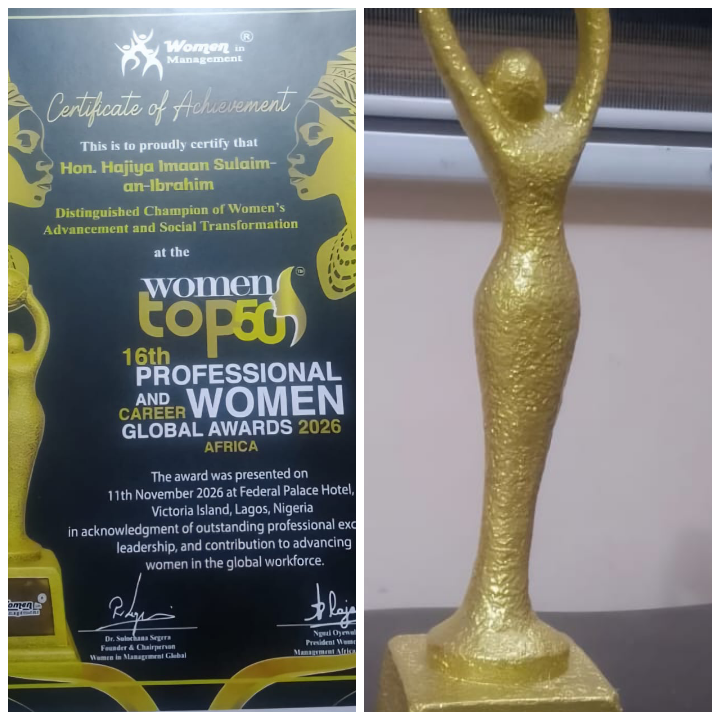
Nigeria’s Minister of Women Affairs and Social Development, Hon. Imaan Sulaiman-Ibrahim, has received international recognition for her contributions to women’s advancement, social transformation and inclusive development, earning the prestigious title of Distinguished Champion of Women’s Advancement and Social Transformation at the 16th Top50 Professional and Career Women Global Awards 2026 (Africa).
The recognition, organised by Women in Management (WIM) Global in collaboration with WIM Africa, celebrates professional excellence, visionary leadership and outstanding contributions to creating opportunities for women in the workplace and society.
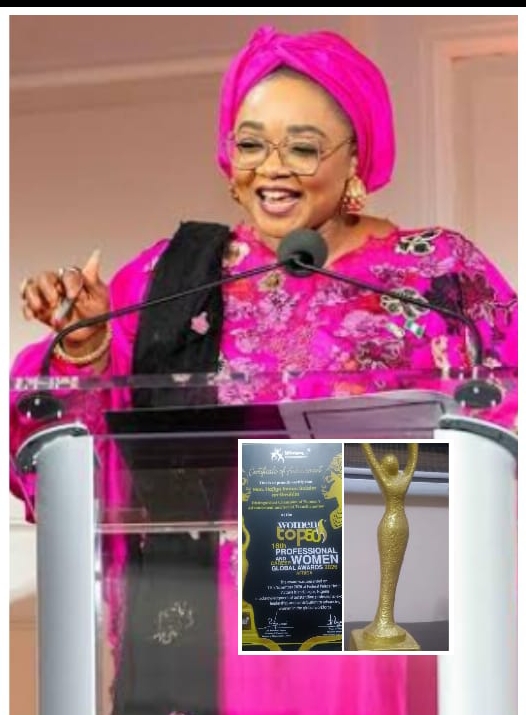
The award was presented at the Federal Palace Hotel, Victoria Island, Lagos, on November 11, 2026.
The Minister was represented at the ceremony by the Director-General and Chief Executive Officer of the Maryam Babangida National Centre for Women Development, Dr. Adedayo Benjamins-Laniyi, alongside the Centre’s Governing Council Chairperson, Princess (Dr.) Joan Jummai Idonije.
The Certificate of Achievement was jointly endorsed by the Founder and Chairperson of WIM Global, Dr. Sulochana Segera of Sri Lanka, and the President of WIM Africa, Mrs. Ngozi Oyewole.
The international honour places renewed attention on Nigeria’s efforts to strengthen women’s participation in leadership, economic activities and national development, while recognising the policy direction being pursued by the Federal Ministry of Women Affairs and Social Development under Sulaiman-Ibrahim.
Since assuming leadership of the Ministry, the Minister has pursued a broad policy agenda involving more than 38 targeted policies, legislative reviews and strategic frameworks designed to improve the welfare, protection and socio-economic opportunities available to women, children, families and vulnerable populations across the country’s 774 Local Government Areas.
A significant aspect of this agenda is the effort to move beyond traditional approaches to women’s empowerment by addressing the structural challenges affecting their economic participation, safety, family responsibilities and access to opportunities.
One of the notable milestones came on October 28, 2026, when the Federal Executive Council approved three major national policy instruments championed by the Ministry.
They include the National Care Policy and Implementation Plan (2026–2030), the National Costed Action Plan on Ending Violence Against Children, and the National Policy on Menstrual Health and Hygiene Management (2026–2030).
The National Care Policy is particularly significant because it recognises the economic and social importance of care work while addressing the disproportionate burden of unpaid domestic and caregiving responsibilities often shouldered by women.
The other policy instruments are designed to strengthen child protection and improve access to menstrual health and hygiene services, reinforcing the government’s wider social protection and human development objectives.
Beyond these approvals, the Ministry has continued to pursue legislative and institutional reforms aimed at strengthening the protection of women and children.
These include the launch of the Third National Action Plan on United Nations Security Council Resolution 1325 on Women, Peace and Security, alongside ongoing reviews of the Child Rights Act 2003, the Violence Against Persons (Prohibition) Act 2015 and the National Gender Policy 2021–2026.
The establishment of the National Council for Social Work also forms part of the institutional development efforts intended to strengthen professional social services and support vulnerable members of society.
In the area of grassroots economic participation, the Ministry is advancing interventions designed to connect policy commitments with practical opportunities for Nigerian women.
Among these is the Nigeria for Women Programme Scale-Up (NFWP-SU), which seeks to expand women’s economic opportunities and strengthen their participation in productive activities.
Another flagship initiative is the Power of 10 Million: One Voice. One Movement. One Choice, a women’s mobilisation and economic empowerment platform intended to strengthen collective participation, solidarity and opportunities for women across the country.
The Ministry’s Nine-Pillared Renewed Hope Social Impact Interventions (RHSII-774) also provide a framework for extending social impact programmes across the Federation, with attention to the needs of women, children, families and other vulnerable groups.
The Minister’s policy approach places particular emphasis on the relationship between women’s economic empowerment, family stability, child protection, peace and national prosperity.
This perspective recognises that women’s advancement cannot be separated from the wider development of communities and the country’s economy. It also reinforces the importance of creating an environment in which women are not simply recipients of government interventions but active contributors to policymaking, enterprise, leadership and national transformation.
The global award therefore comes at a time when Nigeria is pursuing a range of social and economic reforms, with women’s participation increasingly recognised as an important component of sustainable development.
For Nigerian women, the recognition represents an opportunity to draw greater attention to issues of economic inclusion, leadership representation, protection from violence and access to opportunities.
It also provides an international platform for highlighting the country’s ongoing policy initiatives and the work of institutions committed to improving the lives of women and children.
As the Federal Ministry of Women Affairs and Social Development continues to implement its programmes, the challenge will be to sustain the momentum, deepen grassroots impact and ensure that policy approvals translate into measurable improvements in the everyday lives of Nigerian women and families.
The honour bestowed on Sulaiman-Ibrahim is consequently both a recognition of her leadership and an occasion to renew attention to the broader national responsibility of building a society where women, children and families can thrive.
Ultimately, empowering women is not merely a social intervention; it is an investment in stronger families, productive communities and a more inclusive Nigerian economy.