
As Nigerian envoy explores Spanish technology, investment and expertise to unlock food production potential
By Joy Omagha Idam
MADRID — A new conversation around food security, agricultural technology and investment is taking shape between Nigeria and Spain, with Nigeria’s newly accredited Ambassador to the Kingdom of Spain, Dr. Okezie Victor Ikpeazu, placing agriculture at the centre of his early diplomatic engagements in Madrid.
Barely days after formally presenting his Letters of Credence to His Majesty King Felipe VI of Spain, Ambassador Ikpeazu turned his attention to one of the most consequential areas of Nigeria’s economic future: how to transform the country’s enormous agricultural potential into greater food production, employment and investment.
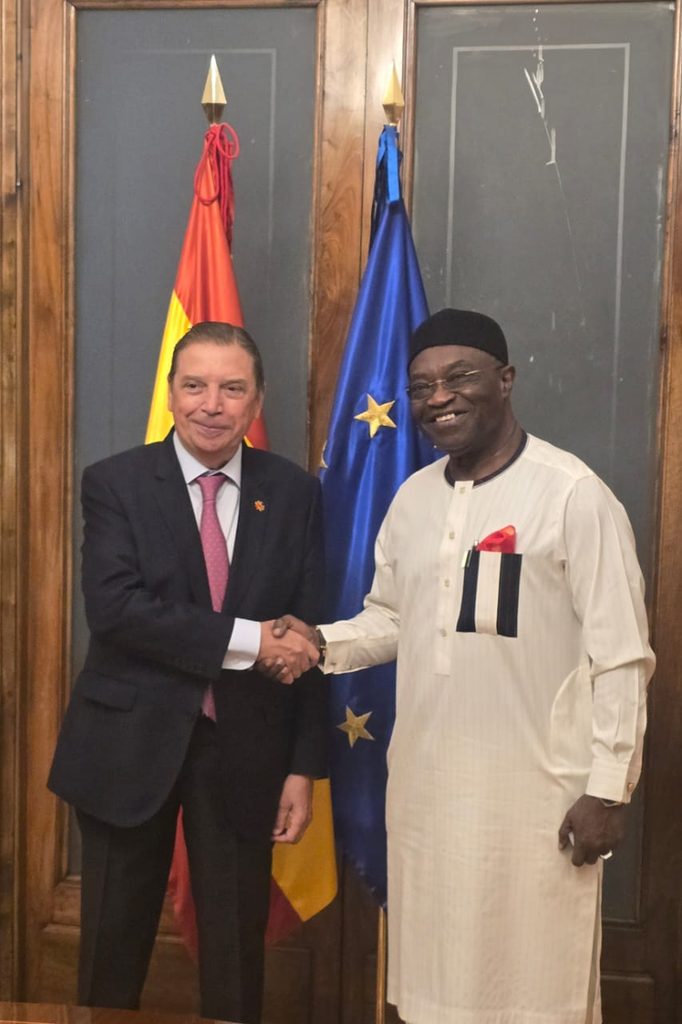
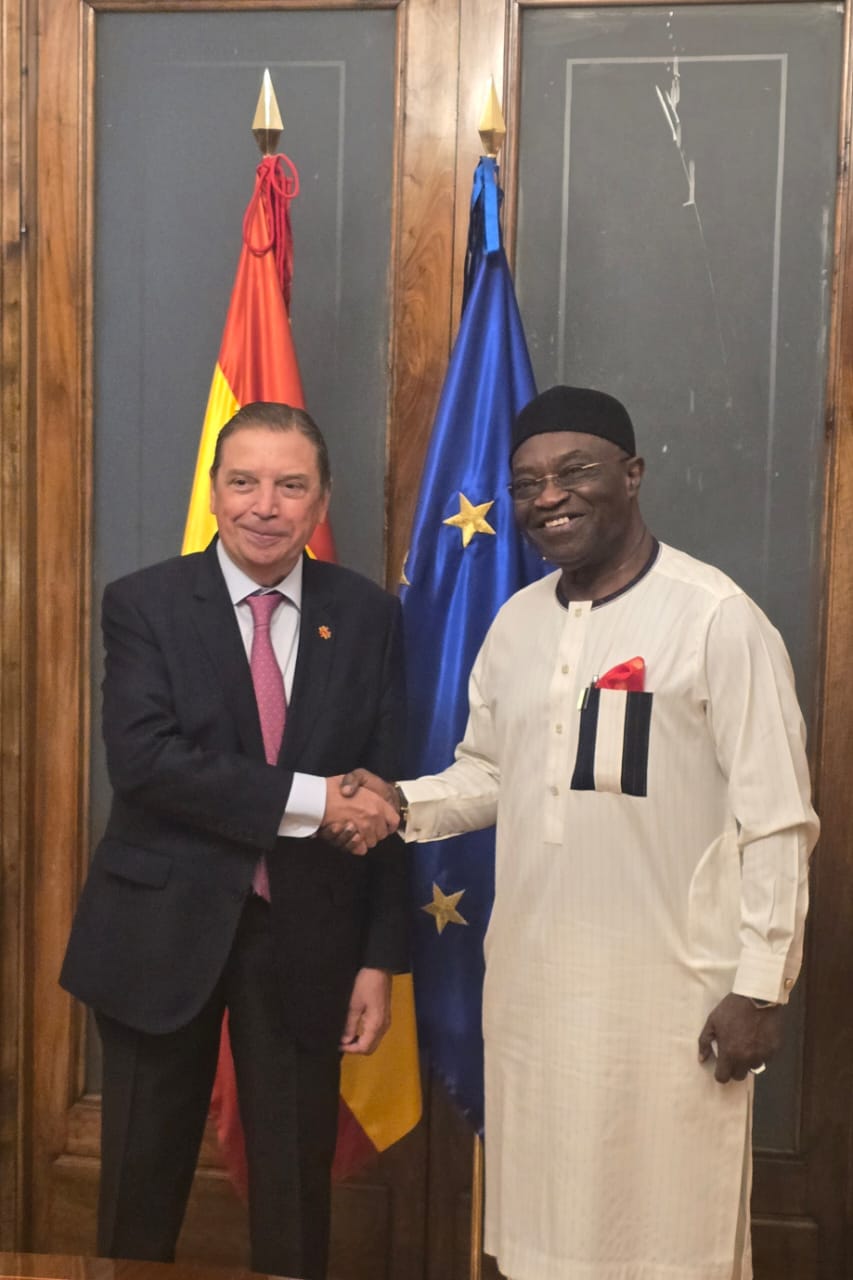
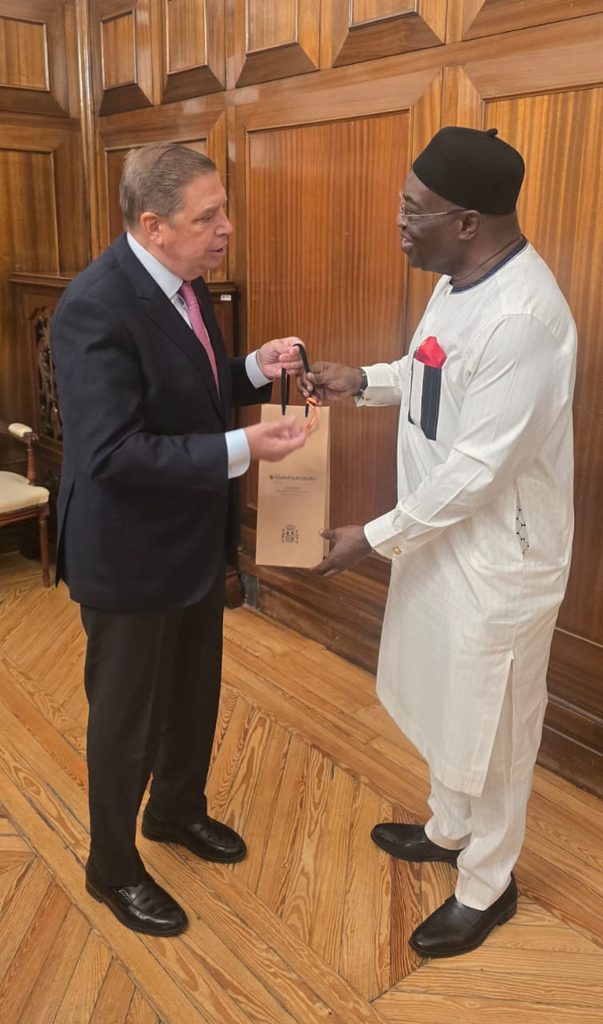
On Thursday, September 17, 2026, the Nigerian envoy paid a courtesy visit to Spain’s Minister of Agriculture, Fisheries and Food, Luis Planas Puchades, at the ministry’s headquarters in Madrid.
The Spanish Ministry of Agriculture confirmed that the meeting focused on exploring possible avenues of cooperation between both countries in the agricultural and livestock sectors. It also identified food security as a shared challenge for Nigeria and Spain, with international cooperation offering opportunities for the exchange of knowledge, experience and practical solutions.
The meeting, therefore, went beyond the traditional courtesies associated with the arrival of a new ambassador. It offered an opportunity to examine what Nigeria could gain from Spain’s experience in modern agriculture — and what opportunities Nigeria’s huge market, extensive agricultural land and growing population could offer Spanish investors and technology providers.
From diplomatic credentials to food security
Ikpeazu’s meeting with Planas came only three days after the Nigerian ambassador formally presented his credentials to King Felipe VI at the Royal Palace in Madrid on September 14.
The Spanish Royal Household confirmed the presentation, marking the formal accreditation of Ikpeazu as Nigeria’s ambassador in Spain.
His immediate engagement with the agriculture minister gives an indication of the economic areas likely to receive attention as the new envoy settles into his diplomatic assignment.
Agriculture remains an important sector in Nigeria’s development equation. Beyond the question of feeding a large and growing population, the sector carries possibilities for employment, rural development, agro-processing, exports and the creation of businesses across entire value chains.
For Nigeria, the challenge is no longer simply about having land suitable for farming. The larger question is how to convert that natural advantage into reliable production through better seeds, irrigation, mechanisation, livestock development, storage, transportation, processing and access to markets.
That is where the Spanish experience becomes particularly relevant.
What Spain brings to the table
During the engagement, Spain’s experience in agricultural technology and food production featured prominently.
The Spanish side highlighted advances in areas including crop disease prevention, improved and high-yielding seedlings, livestock production, irrigation and food preservation.
Such technologies have implications beyond the farm itself.
A better seed can increase yields. Effective irrigation can reduce dependence on unpredictable rainfall. Improved animal production can strengthen meat and dairy value chains. Better storage and transportation can reduce losses between the farm and the consumer.
For Nigeria, where significant quantities of agricultural produce can be lost because of inadequate storage, processing and transportation facilities, these areas represent potential opportunities for cooperation.
Spain’s agricultural development also demonstrates how technology, production systems and food policies can work together to improve the performance of the wider food chain.
Minister Planas pointed to Spain’s experience of producing more food than it imports and highlighted the contribution of improved seedlings, food preservation measures and consumption strategies.
The Spanish Ministry itself described the Nigeria-Spain discussion as part of a broader effort to exchange knowledge and experiences in confronting common agricultural and food-security challenges.
Nigeria’s land, Spain’s technology
For Ikpeazu, the meeting provided an opportunity to underline Nigeria’s vast agricultural potential.
Nigeria possesses extensive arable land and a large workforce, particularly a youthful population that could become a major source of labour, entrepreneurship and innovation within the agricultural sector.
But unlocking that potential requires more than simply encouraging people to return to farming.
It requires a system in which farmers can obtain quality inputs, access modern technology, produce at commercial scale, preserve their harvests and connect efficiently with domestic and international markets.
That is why technology transfer and investment emerged as important components of the conversation.
Ikpeazu expressed Nigeria’s interest in learning from Spain’s experience in improved seedling production, livestock development and food preservation, while encouraging stronger collaboration between institutions and private-sector players in both countries.
The GB Foods example
One of the practical examples cited during the engagement was the experience of GB Foods, a Spanish-linked food company with operations in Nigeria.
The company has been associated with agricultural activities in states including Kebbi and Ogun, where the introduction of improved seedlings has reportedly produced significant increases in tomato yields.
The example illustrates what can happen when agricultural production is connected to technology, investment and an organised value chain.
For Nigeria, the bigger opportunity lies in replicating such approaches across other crops and regions — provided that investment is accompanied by appropriate infrastructure, farmer support, reliable markets and policies capable of sustaining production.
The tomato story also demonstrates that Nigeria’s agricultural future need not be defined exclusively by small-scale subsistence farming.
With the right combination of technology and investment, agriculture can become a commercially driven sector capable of supporting farmers while supplying processors, manufacturers and consumers.
Beyond crops: the livestock opportunity
The discussions also extended beyond crop production.
Nigeria’s demand for animal protein and the size of its domestic market make livestock development another area with significant economic possibilities.
Ikpeazu expressed interest in cooperation with Spain in animal production, with opportunities existing in breeding, animal health, modern production systems, processing and related value chains.
The issue is particularly significant because agricultural development cannot be treated as a single-crop conversation.
A modern food system requires interconnected sectors — crops, livestock, fisheries, processing, logistics, storage and retail.
Spain’s experience across these areas could therefore provide opportunities for Nigerian institutions, businesses and agricultural entrepreneurs to develop new partnerships.
The migration dimension
Another important element of the Nigerian position was the connection between agriculture and employment.
Nigeria has one of the world’s largest youth populations, and the agricultural sector has the capacity to absorb millions of young people if it is transformed into a productive, technology-driven and commercially attractive industry.
Ikpeazu argued that expanding agricultural opportunities could contribute not only to food security and job creation but also to addressing pressures associated with irregular migration.
The logic is straightforward: when young people can see viable economic opportunities at home, particularly in sectors capable of supporting entrepreneurship and sustainable livelihoods, the incentive to seek uncertain opportunities elsewhere may be reduced.
Agriculture, therefore, becomes more than a food issue. It becomes part of a broader conversation about economic opportunity, youth employment and national development.
Reducing the journey from farm to table
Perhaps one of the most practical areas for Nigeria-Spain cooperation lies in reducing food losses.
It is one thing to increase production; it is another to ensure that what is produced reaches consumers in good condition.
Poor storage, inadequate cold-chain facilities, weak transportation systems and limited processing capacity can undermine the economic value of increased agricultural production.
This is where Spanish experience in food preservation and related technologies could potentially complement Nigeria’s agricultural resources.
Rather than allowing increased production to result in increased waste, improved preservation systems could help farmers and processors retain more value from what they produce.
For Nigerian farmers, that could mean better returns. For consumers, it could contribute to a more stable supply. For investors, it could create opportunities in storage, processing, logistics and distribution.
A new chapter in bilateral relations
The agricultural meeting also fits into a wider effort to deepen relations between Nigeria and Spain.
At the beginning of his diplomatic assignment, Ikpeazu has already publicly identified agriculture alongside trade, investment, energy, infrastructure, education, culture, tourism, security and people-to-people exchanges as areas in which Nigeria seeks stronger bilateral engagement with Spain.
The agriculture dialogue therefore has the potential to become one component of a broader economic relationship.
The two sides agreed on the importance of closer collaboration, technology transfer and investment promotion, while indicating readiness to facilitate relevant proposals from government agencies and private-sector stakeholders.
The real test, however, will be what follows the diplomatic discussions.
Meetings can open doors, but implementation determines whether those doors lead to measurable results.
For Nigeria, the opportunity is to convert diplomatic goodwill into practical partnerships — from improved seeds and irrigation to livestock, food preservation, processing and agricultural investment.
For Spain, Nigeria offers a major market and an agricultural economy with considerable room for technology, capital and expertise.
From Madrid to the Nigerian farm
The significance of Ikpeazu’s engagement with Spain’s agriculture minister may ultimately be measured not by the photographs taken in Madrid, but by what happens after the meeting.
Can Spanish technology reach Nigerian farmers?
Can Nigerian agricultural products gain stronger access to international markets?
Can partnerships produce improved yields while reducing post-harvest losses?
Can livestock production become more productive and commercially sustainable?
And can investment in agriculture create meaningful opportunities for Nigeria’s young population?
Those are the questions that now sit behind the diplomatic conversation.
What began as a courtesy visit has placed agriculture firmly within the emerging Nigeria-Spain economic dialogue.
For a country searching for durable solutions to food security, employment and economic diversification, the conversation is timely.
And for Ambassador Okezie Victor Ikpeazu, his early engagement with Spain’s agricultural leadership signals an attempt to make economic diplomacy tangible — by connecting Nigeria’s resources and opportunities with Spanish knowledge, technology and investment.
The next chapter will depend on turning that shared interest into projects that can be seen, measured and ultimately felt far beyond the diplomatic corridors of Madrid.
By Joy Omagha Idam