
Why government ownership, stronger financing and functioning primary healthcare may determine whether reform reaches the ordinary Nigerian
By Joy Omagha Idam
For years, Nigeria’s healthcare conversation has been dominated by familiar questions: How much money is being committed? How many hospitals are being renovated? How many policies have been launched? And how many development partners are supporting the country?
But as Nigeria moves through another phase of health-sector reform, a more fundamental question is emerging: Who ultimately owns the responsibility for delivering better healthcare to Nigerians?
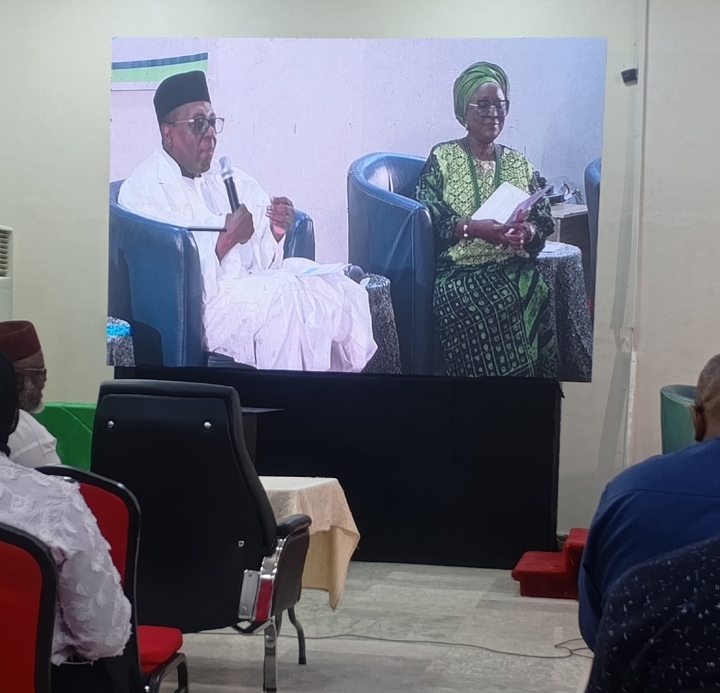
For Coordinating Minister of Health and Social Welfare, Professor Muhammad Ali Pate, the answer cannot indefinitely rest with international agencies and development partners. The Nigerian government—at both federal and state levels—must increasingly take ownership of the reforms and accept responsibility for the results.
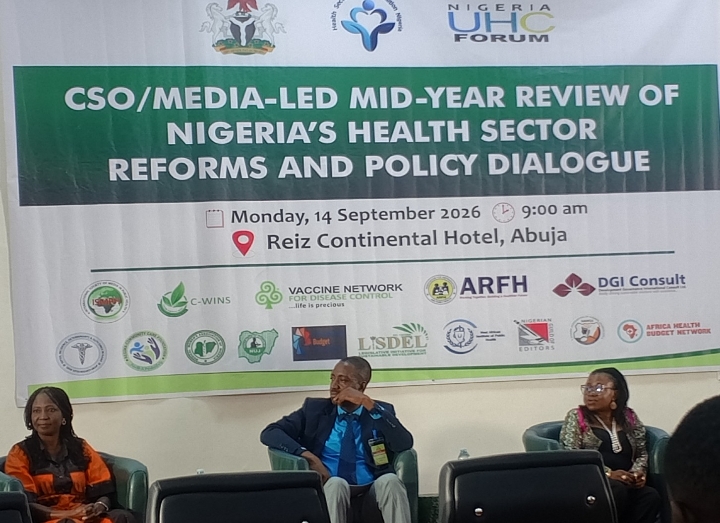
Pate made the point during a mid-term review of Nigeria’s health reform programme organised by the Nigeria UHC Forum and the Health Sector Reform Coalition, where civil society organisations examined progress under the Health Sector Renewal Investment Initiative.
His message was straightforward: external assistance can support transformation, but it cannot substitute for government responsibility.
According to Pate, the Federal Government is pursuing a different model of health-sector management, one that places greater emphasis on coordination between federal and state authorities while bringing development partners and civil society into the reform process.
The minister stressed that government must remain accountable for the outcomes Nigerians experience in their communities.
That distinction is important because health reform is ultimately not measured inside government documents. Its success is felt—or not felt—by the mother who needs safe delivery services, the child waiting for vaccination, the family struggling to pay a hospital bill and the rural patient travelling long distances to find a functioning health facility.
Pate also cautioned against expecting dramatic transformation within a short period.
He acknowledged that Nigeria’s healthcare challenges were accumulated over many years and would therefore require sustained effort to correct.
“We had no illusions that it was going to be easy or that all the problems will disappear within a year or two or three or four,” Pate said.
He added that the government remained committed to building a health system capable of meeting the needs of Nigerians.
That acknowledgement places the reform agenda in a longer-term context. The challenge before government is not simply to introduce another programme, but to build institutions and systems capable of surviving changes in leadership, funding pressures and shifting priorities.
Beyond the Renovated Building
One of the strongest messages emerging from the civil society review is that a healthcare facility cannot become functional merely because its walls have been painted or its infrastructure upgraded.
A renovated primary healthcare centre without trained personnel, medicines, diagnostic equipment, electricity, water and an effective referral system may still leave patients with little practical improvement.
The CSOs therefore argued that primary healthcare reform must move beyond physical infrastructure.
Their position reflects a reality familiar to many Nigerians: access to a building is not the same thing as access to healthcare.
A patient needs a health worker who is available when required. A pregnant woman needs competent maternity care. A child needs vaccines when they are due. A person requiring diagnosis needs functioning equipment. And emergencies require referral systems that can move patients quickly to facilities with the capacity to provide higher-level care.
In other words, the real health reform begins when the patient walks through the door.
The Financing Question
Money remains one of the most important pieces of the reform puzzle.
Civil society groups participating in the review identified high out-of-pocket expenditure, delays in releasing health funds, fragmented financing and continued dependence on external funding as significant challenges.
For ordinary households, the consequences of these weaknesses can be severe.
When families must shoulder a large proportion of healthcare costs directly, illness can become not only a medical crisis but also a financial crisis. The poorest households are particularly vulnerable because even relatively modest medical expenses can compete with food, education, transport and housing costs.
The CSOs consequently called for stronger accountability around health financing.
They urged government to ensure that funds approved for healthcare are released promptly and that it should be possible to follow public resources from the point of allocation down to the facilities where services are delivered.
That demand introduces an important principle into the reform conversation: health funding must be traceable to health outcomes.
It is not enough to announce an allocation. Nigerians need to know whether the money reached its intended destination and what it accomplished.
Maternal and Child Health Still a Critical Test
Perhaps nowhere is the urgency of healthcare reform more visible than in maternal and child health.
Figures cited by the civil society organisations from the Nigeria Demographic and Health Survey 2023–24 show a significant gap between contact with healthcare services and the continuity or quality of care received.
The groups noted that 79 per cent of women had received antenatal care from a skilled provider, while only 43 per cent had completed four or more antenatal visits. They also cited a figure of 50 per cent for live births assisted by a skilled provider.
The vaccination picture also remains a concern. According to figures presented by the CSOs, only 39 per cent of children aged 12 to 23 months had received basic recommended vaccinations, while 14 per cent had received none.
These figures illustrate why healthcare reform cannot be judged simply by the number of programmes introduced.
The question is whether those programmes produce healthier mothers, healthier children and greater protection against preventable disease.
The civil society groups also highlighted continuing concerns around nutrition, family planning and immunisation—areas where sustained intervention can have consequences across generations.
Can Nigeria Produce More of What It Needs?
Another dimension of the reform agenda is the push to strengthen domestic health manufacturing.
Pate said private-sector investment in the production of medical commodities was growing, including diagnostic test kits.
The larger ambition is clear: Nigeria wants to reduce vulnerabilities associated with relying heavily on imported health commodities while creating greater domestic capacity.
But production alone will not solve the problem.
The minister indicated that government is also concerned with ensuring that increased domestic production results in commodities becoming more affordable and available to Nigerians.
That is an important distinction.
A product manufactured locally but priced beyond the reach of the health system or ordinary citizens does not automatically translate into improved healthcare access.
The ultimate objective therefore extends from production to affordability, availability and reliable supply.
Reform Must Become Institutional
For the CSOs, one of the central lessons of the mid-term review is that reforms must be institutionalised.
Policies can be announced by one administration and modified by another. Programmes can receive funding one year and encounter delays the next. But strong institutions, clear responsibilities and transparent implementation systems can provide continuity.
The groups therefore called for stronger alignment between health programmes and the National Health Act 2014.
They proposed a National Health Act Alignment and Implementation Matrix designed to identify gaps, define institutional responsibilities and establish timelines for action.
Such a framework, if effectively implemented, could help answer a question that frequently complicates public-sector reform: Who is responsible for doing what, and by when?
That clarity matters in a system as complex as Nigeria’s, where responsibilities are distributed across federal, state and local structures.
The Reform Beyond Abuja
Ultimately, the health-sector renewal agenda will be judged far beyond conference rooms in Abuja.
It will be judged in communities where mothers seek antenatal care, in primary healthcare centres where children receive vaccines, in laboratories where patients await diagnoses and in households where families calculate whether they can afford treatment.
Pate’s warning about the limits of permanent external support therefore goes beyond funding. It raises the question of national ownership.
Development partners can provide expertise, resources and technical assistance. Civil society can monitor, question and demand accountability. Private companies can invest and produce medical commodities.
But government remains the institution with the responsibility to build a health system that works at scale.
Nigeria’s health reform journey is therefore entering a stage where promises must increasingly be matched by measurable delivery.
The renovated facility must have personnel.
The budget must reach the frontline.
The medicine must be available.
The vaccine must reach the child.
The pregnant woman must receive skilled care.
And the patient who needs referral must have a functioning system to take them there.
Those are the points at which reform stops being a policy document and becomes a public service.
For Nigeria, the real measure of the current health-sector renewal may ultimately be simple: whether an ordinary citizen can enter a healthcare facility with a health problem and leave with meaningful, affordable and timely care.
That is the distance between announcing reform and delivering it—and it is the distance government must now close.