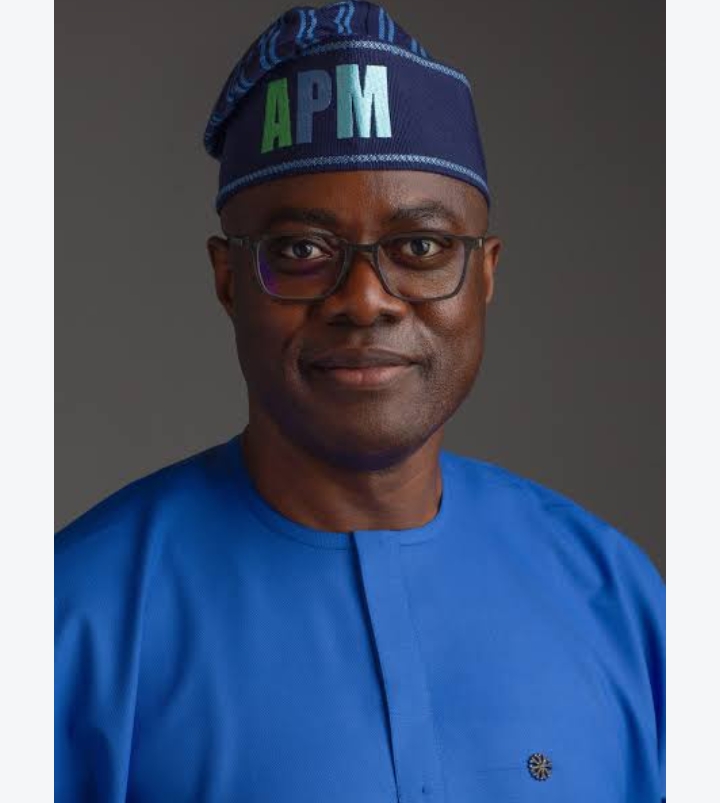
Promises economic relief, security overhaul, education reforms and national political restructuring
By Joy Omagha Idam
Governor Seyi Makinde of Oyo State and presidential candidate of the Allied Peoples Movement (APM) has unveiled his 2027–2031 presidential manifesto, declaring that Nigeria’s greatest challenge is not a shortage of resources but a lack of ideas and responsible leadership.
Makinde made the declaration on Wednesday at the Congress Hall of Transcorp Hilton, Abuja, during the unveiling of his Reset Nigeria Agenda, which outlines his proposed economic, political, educational and security reforms ahead of the 2027 general elections.
“Nigeria is rich in natural resources and human resources, but our leaders are poor in ideas,” he declared.
The governor said his ambition was driven by the need to build a country where government policies translate into tangible improvements in the lives of ordinary citizens.
According to him, governance must go beyond impressive economic statistics to deliver affordable food, employment opportunities, improved incomes and a reduced cost of living.
He explained that the manifesto was developed through extensive consultations with Nigerians across the six geopolitical zones, including town hall meetings designed to identify citizens’ expectations and priorities.
The Reset Nigeria Agenda is built around four major pillars: resetting the economy, restructuring the security architecture, reforming education and resetting the country’s socio-political system.
On the economy, Makinde promised to reduce the structural costs of living and doing business, with particular attention to electricity, energy and infrastructure.
He argued that Nigerian manufacturers cannot compete effectively when they depend heavily on expensive diesel-powered generators, adding that the high cost of doing business has forced some enterprises to consider relocating outside the country.
He also questioned the prevailing petroleum pricing framework, insisting that Nigerians should not be made to suffer because of the government’s inability to manage the country’s resources and borders effectively.
On electricity, the Oyo governor maintained that the Federal Government must remain accountable for its promises to improve power supply, despite the new electricity arrangements allowing states greater participation in the sector.
Makinde further proposed a transitional government of national unity that would bring together different political and social interests to agree on a sustainable direction for Nigeria.
He called for a national conference to address the country’s constitutional and institutional challenges, including the need for a political system that commands broader popular support.
He also proposed that a presidential candidate should secure at least 51 per cent of votes to win, arguing that the arrangement would encourage wider political consensus.
On accountability, Makinde promised that his administration would establish measurable performance targets within its first 100 days, insisting that every political promise must have a responsible institution, a clear implementation plan and verifiable outcomes.
He urged Nigerians to scrutinise the manifesto, examine its commitments and hold political leaders accountable for their promises.
DAURA ADVOCATES INCLUSIVE GOVERNMENT
Speaking at the event, Makinde’s running mate, former Director-General of the Department of State Services (DSS), Lawal Musa Daura, advocated an inclusive government that would respect democratic rights and provide a level playing field for political parties.
Daura warned against the suppression of opposition parties, describing a vibrant opposition as essential to democratic stability and national development.
He said the proposed transitional government would run for four years, providing an opportunity to reset the economy, education, security architecture and socio-political system.
He also called for a national conference involving representatives of government, political parties and other stakeholders to deliberate on the country’s future.
The National Chairman of the Social Democratic Party (SDP), Professor Sadiq Gombe, who attended the unveiling, described Makinde as a shining light of the opposition.
He commended Makinde and Bauchi State Governor Bala Mohammed for their contributions to opposition cooperation and the strengthening of democratic engagement.
Also speaking, APM National Chairman, Yusuf Mamman Dantalle, said the manifesto represented a proposed new direction for Nigeria, stressing that political parties should be regarded as vehicles for national service rather than instruments for personal interests.
Dantalle expressed concern over rising petroleum prices and their impact on ordinary Nigerians, calling for policies that would ease the economic burden on citizens.
The unveiling marks a major step in the Makinde-Daura presidential campaign as the APM seeks to present its Reset Nigeria Agenda as an alternative political and economic direction ahead of the 2027 elections.