
By Nkechinyere Ewa-Okpara
Gender-Based Violence (GBV) is not a private matter it is a public health crisis, a human rights violation, and a barrier to Nigeria’s development.
This was the resounding message from stakeholders in Ebonyi State who converged in Abakaliki on Monday, September 15, for a one-day training and capacity-building workshop aimed at strengthening institutional responses to GBV.
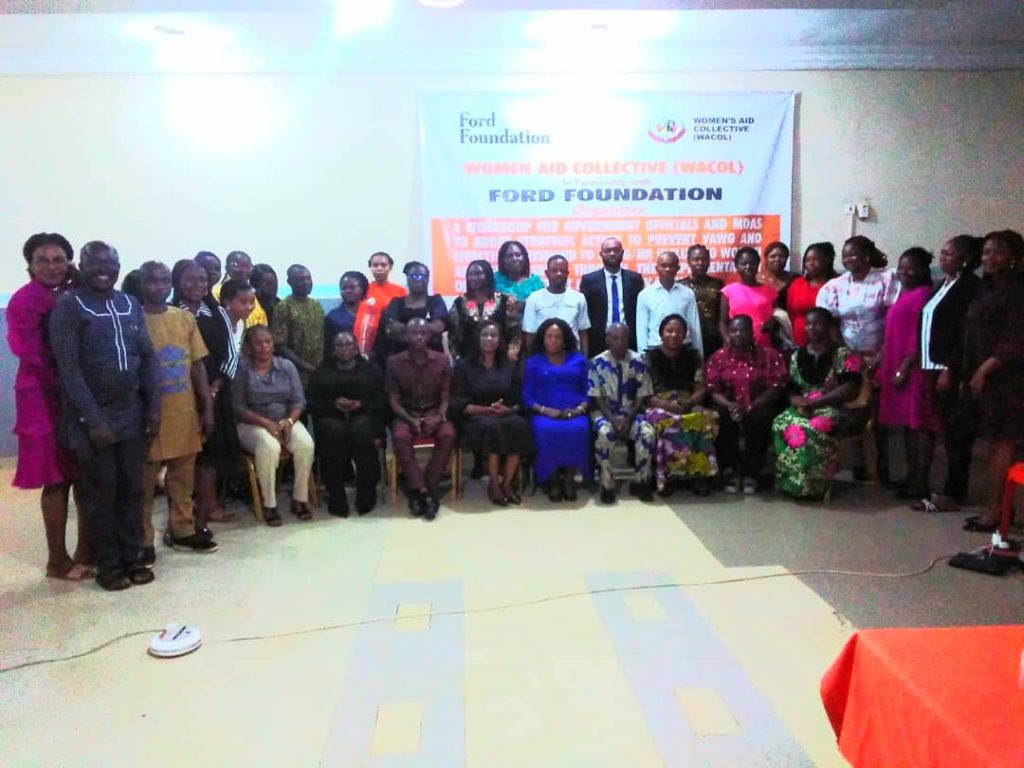
The event, organized by Women Aid Collective (WACOL) with support from the Ford Foundation, New York, brought together key actors from government ministries, law enforcement agencies, the judiciary, and civil society.
Participants included officials from the Ministries of Justice, Women Affairs, Education, Health, Youth Development, and Information, alongside the Nigeria Police, the National Human Rights Commission (NHRC), and the Judiciary.
‘GBV Thrives on Patriarchy and Myths’
Taking participants through the global dimensions of GBV, WACOL’s Legal Officer and lead facilitator, Helen Kalu, described the menace as one of the most pressing human rights challenges of the century.
According to her, one in three women globally has suffered some form of violence, while over 200 million have been subjected to female genital mutilation (FGM).
Kalu emphasized that GBV is deeply rooted in cultural stereotypes, patriarchal structures, and misconceptions. She faulted the widespread belief that “indecent dressing” causes rape.
“Are under-aged children and elderly women also victims because of indecent dressing?” she asked, stressing that such myths only serve to shield perpetrators from accountability.
She argued that GBV is not a “women’s issue” but a threat to peace, equality, and sustainable development. “It requires a coordinated, multi-stakeholder approach that goes beyond law enforcement to include families, schools, communities, and the justice system,” she said.
Families in the Spotlight
While acknowledging the role of weak state institutions the police, judiciary, and government bureaucracies in perpetuating impunity, participants highlighted the family as the first line of defense.
Christopher Okorie, NHRC State Coordinator, said many perpetrators of GBV are products of poor parental upbringing.
“Families must teach love, respect, and tolerance from an early age. Without this foundation, institutional reforms alone cannot win the fight,” he stressed.
Other participants, including Nwakaego Igboke of the Ministry of Women Affairs, Barr. Faithvin Nwanchor of the Ministry of Justice, and Goodness Mgbaja of the Civil Resource Development and Documentation Centre, echoed this sentiment.
Mgbaja went further, blaming both institutional compromises and family negligence for undermining justice. “Survivors and their families often withdraw cases, sabotaging the process.
At the same time, state institutions fail survivors by slowing or compromising justice. This double failure sustains the culture of silence,” she noted.
Commitments to Action
Participants pledged to leverage their offices to strengthen referral pathways, enhance cooperation across ministries and agencies, and create stronger community networks to protect women and girls.
Representing WACOL’s Executive Director, Prof. Ngozi Ezeilo (SAN), Senior Programme Officer Anulika Ezennia said the workshop was designed to break silos among agencies.
“We want every institution represented here to understand its role, its limits, and how to collaborate effectively. GBV victims should never feel abandoned, silenced, or trapped by a slow justice system,” she said.
Ezennia also lamented the silence of survivors, warning that fear, stigma, and institutional delay discourage reporting. “But WACOL and our partners will not relent until women and girls live free of violence in Ebonyi and across Nigeria,” she added.
A Call Beyond Ebonyi
The Abakaliki workshop reflects a growing national urgency. With GBV cases on the rise, experts say Nigeria must move beyond reactive measures to proactive strategies addressing harmful cultural norms, strengthening institutions, and building family values.
Stakeholders agreed that unless systemic failures are corrected and families reclaim their role in nurturing values of respect and non-violence, GBV will continue to erode Nigeria’s social fabric.
For Ebonyi, the message was clear: the fight against GBV is not just a government task. It is a collective responsibility of families, institutions, and communities. And until every survivor finds justice, the war is far from over.