
By Joy Omagha Idam
The Economic Community of West African States (ECOWAS) Parliament has called for stronger regional financing and implementation of climate policies, including the establishment of a dedicated regional fund to strengthen climate resilience and human security across West Africa.
The call formed part of the resolutions adopted at the end of the 2026 Second Extraordinary Session of the ECOWAS Parliament, following a week of deliberations on the interconnected challenges of climate change, environmental degradation, population displacement and insecurity.
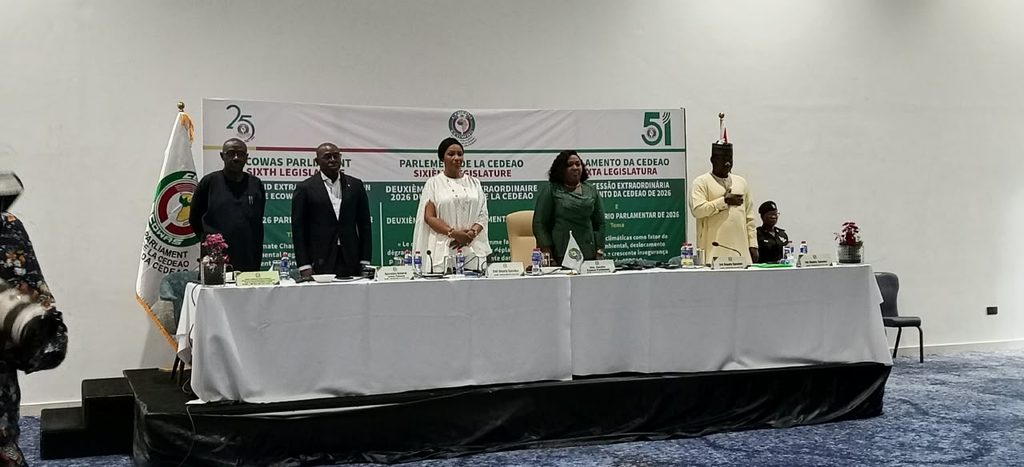
The regional lawmakers stressed that while West Africa already possesses various strategies and policy instruments to address climate-related challenges, inadequate financing, implementation gaps and limited national ownership continue to constrain their impact.
Speaking at the closing of the session, Speaker of the ECOWAS Parliament, Honourable Memounatou Ibrahima, said the credibility of the regional legislature would ultimately be measured by its ability to transform its decisions into practical actions that improve the lives of citizens.
“Our credibility will depend therefore on our ability to transform our decisions into concrete actions, which will be measurable and have impact on the populations that we represent,” she said.

Ibrahima said the Parliament would continue to concentrate on key regional priorities, including infrastructure, transportation, energy, peace and security, community development and increased participation of women in politics.
She emphasised that recommendations adopted by the Parliament must be followed through and assessed based on their ability to influence public policies and produce meaningful action at community level.
According to her, the region is not short of strategies and policy frameworks but requires the political commitment and financial resources necessary to turn those frameworks into tangible outcomes.
“Our region doesn’t lack strategies nor instruments. What it requires is the funding and political will to implement them and translate them into visible and tangible assets for the populations,” she said.
The Speaker also called for a balance between the Parliament’s ambitions and the realities of managing increasingly constrained resources, stressing the importance of maintaining the quality and relevance of parliamentary deliberations.

She said the institution’s objective remained to strengthen the Parliament and ensure that it effectively reflected the concerns and aspirations of citizens across the region.
Parliament outlines climate action priorities
Presenting the resolutions arising from the parliamentary seminar, Guinean legislator Bademba Baldé said the discussions examined the role of parliamentary leadership in responding to the interconnected effects of climate change, environmental degradation, displacement and insecurity.
He said deliberations covered vulnerability mapping, early-warning systems, water resources, displacement governance and climate financing, with five ECOWAS member states, including Nigeria, presenting their national experiences.
Baldé noted that existing regional frameworks could provide a foundation for action but identified effective implementation, adequate financing and stronger national ownership as critical requirements for success.
He also identified reliable data, vulnerability mapping and functional early-warning systems as essential tools for anticipating and managing climate-related risks.
According to him, limited access to climate finance remains a major obstacle, particularly in the preparation of viable projects, feasibility studies and financial structuring.
The lawmaker said climate financing should take into account peace and security, human mobility and social protection, while the Parliament should strengthen its oversight role in monitoring financing and promoting the inclusion of women, young people, displaced populations and farmers.
Calls for stronger laws and investment
The adopted recommendations urged ECOWAS member states to strengthen laws and policies relating to environmental protection, climate adaptation, disaster-risk reduction and sustainable management of natural resources.
Member states were also encouraged to incorporate climate resilience, conflict prevention and sustainable natural-resource management into national development plans, public budgets and land-use planning.
The Parliament called for stronger national systems for climate-data collection, early warning and risk mapping, with climate information integrated into disaster preparedness and security responses.
It further urged member states to mobilise national, regional and international resources for climate financing while building their capacity to prepare bankable projects and undertake feasibility studies and financial structuring.
On environmental protection, the Parliament advocated greater protection and restoration of forests, mangroves, degraded lands and coastal ecosystems.
It also encouraged wider adoption of climate-resilient agriculture, agroforestry and improved water-management practices.
Tackling resource-related conflicts
The resolutions also addressed conflicts associated with competition over land, water and pastoral resources.
The Parliament called for effective mechanisms to prevent and resolve such conflicts, alongside gradual harmonisation of national legal frameworks covering environmental protection, transhumance, natural-resource management and climate-related disaster prevention.
It further proposed credible carbon-market frameworks anchored on transparency, integrity and verification, with equitable sharing of benefits involving affected communities.
Regional climate resilience fund proposed
A major component of the resolutions is the call for ECOWAS Heads of State and Government to consider establishing a regional fund for climate resilience and human security.
The proposed financing mechanism is expected to support regional efforts to respond to climate-related vulnerabilities while strengthening the connection between environmental resilience, humanitarian needs and peace and security.
The ECOWAS Commission was also urged to develop a five-year roadmap for accelerated implementation of the regional climate strategy.
The roadmap is expected to strengthen regional early-warning and rapid-response mechanisms for climate, humanitarian and security risks, as well as improve regional risk mapping and climate-data systems.
The Parliament further called for increased technical assistance to member states to implement the regional climate strategy and improve their access to available climate-financing opportunities.
It also sought stronger cross-border cooperation on pastoral mobility, shared water resources, ecosystem protection and risk prevention.
Wider access to climate information
The lawmakers stressed the importance of ensuring that climate information and early warnings reach those responsible for taking decisions at different levels.
They called for improved dissemination of early-warning information to national decision-makers, member states, local authorities, communities and the ECOWAS Parliament.
Technical and financial partners were equally encouraged to support member states and regional institutions in climate adaptation, resilience-building and accessing international climate-finance mechanisms.
The resolutions adopted at the session are to be transmitted to the ECOWAS Commission, the Council of Ministers and the Speakers of National Assemblies of member states.
As the extraordinary session ended, Speaker Ibrahima urged lawmakers to move beyond deliberations and translate the Parliament’s decisions into concrete responses to the needs of West African citizens.
“We are leaving here with our heads high and henceforth; we must concretize our decisions to answer to the aspirations of the population,” she said, before formally declaring the Second Extraordinary Meeting of the ECOWAS Parliament closed.