
By Joy Omagha Idam
President of India, Smt. Droupadi Murmu, has called on Indians at home and abroad to remain united, patriotic and committed to building a developed, inclusive and self-reliant India as the country prepares to celebrate its 80th Independence Day.
In her address to the nation on the eve of Independence Day, President Murmu paid tribute to the country’s freedom fighters and millions of citizens whose contributions continue to drive India’s development, stressing that the true meaning of freedom lies in creating opportunities for every citizen to fulfil their aspirations.
Her Address was Read By the Indian High Commissioner to Nigeria, read the address to the Indian Community in Nigeria.
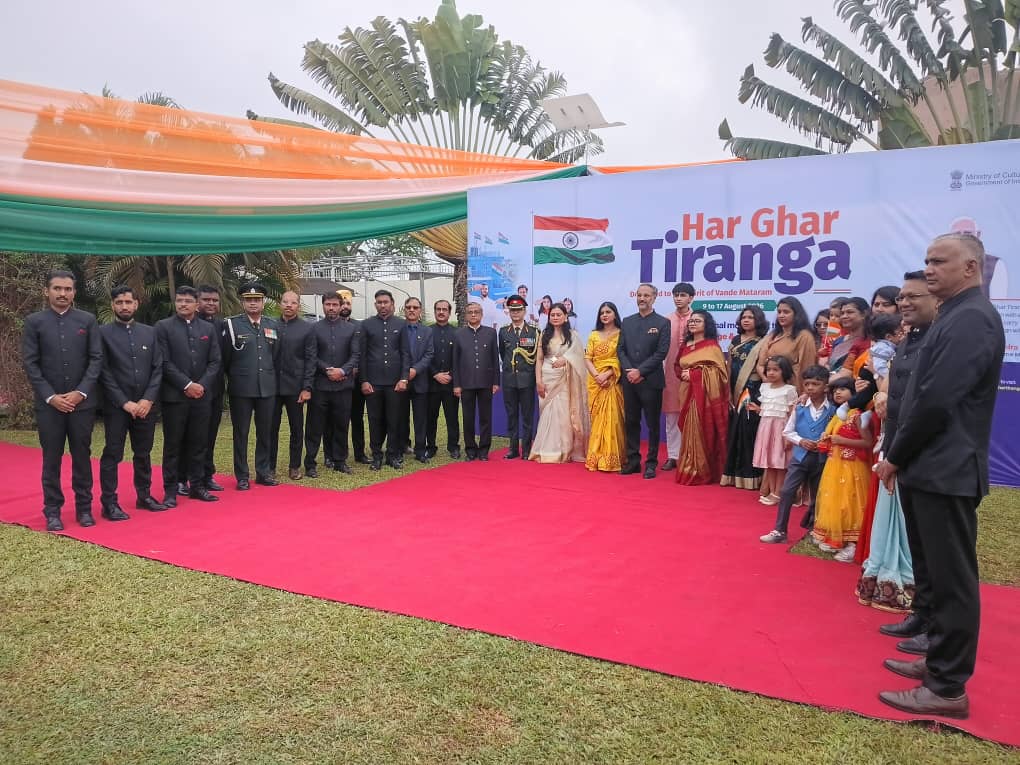
She described the Indian Tricolour as a powerful symbol of freedom and national pride, while urging citizens to contribute to nation-building through their respective professions and responsibilities.
The President commended India’s soldiers, armed police forces and police personnel for their dedication to national security, while also acknowledging the contributions of farmers, scientists, teachers, healthcare workers, engineers, entrepreneurs, artists, sportspersons, civil servants, social workers and members of the Indian diaspora.
Vision of a Developed India by 2047
President Murmu said India is moving towards the goal of becoming a Viksit Bharat — Developed India — by 2047, when the country will mark 100 years of independence.
She said the development agenda must be guided by the principle of Antyodaya, ensuring that the benefits of economic growth and national development reach every section of society.
According to her, India’s development journey combines modernisation with its rich cultural heritage and the ideals of the freedom movement.
The President also paid tribute to Mahatma Gandhi, Dr. B.R. Ambedkar, Sardar Vallabhbhai Patel, Mahatma Jyotiba Phule and Savitribai Phule, describing their contributions to India’s freedom, social justice, equality, education and national unity as enduring sources of inspiration.
Remembering Partition Victims
President Murmu also recalled the suffering caused by the 1947 Partition, noting that millions of Indians lost their lives, were displaced or became refugees as a result of communal violence.
She said the observance of Vibhajan Vibheeshika Smriti Divas provides an opportunity to remember the victims and reflect on the importance of unity and social harmony.
The President equally honoured Sardar Vallabhbhai Patel for his historic role in integrating more than 550 princely states into independent India, describing him as the architect of the unity of modern India.
Development, Poverty Reduction and Social Welfare
Highlighting India’s socio-economic progress over the past decade, President Murmu cited rapid and inclusive development, expansion of infrastructure and the removal of long-standing obstacles to growth.
She said more than 25 crore people have been lifted out of poverty, while nearly 59 crore people have been brought into the formal banking system through the Pradhan Mantri Jan Dhan Yojana.
More than 32 crore of the Jan Dhan account holders are women, she said.
The President also highlighted food security programmes providing free rations to more than 80 crore people and healthcare coverage of up to ₹5 lakh annually for 60 crore people under the Ayushman Bharat scheme.
She noted that farmers have also received support through initiatives including the Kisan Samman Nidhi and Kisan Credit Cards.
India’s Digital Revolution
President Murmu described India’s digital transformation as one of the country’s major achievements, noting that digital payments have become widespread even among rural businesses and street vendors.
She said more than half of the world’s real-time digital transactions take place in India, describing the country’s digital infrastructure as an example for the international community.
According to her, technology has also enabled greater transparency in the delivery of government welfare programmes.
She further pointed to the expansion of highways, waterways, railways and airports as drivers of employment, entrepreneurship and investor confidence.
Economy and Global Standing
Despite economic uncertainty and conflicts in different parts of the world, President Murmu said India’s economy continues to demonstrate resilience and remains the fastest-growing major economy.
She said India’s economic growth rate is projected to remain significantly above the global average, while the Atmanirbhar Bharat initiative continues to strengthen the foundations of economic development and national security.
On foreign policy, she said India’s approach remains anchored on national interest, peace, cooperation, dialogue and the philosophy of Vasudhaiva Kutumbakam — the world is one family.
The President highlighted India’s growing engagement with the Global South, Free Trade Agreements with various countries and its advocacy for a more representative global governance system.
She also reiterated India’s support for a rules-based international order and greater representation for the global community in institutions such as the United Nations.
Women and Youth at the Centre of India’s Future
President Murmu placed strong emphasis on women’s empowerment, noting the growing participation of Indian women in education, agriculture, entrepreneurship, sports, security and other sectors.
She said more than 10 crore women are members of Self Help Groups, while the target of creating three crore Lakhpati Didis has been achieved, with a new target now set to create another three crore.
The President also highlighted women’s growing participation in entrepreneurship and leadership, noting that about two-thirds of beneficiaries of financial assistance under the MUDRA scheme are women.
She welcomed the enactment of the Nari Shakti Vandan Adhiniyam, which provides for 33 per cent representation for women in the Lok Sabha and State Legislative Assemblies.
Turning to India’s youth, President Murmu said approximately 65 per cent of the country’s population is below the age of 35, making young Indians one of the nation’s greatest assets.
She praised young entrepreneurs, scientists, innovators and professionals for creating new solutions and strengthening India’s start-up ecosystem.
She also highlighted India’s expanding space programme, pointing to the successful rocket launch by a young team whose average age was reportedly only 28 years.
Sports as a Tool for Nation-Building
President Murmu described sports as an important instrument for youth development and nation-building.
She said the Khelo India programme is helping to develop India’s sporting ecosystem from grassroots level to elite competition, while increased investment in sports is producing stronger performances at international tournaments.
She also celebrated the achievements of Indian women in international sport, highlighting their contribution to India’s medal haul at the recently concluded Commonwealth Games in Glasgow.
Security and the Fight Against Terrorism
On national security, President Murmu paid tribute to the armed forces and recalled the country’s commemoration of Kargil Vijay Diwas and the first anniversary of Operation Sindoor.
She said the operation demonstrated the capability of India’s armed forces to respond to terrorism with precision, while sending a strong message to terrorists and their supporters.
The President also described the suspension of the Indus Waters Treaty as a decisive step taken in India’s national interest, particularly in relation to the country’s farmers.
She further declared the progress made towards making India free of Naxalism a major achievement, noting that development, sports and cultural activities are increasingly taking place in regions previously affected by the insurgency.
Environment and Responsibility to Future Generations
President Murmu called on Indians to protect natural resources and ensure that future generations inherit a healthy environment.
Drawing from India’s cultural traditions and a Santali song by Pandit Raghunath Murmu, she stressed that the destruction of nature should evoke the same concern as the destruction of human values.
She encouraged citizens to support environmental initiatives such as Ek Ped Maa Ke Naam and Lifestyle for Environment (LiFE).
India’s Heritage on the Global Stage
The President also celebrated India’s cultural and historical heritage, noting that 12 forts associated with the Maratha military tradition were added to the UNESCO World Heritage List last year.
She further highlighted the inclusion of Sarnath, associated with Bhagwan Buddha’s first sermon, on the UNESCO World Heritage List this year.
President Murmu said India’s heritage demonstrates the country’s rich spiritual, cultural and historical legacy while strengthening its identity in the modern world.
A Call to Every Indian
As India enters its 80th year of independence, President Murmu’s address presented a vision of a country seeking to combine economic growth, social justice, technological advancement, cultural pride and national security.
She urged citizens to recognise that nation-building is not the responsibility of government alone but a collective duty involving every Indian.
With India looking ahead to its centenary of independence in 2047, the President called for continued public participation, respect for constitutional values, protection of the environment, empowerment of women and youth, and a shared commitment to building a stronger and more prosperous nation.
Her message was clear: India’s journey towards a developed nation will depend not only on the achievements of its government and institutions, but on the contribution, unity and sense of responsibility of every citizen.