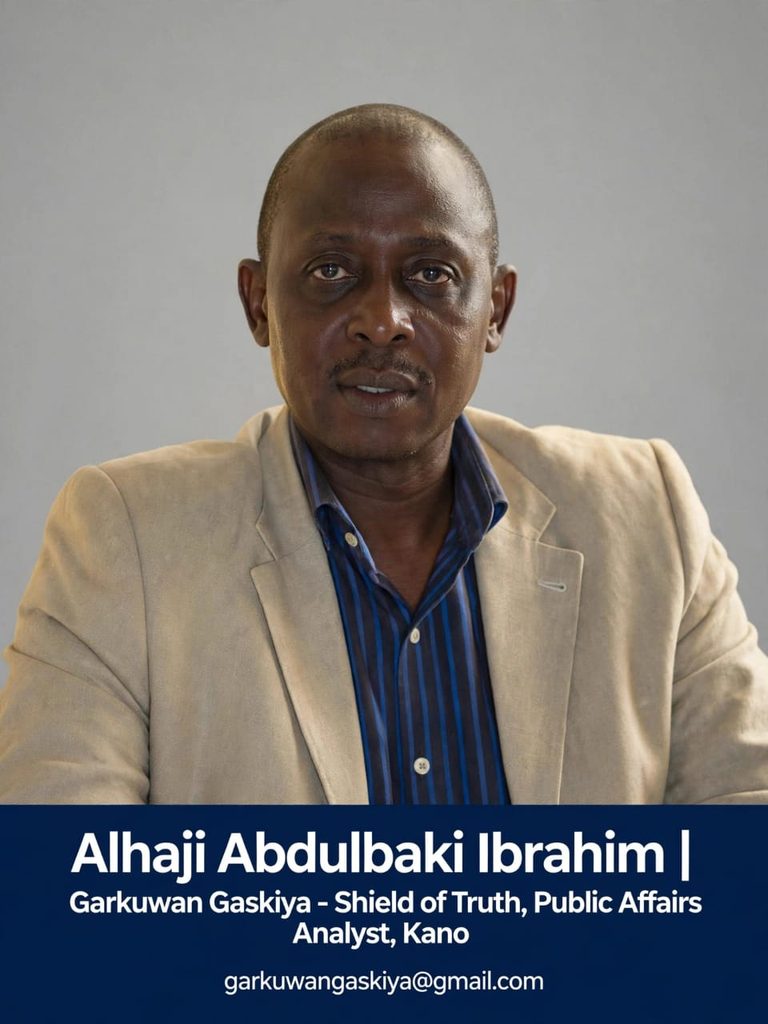
By Alh. Abdulbaki Ibrahim, Public Affairs Analyst
Kano State has an important role to play in Nigeria’s political, commercial and social development. As political activities gradually intensify ahead of the 2027 general elections, preserving peace, strengthening democratic institutions and promoting responsible political engagement should remain priorities for all stakeholders.
Political competition is an essential feature of democracy. However, disagreements over party affiliations, leadership choices and electoral ambitions should not distract attention from the welfare and aspirations of the people.
For Kano, the challenge is to sustain an environment where different political interests can coexist peacefully and citizens can participate freely in the democratic process.
The state’s political future should be shaped by constructive debate, respect for the law and a shared commitment to development.
Peaceful Competition Is Essential
Political parties and their supporters have different ideas about leadership and governance. Such differences are legitimate in a democratic society, provided they are expressed within the law.
Political leaders have an important responsibility to encourage peaceful participation and ensure that disagreements do not become sources of unnecessary tension.
Supporters should equally exercise restraint in their public statements, particularly on social media, where information can circulate rapidly and misunderstandings can escalate.
Responsible political communication requires participants to distinguish facts from opinions, verify information before sharing it and avoid language that could encourage hostility.
Kano’s political stakeholders can help sustain public confidence by promoting dialogue, mutual respect and peaceful competition throughout the electoral period.
Three Priorities for a Peaceful Kano
First: Promote Dialogue and Mutual Respect
Dialogue remains an important means of managing disagreements in a diverse society.
Political parties, community leaders, traditional institutions, civil society organisations and other stakeholders can contribute to peace by encouraging respectful engagement and peaceful resolution of differences.
Where misunderstandings arise, constructive communication can help clarify positions and identify areas of common interest.
The objective should not be to eliminate political differences but to ensure that such differences are managed responsibly.
All stakeholders should recognise that political competition does not remove their shared responsibility to protect the peace and wellbeing of Kano’s residents.
Second: Respect the Law and Electoral Procedures
Credible elections depend on compliance with applicable laws, transparent procedures and respect for the institutions responsible for administering the electoral process.
Political parties should ensure that their internal processes and candidate nominations comply with relevant legal requirements.
The Independent National Electoral Commission (INEC) should be allowed to perform its statutory responsibilities in accordance with the law.
Where electoral disagreements arise, the appropriate response is to seek clarification through the established administrative and judicial channels.
Citizens and commentators also have a responsibility to approach electoral matters carefully, relying on verified information and avoiding premature conclusions about disputes that have not been conclusively resolved.
Respect for due process helps strengthen democratic participation and public confidence in electoral institutions.
Third: Put the People’s Needs at the Centre of Politics
The most important measure of political leadership is its contribution to the welfare of the people.
Residents of Kano need practical solutions to challenges affecting employment, education, healthcare, access to clean water, security, infrastructure and economic opportunity.
The state’s commercial importance also makes support for traders, small businesses, farmers and other economic participants essential to sustainable development.
Political parties should therefore use the electoral period to explain their policy proposals, development priorities and plans for addressing the concerns of citizens.
The government should communicate its programmes and performance transparently, while opposition parties should present credible alternatives for public consideration.
Voters deserve a political environment in which ideas, policies and public service receive greater attention than personal disagreements.
Such an approach would help strengthen accountability and enable citizens to make informed electoral choices.
Conclusion: The Responsibility to Preserve Peace
As Kano approaches another electoral cycle, political stakeholders should remember that peace and democratic participation are complementary.
Political parties may disagree on policies, leadership and the direction of government, but these differences should be addressed through lawful and peaceful means.
Traditional institutions, community leaders, civil society organisations, the media and ordinary citizens all have roles to play in promoting responsible public discourse.
The media, in particular, can support peaceful democratic participation by verifying information, presenting competing perspectives fairly and avoiding the publication of unsubstantiated allegations.
Ultimately, the people of Kano deserve an environment where they can express their political preferences freely, pursue economic opportunities and go about their daily activities without unnecessary tension.
The task before all stakeholders is to promote dialogue, uphold the law and make public welfare the central consideration in political engagement.
Kano’s future should be defined not by the intensity of political disagreements, but by the commitment of its people and leaders to peace, democratic values and sustainable development.
Kano First. Peace Before Politics. Development Above Division.
Alh. Abdulbaki Ibrahim is a Public Affairs Analyst who writes from Kano, Nigeria.