
By Nkechinyere Ewa
The Nigerian Export Promotion Council (NEPC) has urged the Ebonyi State Government to establish hides and skins processing facilities to create jobs, increase traders’ earnings and boost the state’s participation in the non-oil export market.
The council also called on hides and skins dealers to formalise their businesses, form cooperatives and adopt improved preservation methods to enhance product quality and meet international market standards.
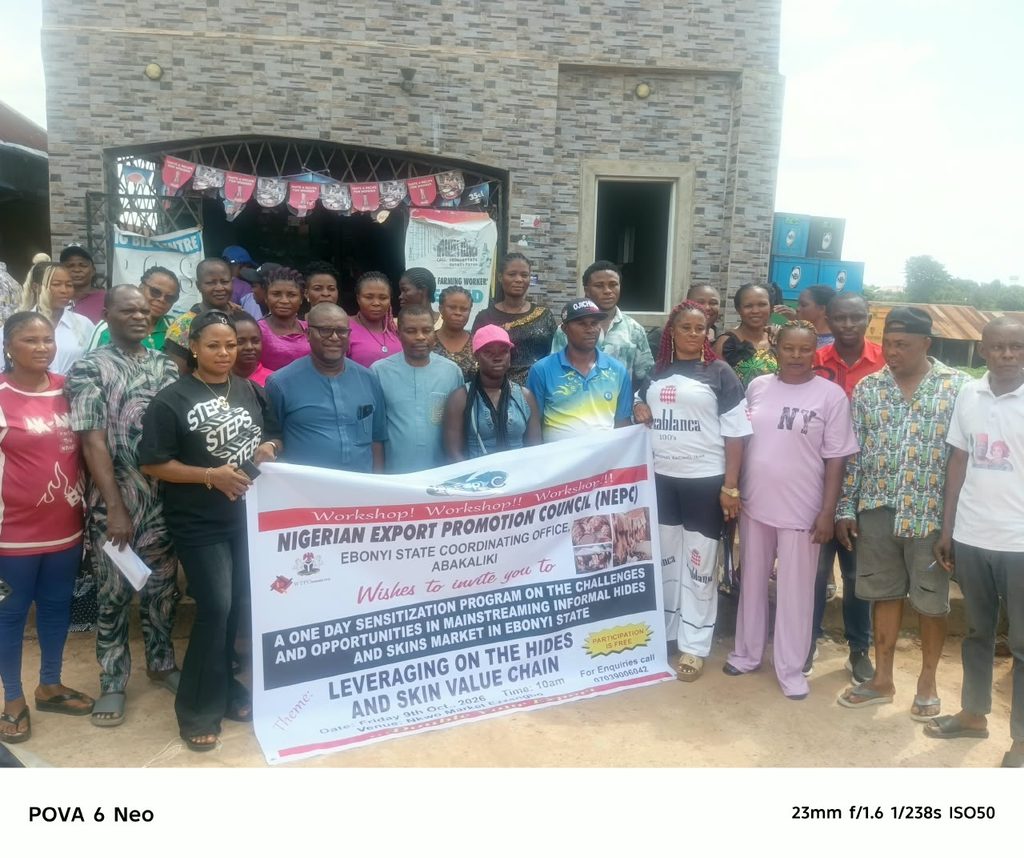
The NEPC State Coordinator, Okechukwu Amechi, made the call during a one-day sensitisation workshop on the challenges and opportunities in mainstreaming the informal hides and skins market in Ebonyi State, held on Friday at Nkwo Market, Ezzangbo, in Ohaukwu Local Government Area.
Amechi said informal trading accounted for an estimated 70 to 80 per cent of hides and skins transactions in Nigeria, limiting proper documentation, access to finance and the economic benefits available to producing communities.
He said formalising businesses through registration, training, standardisation and cooperative structures would improve traders’ bargaining power and enable them to access support programmes and larger markets.
The coordinator identified poor flaying techniques, inadequate salting, improper preservation and drying skins directly on the ground as practices that reduced product quality and could lead to rejection by international buyers.
He urged the traders to establish cooperatives to pool resources, protect their interests and negotiate better prices with major buyers.
Amechi advocated a common facility centre where raw hides and skins could be processed into finished leather for manufacturing shoes, bags, belts and other products, citing the leather industry in Aba, Abia State, as an example of the benefits of local processing.
He said value addition could generate employment opportunities for women and youths across the supply chain.
Although NEPC was not primarily a lending institution, Amechi said it occasionally provided grants under relevant programmes. He urged traders to seek information on available government support schemes and comply with the requirements for accessing them.
He also encouraged women entrepreneurs to formalise their businesses to benefit from the council’s support initiatives.
Speaking at the workshop, Alhaji Spina, leader of the Muslim community at Nkwo Jackie Market and a live-animal dealer, identified delayed payments and inadequate working capital as major challenges affecting the supply chain.
He explained that delayed payments from buyers often prevented butchers from settling their debts to animal suppliers, with some transactions remaining unpaid for between one and three months.
“If the government can help the butchers, the dealers and the suppliers with either grants or loans, it will boost the business and the government will be getting more revenue,” Spina said.
Similarly, Chris Omeoha Chibuike, chairman of the Hides and Skins Dealers Association in the area, called for government assistance to improve traders’ access to capital.
He lamented that dealers had little control over selling prices, which he said were often determined by major buyers, particularly Chinese traders.
“We can buy the goods, then the Chinese will determine the price to buy the goods from us,” he said, adding that access to affordable loans or grants would enable dealers to expand their businesses and improve their bargaining power.
Chibuike commended NEPC for organising the workshop, noting that many traders were previously unaware of the council’s presence and available opportunities.
In a separate presentation, Ude Chukwu Eze, a representative of the Raw Materials Research and Development Council (RMRDC), called for increased investment in local processing to strengthen the hides and skins value chain.
Eze said the value chain covered livestock production, slaughtering, collection, preservation, tanning and the manufacture of finished leather products.
He observed that Ebonyi’s trade remained largely informal, with limited processing capacity and inadequate infrastructure to support large-scale production and exports.
He urged the state government to establish a tannery and a dedicated hides and skins market to promote entrepreneurship, skills development and employment, particularly among women and youths.
Eze also encouraged traders to explore opportunities under the Federal Government’s Livestock Productivity and Resilience Support (L-PRES) project in Abakaliki for assistance relating to livestock production and associated value chains.
The workshop, themed “Leveraging on the Hides and Skins Value Chain,” brought together traders and other stakeholders to examine ways of improving financing, handling, preservation and processing in the sector.