
By Our Reporter
The Pan African Alliance of Small and Medium Industries (PAOSMI) has identified high lending rates, expensive and unreliable electricity, skills shortages and fragmented standards across African countries as major obstacles to industrialisation and the growth of small businesses.
The organisation called for stronger advocacy and collaboration among governments, industries, academia and the media to address the challenges, warning that African businesses would struggle to compete globally without deliberate policies to support local production.
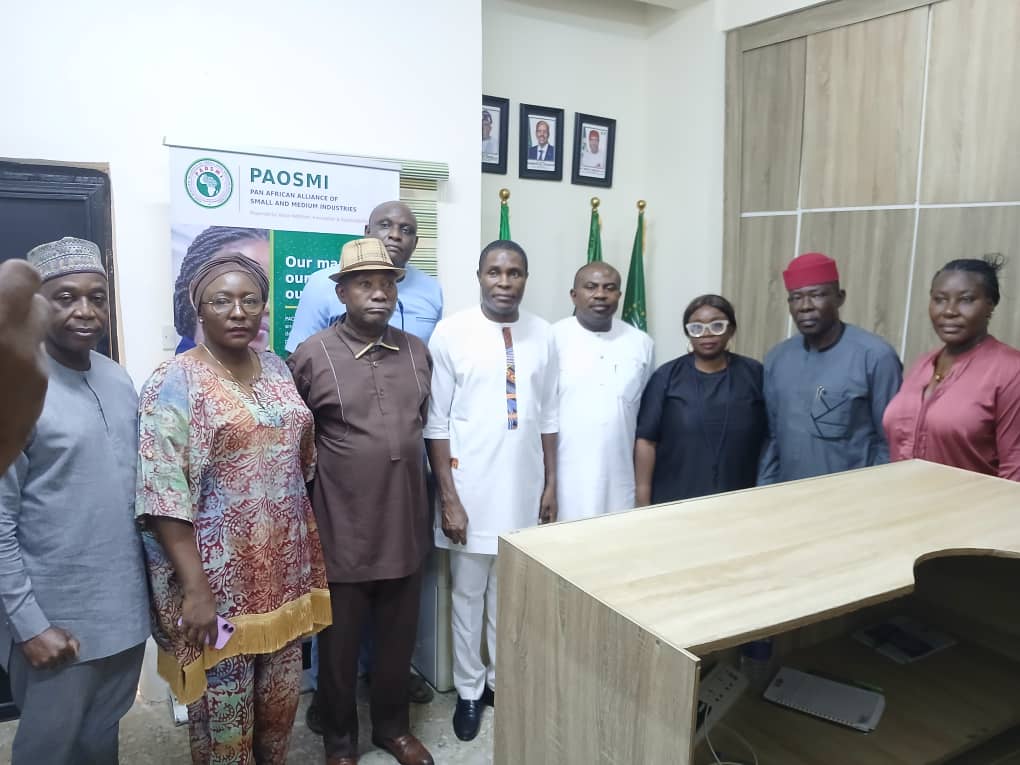
Director-General of PAOSMI, Dr Henry Emejuo, stated this on Thursday when the executive members of the Association of West African Legislative Correspondents (AWALCO), led by its President, Innocent Odoh, paid him a courtesy visit in Abuja.
Dr. Emejuo said the alliance was working to strengthen small and medium industries, emerging manufacturers and start-ups as drivers of industrial development across the continent.
“PAOSMI, Pan-African Alliance for Small and Medium Industries, for those who do not know, is a continental organisation that supports small and medium industries, emerging manufacturers, and start-ups, as a catalyst to drive African industrialisation,” he said.
He explained that the organisation operated both as a development institution and a membership-based body, designing and implementing programmes to support businesses and strengthen industrial capacity.
According to him, PAOSMI has affiliate networks in 40 countries, with about 84 affiliate networks, including ASURI in Nigeria.
Emejuo said its approach was built around bringing industry, academia and government together, with the media playing a critical role in driving industrialisation and communicating policies and opportunities to businesses.
“Our approach is a triple helix. So how do we bring industry, academia, and the government? And then they talk like the media to drive industrialisation in the continent,” he said.
He explained that while universities and research institutions were expected to drive research and innovation, industries needed to translate research outcomes into commercial products, while governments must provide policies and an enabling environment for businesses to thrive.
The PAOSMI chief said African countries also needed to align their industrial policies with regional and continental frameworks, particularly as the continent moves towards a unified market under the African Continental Free Trade Area (AfCFTA).
He said the absence of policy alignment across countries made it difficult for businesses to operate, expand and trade seamlessly across borders.
High borrowing costs, poor power supply
Emejuo said the cost of accessing finance remained one of the biggest burdens on African businesses, particularly manufacturers seeking to invest in production and expansion.
He lamented that lending rates across the continent were significantly higher than those obtainable in countries with more developed industrial economies, while the short-term nature of loans made them unsuitable for productive investments.
“One, the rate is high, in average in the continent, compared to China and other countries. And then the second one is a short term.
“And if you want to embark on a productive economy, it becomes very difficult when you have short-term loans. In other words, we say that banks in the continent really do not want to lend money for productive economy,” he said.
He called for urgent advocacy to reduce the cost of borrowing and ensure businesses could access longer-term financing to invest in factories, equipment and other productive ventures.
The PAOSMI director-general also identified electricity costs and unreliable supply as major factors undermining the competitiveness of African manufacturers.
He said Nigerian businesses faced a double burden of expensive electricity and inadequate supply, forcing many to incur additional costs to sustain production.
“If you look at the average in Nigeria, one kilowatt of power of energy is about 16 cents. When you compare that to other countries, it cannot work. Your product is not competitive in the market,” he said.
He added that the problem was not only the cost of electricity but also its availability, stressing that businesses could not achieve meaningful productivity without affordable and reliable power.
“When I say there is a need for cheap power, and then there’s a need for availability of power, I started from the cheapness of the power, but it’s not also available. So you find out that it’s a double jeopardy,” Emejuo said.
The PAOSMI chief further expressed concern over the shortage of skilled workers required to operate industries across the continent, questioning why foreign workers were often engaged for technical roles in major industrial projects.
“Let me give us an example. Don’t go to build a refinery. The skilled workforce were Indians. Why is it that they’re not Nigerians?” he asked.
He called for a review of the education and technical training system to ensure graduates possessed skills required by industries, urging stronger collaboration between educational institutions and employers.
“So do we need to restructure our academic system? Do we need to talk to industry? Do we need to get a good technique to see where, what do the industry need? What kind of skills do they need to be able to operate effectively?” he said.
He also advocated harmonisation of standards across African countries to eliminate multiple certification requirements and reduce the cost of doing business.
According to him, products manufactured in Nigeria should be able to enter other African markets without businesses being subjected to repeated registrations and different standards.
He said the African Organisation for Standardisation and national standards bodies were already working towards harmonisation but needed to accelerate the process.
Emejuo also cited poor financial connectivity and difficulties transferring money across African countries as additional barriers to intra-African trade, alongside mobility and transportation challenges.
Earlier, President of AWALCO, Comrade Innocent Odoh, said the association was seeking stronger partnerships with organisations whose activities aligned with its members’ legislative reporting responsibilities.
Odoh said the association’s previous engagement with PAOSMI had opened members’ eyes to the organisation’s activities and prompted discussions on how both bodies could work together beyond occasional engagements.
“That meeting was very productive, and we were able to come up with certain things. So we decided that it is not just about having business or collaboration in areas to achieve purposes,” he said.
He explained that members were interested in understanding PAOSMI’s programmes, expanding coverage of its activities and creating opportunities for interviews, conferences, seminars and workshops.
“As a media organisation, as those who cover the media industry, we are here to ensure that that collaboration is actually enriched in a way that will make us partners, not just about achieving some activities, but also becoming very, very closer in terms of reportage,” Odoh said.
He said the association was particularly interested in trade, investment, manufacturing and industrial development, adding that stronger engagement with PAOSMI would help members deepen their understanding of the sectors and improve their reporting.
“We want to assure you that we’re always going to be here for you in terms of reportage, expand it to whatever level you want,” he said.
Odoh added that the partnership will also give members opportunities to engage PAOSMI officials on issues affecting businesses and industrial development while helping the organisation reach wider audiences through legislative and economic reporting.
The PAOSMI director-general welcomed the proposed partnership with AWALCO, saying stronger media engagement could help bring industrial challenges to the attention of policymakers, regional institutions and governments while promoting solutions that would support African businesses.
Story Credit By Gloria Ikibah