
ECOWAS Parliamentarians Examine Land, Water, Livelihoods and Regional Security
By Joy Omagha Idam
Climate change is increasingly reshaping the social, economic and security landscape of West Africa, as changing rainfall patterns, water scarcity, environmental degradation and pressure on productive land place growing demands on communities and governments across the region.
The far-reaching consequences of the changing environment came under scrutiny as parliamentarians from ECOWAS member states converged in Accra, Ghana, for the Second 2026 Parliamentary Seminar of the Economic Community of West African States (ECOWAS).
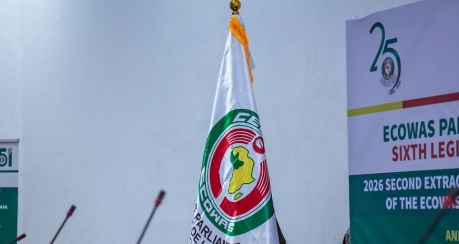
The deliberations examined the relationship between climate change, environmental degradation, population displacement, food security, livelihoods and insecurity, with country presentations highlighting the different ways communities are responding to mounting environmental pressures.
Across the region, farming and pastoral communities are among those directly affected by changing weather patterns and declining access to natural resources. As land and water come under increasing pressure, competition over resources has become a factor in tensions, displacement and economic hardship in some communities.
Nigeria Highlights Farmer-Herder and Displacement Concerns
Nigeria’s presentation to the seminar focused on the complex relationship between environmental changes, resource competition, conflict and population displacement.
The presentation noted that Nigeria’s large agricultural and pastoral population faces increasing pressure on land and water due to population growth, agricultural expansion, climate variability, environmental degradation and changing migration patterns.
According to the report presented by Nigeria, these pressures have contributed to tensions between farming and pastoral communities in different parts of the country.
It identified issues including crop damage, competition over land and water, encroachment on livestock routes, cattle theft and changing patterns of seasonal migration among factors associated with such disputes.
However, the Nigerian presentation stressed that farmer-herder tensions should not be viewed solely through the lens of competition between farmers and pastoralists, noting that communal tensions, banditry, organised crime, climate pressures and weaknesses in dispute-resolution mechanisms can also influence the situation.
On displacement, the presentation cited International Organization for Migration assessments from 2025, which put the number of internally displaced people at more than 2.2 million in the North-East and over 1.3 million across the North-Central and North-West regions.
The presentation described displacement as not only a humanitarian concern but also an issue linked to development, governance, security, the environment and the economy.
For communities dependent on agriculture and livestock, it noted, access to land and water goes beyond economic considerations, as these resources are fundamental to livelihoods and survival.
Togo Strengthens Transhumance Management
Togo’s presentation offered another perspective, focusing on the management of transhumance and the prevention of conflicts associated with livestock movement.
The country has had a National Transhumance Committee since 1995, with responsibilities including monitoring livestock movement, designated routes, animal health and disputes.
According to the presentation, changing environmental and security conditions have led Togo to develop a new 2026–2030 plan.
The plan identifies farmer-herder conflicts, pressure on land, climate change, security challenges, inadequate monitoring and weak enforcement among issues affecting transhumance management.
The experience highlighted a recurring regional challenge: when traditional livestock routes become inaccessible, water sources decline or agricultural activities expand into previously used grazing areas, competition over available resources can intensify.
The discussions also underscored the importance of dialogue and effective dispute-resolution mechanisms in preventing environmental pressures from escalating into wider security concerns.
Gambia Links Climate Resilience to Food Security
The Gambia’s presentation highlighted the importance of strengthening community resilience alongside climate adaptation.
Through the Participatory Integrated Platform for Resilience and Food Security Phase II (P2P2RS Phase II), the country is supporting communities to improve food security while strengthening their capacity to respond to climate-related risks.
The programme targets small-scale producers, herders and agro-pastoralists across 19 districts and focuses on areas including sustainable agriculture, natural-resource management, climate adaptation and rural livelihoods.
Its interventions include climate-smart agriculture, irrigation, agricultural inputs, livestock support, post-harvest equipment and assistance for women and young people.
The programme has also incorporated awareness activities around farmer-herder relations, including discussions on cattle tracks and grazing areas.
The Gambian approach reflects a broader theme emerging from the parliamentary discussions: climate resilience cannot be treated as an environmental issue alone.
Food production, livelihoods, poverty reduction, natural-resource management and social stability are closely connected to how communities withstand climate-related shocks.
The country’s presentation also emphasised the role of women and young people in strengthening community resilience.
Cabo Verde Focuses on Water Security
For Cabo Verde, one of the major concerns is the impact of climate change and water scarcity on sustainable development.
The country’s presentation highlighted measures aimed at protecting and increasing water availability, strengthening coastal protection and improving water-resource management.
Its adaptation priorities include integrated water management and climate-resilient agricultural production.
The Cabo Verde experience demonstrates how water scarcity can affect several aspects of economic and social life at the same time.
Reduced water availability can affect agricultural production, which in turn affects livelihoods and may contribute to migration and increased competition over limited resources.
Beyond Emergency Relief
The parliamentary discussions also drew attention to the need to look beyond immediate humanitarian assistance when responding to displacement.
Nigeria’s presentation argued that durable solutions require conditions that enable displaced people to rebuild their lives.
These include safe and voluntary return where possible, local integration or relocation, access to land and housing, restoration of property rights, livelihoods, education, healthcare, documentation and participation in community life.
The discussions therefore pointed towards a broader shift from simply responding to displacement after it occurs to preventing the conditions that contribute to displacement in the first place.
Such preventive measures include early-warning systems, conflict prevention, mediation, improved land and resource governance, climate adaptation, sustainable livelihoods and better livestock infrastructure.
Nigeria’s presentation also emphasised that security operations alone cannot address the underlying causes of these challenges, pointing instead to the importance of dialogue, effective institutions and economic opportunities for affected communities.
Parliament’s Role Comes Into Focus
A major issue emerging from the seminar was the role of parliamentarians in shaping policies, legislation and budgets capable of responding to climate-related displacement and insecurity.
The Gambia called for greater attention to climate resilience and food security in legislative agendas, budgetary processes and parliamentary oversight.
Nigeria similarly highlighted the need for evidence-based parliamentary oversight, stronger legislative frameworks and platforms for dialogue involving displaced persons, farmers, pastoralists, women, young people and host communities.
The discussions consequently placed parliamentarians at the intersection of environmental policy, security, development and human rights.
Rather than waiting until communities have already been displaced, lawmakers were encouraged to support policies capable of reducing the risks of conflict while strengthening communities’ capacity to withstand climate shocks.
A Regional Challenge Demands Regional Action
One of the recurring messages from the country presentations was that climate-related challenges do not stop at national borders.
Pastoral movements can cross countries, weather systems extend across national territories, while conflict and displacement in one community can have consequences for neighbouring areas.
The presentations consequently called for stronger regional cooperation, knowledge-sharing, community participation, early-warning mechanisms, climate adaptation, responsible resource governance and parliamentary collaboration.
For West Africa, the challenge is increasingly about preventing environmental pressures from translating into the loss of livelihoods, conflict and forced displacement.
The discussions in Accra therefore underscored the need for long-term investment in vulnerable communities, stronger institutions, better management of land and water resources, climate adaptation and mechanisms capable of resolving disputes before they escalate.
At the centre of the conversation was a simple regional reality: environmental change, livelihoods, peace and security are increasingly interconnected, making coordinated action across West Africa an important part of the response.