
By Remi Johnson
The Minister of the Federal Capital Territory (FCT),Mr Nyesom Wike, has said President Bola Ahmed Tinubu rescued Nigeria from near economic collapse through courageous policy decisions, particularly the removal of the petrol subsidy.
Wike who stated this during an interactive town hall meeting with traders and market associations across the FCT, organised by Abuja Investments Company Limited (AICL) in Abuja, Urged them to support President Tinubu to win 2027.
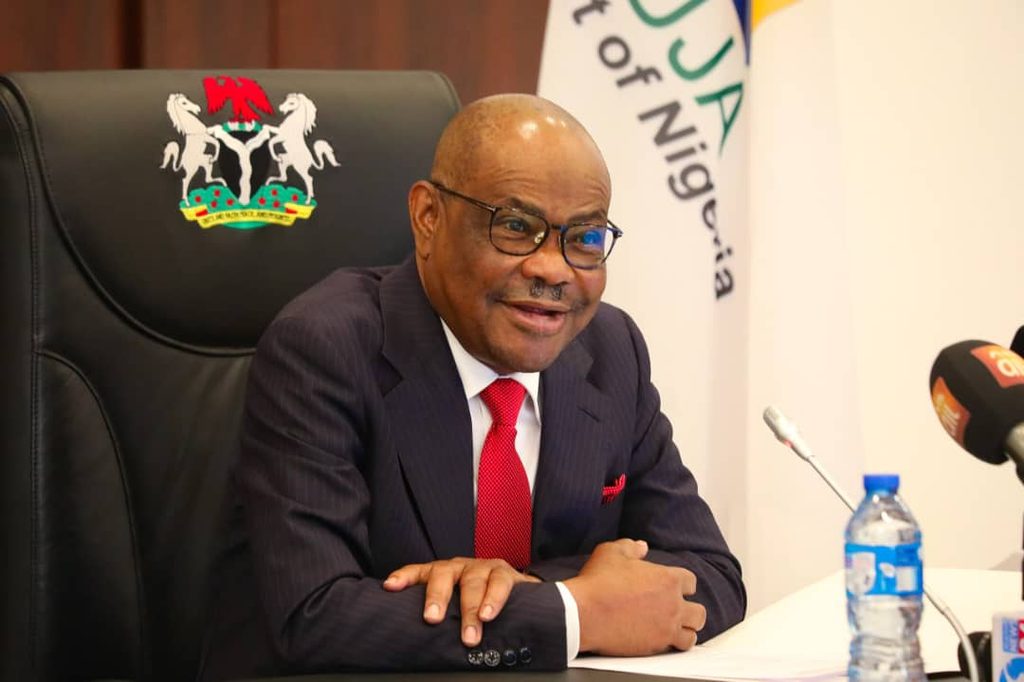
He described the President’s decision to remove the petrol subsidy as a bold but necessary step towards rebuilding the country’s economy, despite the temporary hardship it imposed on Nigerians.
According to him, previous administrations failed to address the subsidy regime despite the huge financial resources allegedly lost through the system, because they lacked the political courage to take decisive action.
“Leadership requires courage. If you don’t have courage, too bad. This man came on May 29, 2023, and after taking the oath of office, took a very big risk. No politician who wants to run for a second term would do that,” Wike said.
The FCT Minister argued that although the removal of the subsidy brought some economic difficulties, it had increased allocations to state and local governments, providing them with more resources to meet their obligations.
He cited the relative industrial peace in Nigerian universities, noting that the Academic Staff Union of Universities (ASUU) had not embarked on a nationwide strike in the past two and a half years.
Wike also said the Federal Government had addressed outstanding gratuity payments owed to former workers of the defunct national airline following its privatisation, adding that pensioners were no longer compelled to protest over unpaid entitlements.
He urged Nigerians to give the Tinubu administration more time for its economic policies to stabilise, expressing optimism that the country would experience greater prosperity in the coming years.
“If we allow these policies and government programmes to stabilise, watch what will happen in the next four years. It will be bliss,” Wik said.
The Minister also called on traders and market leaders to recognise the importance of infrastructure development, noting that good road networks were essential to the growth of businesses and the reduction of transportation costs.
Wike recalled that during an earlier visit to some communities in the FCT, traders had complained about poor road conditions and how they affected their businesses.
He said his administration subsequently intervened, stressing that the government remained committed to addressing infrastructure challenges across the territory.
According to him, the FCT Administration would continue to engage residents, traditional institutions, youth groups, area council chairmen and business associations to identify their needs rather than make decisions without consulting them.
He promised to sustain regular engagement with market stakeholders, proposing that such interactive meetings should hold at least once every six months.
Wike maintained that governance should not be determined by ethnic or religious considerations but by the ability of leaders to deliver projects that improve people’s lives.
“Governance has nothing to do with where I come from. It is not about an Igbo man, Hausa man, Fulani man or Yoruba man. It is about whether I am doing my business here and whether I am happy,” he said.
He further disclosed that the administration was working towards completing the Kubwa road project before the end of the year, while assuring traders of continued government support for market development.