By Remi Johnson
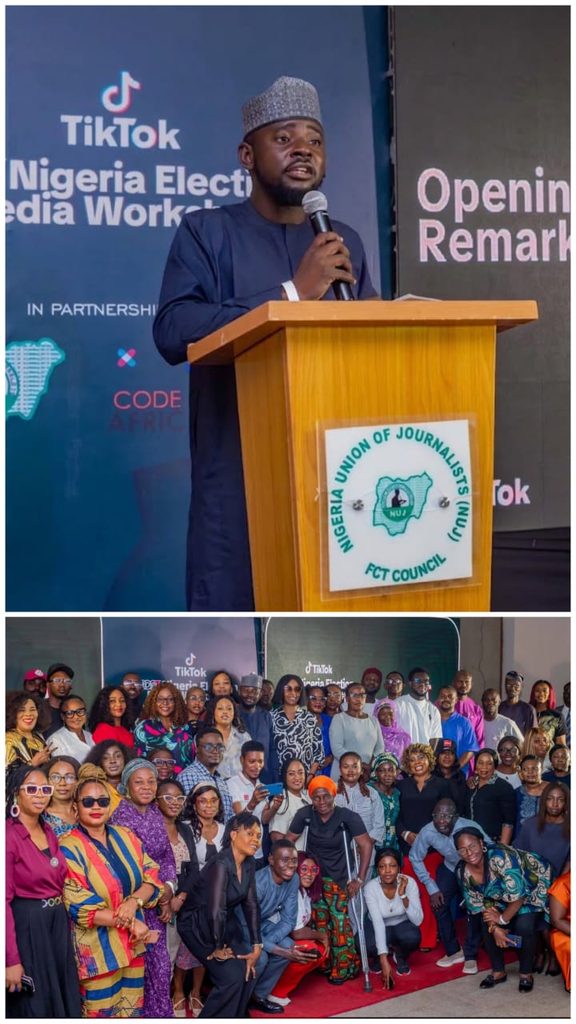
TikTok has trained members of the Nigeria Union of Journalists (NUJ), Federal Capital Territory (FCT) Council, on digital journalism, content verification and the responsible use of social media, urging journalists to strengthen efforts against misinformation, disinformation and information manipulation before, during and after the 2027 general elections.
The training, held at Omni Grand Hotel, Jabi, Abuja, featured experts from TikTok, Code for Africa and Irvine Partners, who highlighted the growing influence of digital platforms in shaping public opinion and the need for journalists to acquire skills to navigate the changing media landscape.
Speaking at the workshop, Head of Communications, Sub-Saharan Africa, TikTok, Keagile Makgoba, urged journalists to embrace 21st-century digital trends and explore the opportunities offered by the platform to expand their reach and improve storytelling.
Makgoba explained that TikTok had evolved beyond its initial identity as an entertainment and dancing platform, with increasing numbers of people using it to access news, educational materials and other informative content.
She encouraged journalists and media organisations to take advantage of the platform’s growing reach to disseminate credible information, educate audiences and develop innovative storytelling formats.
On election integrity, she disclosed that TikTok does not accept payments from political parties or politicians for campaign advertisements, adding that political accounts are also subject to additional restrictions, including limitations on advertising and monetisation.
According to her, the measures are part of efforts to prevent the platform from being exploited to manipulate public opinion, particularly during sensitive political periods.
She further explained that TikTok deploys artificial intelligence technology and human moderation to identify and remove misinformation, deceptive behaviour and harmful content, while strengthening systems for detecting and labelling AI-generated materials.
Makgoba disclosed that TikTok removed 4,378,587 videos in Nigeria between April and June 2026 for violating its Community Guidelines.
She said 91.7 per cent of the videos were removed within 24 hours, while 99.8 per cent were detected and taken down proactively before users reported them.
The TikTok communications executive also emphasised the importance of parental supervision of children’s online activities, cautioning parents against allowing pre-teens unrestricted access to age-inappropriate content.
She urged parents to familiarise themselves with the platform’s safety features and age-related restrictions to protect children from inappropriate material and potentially harmful online interactions.
In her remarks, the Chairman of NUJ FCT Council, Comrade Grace Ike, represented by the Vice Chairman of the Council, urged participants to take the training seriously, describing it as an opportunity to equip journalists with the skills required for impactful journalism and positive societal change.
Ike noted that the way people consume information had changed significantly, with many audiences now relying on mobile phones and short-form videos, including TikTok, to access news.
She said journalists who understood how to use emerging digital platforms could reach audiences that traditional media might not easily access.
According to her, the growing speed of information dissemination also presents challenges, as false information can spread across the country before corrections are issued.
She therefore urged journalists to make verification a priority, particularly as the country approaches the 2027 general elections.
Ike outlined three key expectations from participants: learning, verification and sharing the knowledge acquired with colleagues who were not present at the training.
She stressed that speed must never take precedence over accuracy, adding that every information published by journalists, irrespective of the platform, must meet professional standards.
The NUJ chairman also encouraged participants to cascade the training to their respective chapels, describing the exercise as a training-of-trainers initiative that would extend its benefits to more journalists.
Speaking on information disorder, a representative of Code for Africa, Kunle Adebajo, educated participants on misinformation, disinformation and malinformation, explaining how confirmation bias and other psychological factors make people susceptible to false narratives.
He said fact-checking was essential to preventing harm, providing clarity and maintaining public trust, particularly during election periods when misleading information could influence voters’ decisions.
Adebajo warned journalists against amplifying false claims about candidates stepping down, fake endorsements, purported concessions by political candidates and election results announced by unauthorised sources.
He advised journalists to always investigate the source of information, cross-check claims against credible reports and examine images and videos for inconsistencies that could indicate manipulation.
He also recommended Google searches, reverse image searches and credible fact-checking platforms such as Dubawa to establish the authenticity of information circulating online.
On the growing threat of artificial intelligence, Adebajo warned that advances in synthetic media had made it increasingly difficult to distinguish authentic content from manipulated materials.
He identified voice cloning and face-swapping as emerging threats to election credibility, explaining that fabricated audio recordings could falsely attribute statements to political leaders, while manipulated videos could portray candidates in situations that never occurred.
He, however, cautioned journalists against relying entirely on automated detection tools, stressing that critical thinking and careful examination of content should come before using verification applications.
Another Code for Africa representative, Martin Ayotunde, also trained participants on verifying electoral information, images, videos, online accounts and AI-generated content, sharing practical techniques for identifying manipulated materials.
The training was moderated by Melody Hassan, a representative of Irvine Partners, who emphasised the need for journalists to adopt strategic and innovative approaches to using TikTok ahead of the 2027 elections.
Hassan encouraged media practitioners to explore the platform’s potential for educating and engaging the electorate before, during and after the elections, particularly among younger audiences who increasingly rely on digital platforms for information.
Some participants who expressed appreciation to the NUJ FCT Council leadership for organising the training pledged to apply the knowledge acquired to promote credible information, strengthen developmental journalism and contribute to a more informed electorate ahead of the 2027 general elections.