
Lawmakers unveil bold reforms to harmonise customs procedures, unlock finance, strengthen regional trade and position MSMEs as the engine of West Africa’s economic transformation.
By Joy Omagha Idam
Across West Africa, millions of entrepreneurs wake up every morning with ideas capable of transforming their communities. Yet many of these businesses never realise their full potential—not because of a lack of innovation or determination, but because they must navigate a maze of inconsistent customs procedures, multiple taxation systems, bureaucratic border controls and complex business regulations that make regional trade unnecessarily difficult.
For years, these barriers have slowed economic integration, discouraged investment and limited the growth of Micro, Small and Medium Enterprises (MSMEs), which account for the overwhelming majority of businesses across the ECOWAS region.
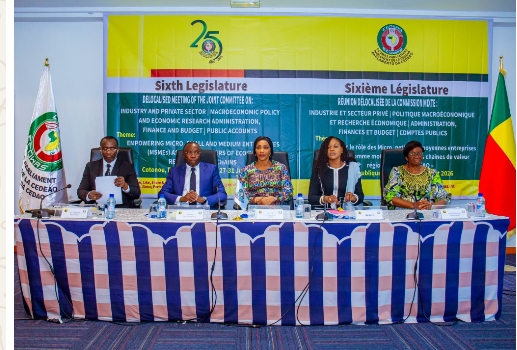
Now, the ECOWAS Parliament is seeking to change that narrative.
Meeting in Cotonou, Republic of Benin, members of the Parliament’s Joint Committee on Industry and Private Sector, Macroeconomic Policy and Economic Research, Administration, Finance and Budget, and Public Accounts have outlined an ambitious roadmap designed to create a seamless regional market where businesses can trade more freely, compete more effectively and expand beyond national borders.
Creating One Regional Marketplace
At the heart of the Parliament’s recommendations is a simple but transformative idea: businesses should not face entirely different rules every time they cross an ECOWAS border.
The lawmakers are advocating harmonised customs procedures, simplified import regulations, coordinated taxation policies and streamlined business registration systems across Member States. Such reforms, they believe, would significantly reduce the cost of doing business while encouraging investment and boosting regional competitiveness.
Presenting the committee’s resolutions, Hon. Alhagie Darbo emphasised that West Africa cannot achieve meaningful economic integration while traders continue to struggle with unnecessary administrative obstacles and inconsistent regulatory frameworks.
Beyond harmonisation, the Parliament called for the full implementation of ECOWAS trade and investment protocols, stronger monitoring mechanisms, increased investment in transport and trade infrastructure, and the elimination of non-tariff barriers that continue to frustrate businesses across the region.
The Untapped Power of MSMEs
MSMEs remain the backbone of West Africa’s economy.
They create jobs, stimulate innovation, reduce poverty and drive inclusive economic growth. Yet despite their importance, many small businesses remain trapped in the informal sector, with limited access to finance, modern technology and larger regional markets.
Recognising these challenges, the Parliament urged Member States to adopt legal, regulatory and fiscal reforms that encourage entrepreneurship, simplify business formalisation, promote local value addition and improve the competitiveness of indigenous enterprises.
The lawmakers also highlighted the need for greater protection of traders through transparent management of market facilities, fair tenancy arrangements and stronger action against unlawful harassment and restrictive trading practices.
Such reforms, they argued, would create a more predictable business environment capable of attracting investment while encouraging thousands of informal businesses to enter the formal economy.
Finance: The Missing Ingredient
Access to affordable finance remains one of the biggest obstacles confronting entrepreneurs across West Africa.
Many promising businesses collapse before reaching maturity simply because they cannot obtain the capital needed to expand production, modernise operations or enter new markets.
To address this gap, the Parliament called on the ECOWAS Bank for Investment and Development to introduce innovative financing solutions, including credit guarantee schemes, concessional loans and risk-sharing facilities tailored to the needs of MSMEs.
Special emphasis was placed on women-owned and youth-led enterprises, whose contributions to economic development continue to outpace their access to financial support.
The legislators also proposed financing regional industrial and agricultural clusters that would strengthen value chains, improve productivity and enhance competitiveness throughout the sub-region.
Beyond Borders: Building a Truly Integrated Economy
Another major focus of the deliberations was the implementation of the ECOWAS Trade Liberalisation Scheme, widely regarded as one of the Community’s most important economic integration initiatives.
The Parliament wants procedures simplified, awareness among businesses increased and border operations made more transparent to encourage greater intra-regional trade.
It also recommended harmonising product standards and certification processes to ensure goods produced in one Member State can move more easily across the region without facing unnecessary regulatory hurdles.
The lawmakers further encouraged industries to source raw materials and intermediate products from within West Africa, thereby reducing dependence on imports from outside the continent while strengthening regional manufacturing and industrial development.
From Policy to Prosperity
The Parliament also tasked the ECOWAS Commission with accelerating implementation of the ECOWAS MSME Development Policy (2021–2030).
The strategy includes expanding enterprise support centres, strengthening entrepreneurship programmes, promoting digital skills and establishing export assistance centres at major trade corridors and border posts to guide businesses through export procedures and reduce costly delays.
If effectively implemented, these measures could significantly improve the ease of doing business while opening new markets for thousands of entrepreneurs.
Nigeria’s Role in Driving Regional Reform
Speaking on the sidelines of the meeting, Hon. Pascal Agbodike assured that Nigerian members of the ECOWAS Parliament would engage the National Assembly to facilitate implementation of the resolutions.
He acknowledged concerns regarding operational challenges at Nigeria’s borders and pledged that lawmakers would work with relevant authorities to address them comprehensively.
His remarks underscore Nigeria’s strategic importance in the success of regional integration efforts, given the country’s position as West Africa’s largest economy and one of its busiest trading hubs.
The Road Ahead
The resolutions adopted in Cotonou represent far more than another set of parliamentary recommendations. They reflect a growing recognition that regional integration must move beyond political declarations to practical reforms capable of improving the daily realities of businesses and citizens.
For millions of entrepreneurs, traders and manufacturers, success will ultimately depend not on the quality of policy documents but on faithful implementation by Member States.
If governments embrace the proposed reforms with the urgency they deserve, West Africa could witness a new era of economic cooperation—one in which borders become bridges rather than barriers, and MSMEs emerge as the true drivers of industrialisation, employment and sustainable prosperity.
For ECOWAS, the challenge now is no longer identifying what must be done. The challenge is ensuring that today’s resolutions become tomorrow’s reality.