
By Joy Omagha Idam
For thousands of young Nigerians, the dream of a better life abroad often appears irresistible. Yet, behind promises of greener pastures lie harrowing journeys across scorching deserts, dangerous seas and the hands of ruthless human traffickers. Every year, countless families are left grieving as loved ones disappear or perish while attempting irregular migration through the Sahara Desert and the Mediterranean Sea.
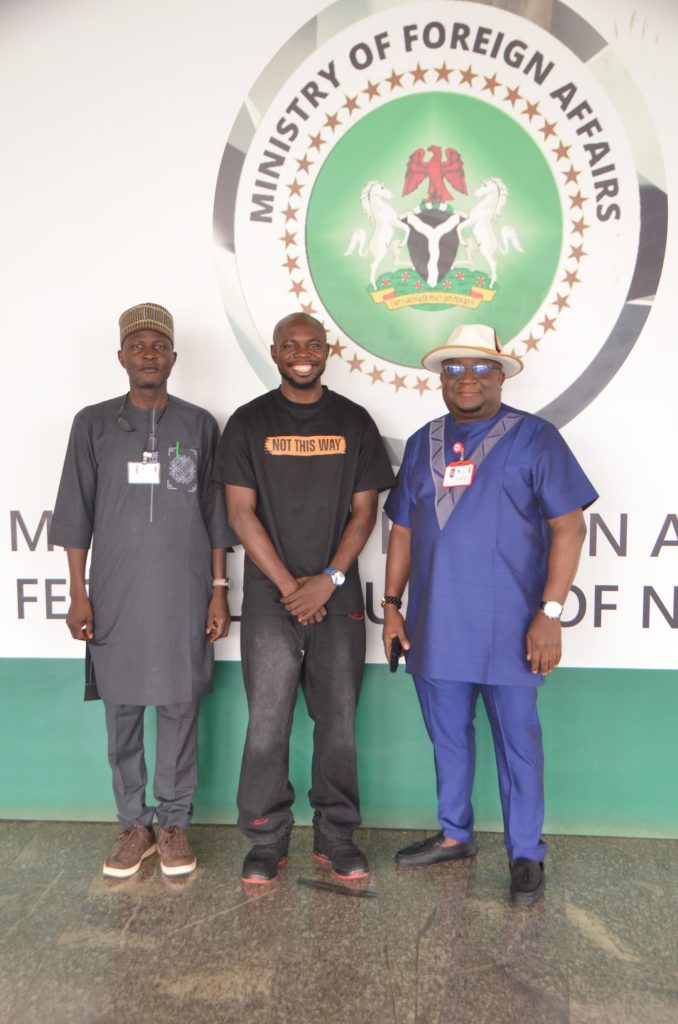
It is against this backdrop that the Ministry of Foreign Affairs has renewed its warning against illegal migration, urging Nigerians—particularly the youth—to reject dangerous migration routes and embrace safe, lawful alternatives.
The renewed appeal followed a meeting in Abuja between the Ministry’s Spokesperson, Kimiebi Imomotimi Ebienfa, and George Emmanuel, a Nigerian whose life story has become a sobering reminder of the deadly consequences of irregular migration.

A Journey That Nearly Ended in Tragedy
George Emmanuel’s experience mirrors that of many young Africans who embark on dangerous journeys in search of opportunities overseas.
During his meeting with the Ministry, he recounted the terrifying realities of travelling through the Sahara Desert before attempting the perilous crossing of the Mediterranean Sea in an overcrowded boat.
The journey almost claimed his life.
According to Emmanuel, the boat capsized during the crossing, resulting in the death of 28 migrants, while only a few survived to tell the story. His testimony serves as a powerful warning that the promise of a better future can quickly become a nightmare when pursued through illegal migration routes.
Beyond Statistics Are Human Lives
While irregular migration is often discussed in terms of numbers, the Ministry insists that every statistic represents a human life—a son, daughter, husband, wife or friend.
Many migrants face extreme dehydration and starvation in the Sahara Desert before falling victim to criminal trafficking networks operating across international borders. Others endure imprisonment, torture, forced labour, sexual exploitation and abuse in transit countries before attempting the hazardous Mediterranean crossing.
For many, the journey ends not with opportunity but with death.
Those who survive frequently return home carrying physical injuries, emotional trauma and psychological scars that can last a lifetime.
Government’s Multi-Pronged Response
The Federal Government says addressing irregular migration requires more than discouraging risky travel; it also demands tackling the underlying conditions that push people to leave.
Nigeria is therefore pursuing measures aimed at expanding economic opportunities for young people, strengthening border management, dismantling human trafficking and migrant smuggling networks, and promoting safe, orderly and regular migration pathways through collaboration with destination countries, transit states and international organisations.
These efforts form part of a broader strategy to reduce the appeal of illegal migration while ensuring that Nigerians seeking opportunities abroad can do so through legitimate channels.
Protecting Nigerians Abroad
The Ministry also reaffirmed its commitment to supporting Nigerians who find themselves stranded or distressed overseas.
Through Nigerian diplomatic missions, citizens in difficulty continue to receive consular assistance, while voluntary return programmes, psychosocial support and reintegration initiatives are being strengthened to help returning migrants rebuild their lives.
These interventions recognise that many victims of irregular migration are themselves deceived by false promises made by traffickers and should be assisted rather than stigmatised.
Survivors Becoming Advocates
One encouraging aspect of George Emmanuel’s story is his decision to transform personal tragedy into public advocacy.
The Ministry commended him for using his experience to educate others about the dangers of illegal migration, particularly the risks associated with crossing the Sahara Desert and the Mediterranean Sea.
His voice now joins those of other survivors who are helping to dismantle the myths surrounding irregular migration by sharing firsthand accounts of hardship, exploitation and loss.
Such testimonies carry a credibility that official warnings alone often cannot achieve.
A Message to Nigerian Youth
The renewed warning from the Ministry is ultimately a call for informed decision-making.
Young Nigerians are encouraged to verify information carefully, reject the deceptive promises of human traffickers and avoid embarking on dangerous journeys that frequently end in tragedy.
Migration, experts agree, is not inherently wrong. However, when pursued through illegal and unsafe channels, it exposes individuals to life-threatening dangers and exploitation.
As Nigeria continues to strengthen international cooperation on migration management, the story of George Emmanuel stands as a powerful reminder that no dream is worth risking one’s life for. The country’s message is clear: opportunities abroad should be pursued through safe, legal and dignified pathways—not through deserts, smugglers or overcrowded boats that too often become floating graves.
For many aspiring migrants, that distinction could mean the difference between a future filled with hope and a journey that never reaches its destination.
