
From Rashidat Suleiman ,Minna
Christian leaders in Niger State have estimated that Christians constitute 45.7 per cent of the state’s projected population, putting the Christian population at approximately 3,417,636 out of a projected 7,478,417 residents.
The figure was disclosed by the Chairman of the Christian Statistics Committee of the Christian Association of Nigeria (CAN), Niger State Chapter, Evangelist Marcus Salka, during a press conference held on Sunday in Minna.
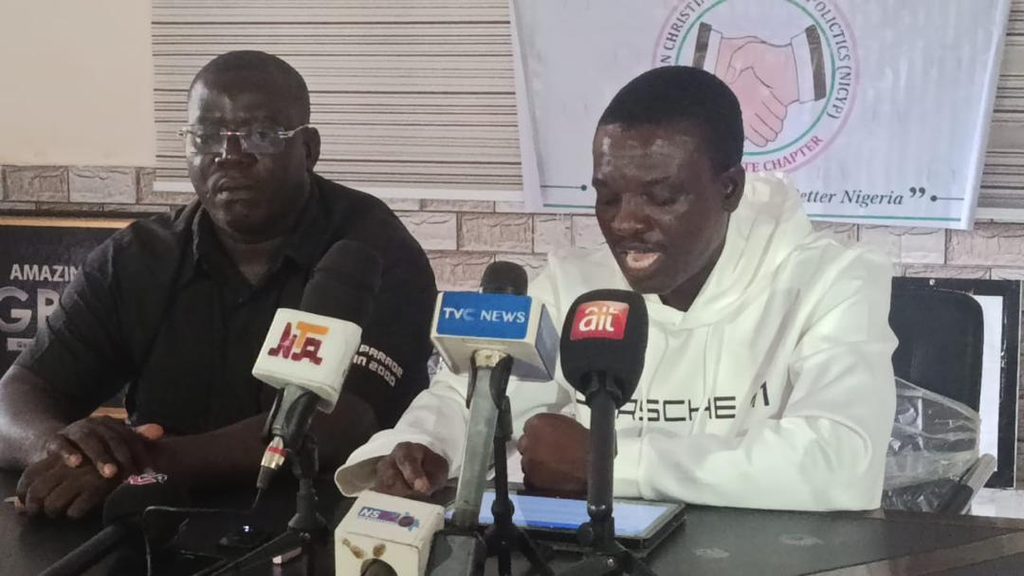
Salka, who is also the Chairman of the Nigeria Christian Youths in Politics, Niger State Chapter, said the committee arrived at the estimate after collating available demographic data, surveys and research conducted since 2025.
He explained that the exercise was aimed at providing what the committee considers a more accurate representation of the Christian population in the state and correcting figures being circulated, particularly on social media.
According to him, the estimated Christian population represents 45.7 per cent of the state’s projected 2025 population of 7,478,417, as provided by the Niger State Bureau of Statistics.
Salka, who was accompanied by the committee’s Secretary, Barde Jesse, said the estimated population comprised approximately 3,417,636 Christians, while other religious categories accounted for about 46.1 per cent and 8.2 per cent respectively.
He, however, acknowledged that the figures were estimates, noting that Nigeria’s last official population census in 2006 did not collect data on religious affiliation.
The 2006 census put Niger State’s population at 3,950,249, comprising 2,032,725 males and 1,917,524 females.
Salka said the committee therefore relied on the 2025 population projection and other available demographic information to arrive at its estimate.
He stressed that the size of the Christian population should not be measured by the level of Christian participation in partisan politics.
“The fact that some Christians do not participate actively in politics does not mean that we do not have the number. Christians make up a significant population in Niger State,” he said.
He added that the committee would continue to challenge population figures which it believes do not accurately reflect the presence of Christians across the state.
Salka also attributed changes in the distribution of Christian communities to prolonged insecurity and displacement in some parts of Niger State.
He specifically mentioned Shiroro, Munya, Paikoro, Rafi, Wushishi and Magama as areas where, according to him, insecurity had resulted in deaths and displacement of residents from communities with significant Christian populations.
“Following the incessant insecurity in Christian-dominated local government areas, especially Shiroro, Munya, Paikoro, Rafi, Wushishi, Magama and others, majority of our people were killed, while others relocated,” he alleged.
He further alleged that the displacement had affected the demographic distribution of Christians in the affected communities, while maintaining that Christians remained present in both rural and urban areas of the state.
According to him, Christians are represented across the 25 local government areas of Niger State through various denominations and Christian bodies, including the Catholic, Anglican, Methodist, Baptist, Pentecostal, Evangelical and African Instituted churches.
The committee also identified major Christian blocs in the state, including the Catholic Secretariat of Nigeria, Christian Council of Nigeria, Pentecostal Fellowship of Nigeria, Organisation of African Instituted Churches, TEKAN and ECWA-related fellowships.
Salka said the committee would continue to document the Christian population in the state and engage relevant stakeholders to promote what it described as accurate and evidence-based representation of demographic realities in Niger State.