
By Joy Omagha Idam
The growing impact of climate change, population displacement, food insecurity and regional security challenges across West Africa has renewed debate over the legislative powers of the Parliament of the Economic Community of West African States (ECOWAS).
Nigerian lawmakers participating in the ongoing 2026 Second Extraordinary Session and Parliamentary Seminar in Accra, Ghana, have called for a review of the legal framework governing the regional Parliament, arguing that stronger legislative authority would enable it to play a more effective role in addressing challenges confronting the sub-region.
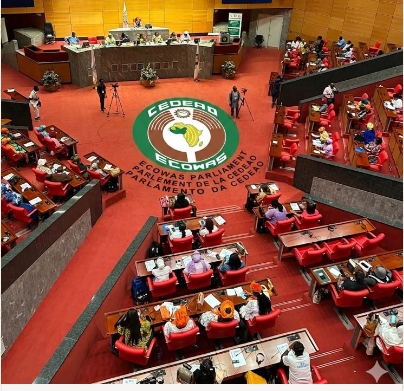
The position was canvassed by Senators Ali Ndume and Awaji N. Abiante on the sidelines of the week-long meeting, which is examining the interconnected challenges of climate change, environmental degradation, migration and regional security.
The lawmakers expressed concern that while the ECOWAS Parliament has responsibilities relating to regional integration, peace, security and other matters, its predominantly advisory character limits its ability to ensure that recommendations are translated into concrete action.
According to them, the effectiveness of a parliamentary institution is closely connected to the powers vested in it and the extent to which those powers allow lawmakers to influence implementation and hold relevant institutions accountable.
“The issue is how the power of the regional Parliament can be increased so that they don’t just advise or make recommendations but be able to compel implementation of recommendations,” the lawmakers said.
They also advocated amendments to relevant provisions of the ECOWAS legal framework to strengthen the Parliament and provide greater authority to the ECOWAS judicial system.
Beyond Recommendations
For Senator Ndume, the debate is not simply about the number of resolutions adopted by the regional Parliament but the practical impact of those resolutions.
He questioned the extent to which an institution can effectively respond to pressing regional challenges when its role remains substantially consultative.
“Do we have powers outside of advisory? And how many of the pieces of advice rendered have honestly been considered?” Ndume asked, using the climate crisis as an example of the governance challenges facing the region.
The question assumes greater significance as West African countries continue to confront the effects of environmental changes, including pressure on livelihoods, food production, land use and human settlements.
The Accra seminar has consequently placed considerable attention on the relationship between climate-related pressures and population movement, including the consequences for communities and governments when people are forced to relocate across or within national borders.
Climate, Migration and Farmer-Herder Tensions
Ndume linked the movement of pastoral communities from environmentally stressed areas to some of the farmer-herder tensions experienced in Nigeria.
He argued that the situation requires stronger engagement between governments, communities and pastoral groups, particularly on the management of land and natural resources.
The lawmaker also referred to previous efforts at addressing livestock management and ranching, stressing the importance of political commitment and clear rules capable of guiding the use of land and movement of livestock.
His position was that where legal and institutional arrangements are inadequate, disputes over resources can become more difficult to manage.
He therefore called for clearer frameworks covering livestock movement, land use and resource management.
For the Senator, the challenges demonstrate the need for regional institutions to possess sufficient authority to move beyond policy discussions and contribute more effectively to coordinated action.
The ECOWAS Parliament Question
The debate over the powers of the ECOWAS Parliament is not entirely new.
The regional legal framework provides the Parliament with responsibilities connected to integration and other Community matters, while the 2016 Supplementary Act provides for parliamentary opinions and mandatory assent in specified areas.
However, a distinction remains between exercising parliamentary functions and possessing full legislative authority to independently enact binding regional laws.
Earlier ECOWAS institutional documents had envisaged a gradual evolution of the Parliament from an advisory body towards greater participation in decision-making, including co-decision and, ultimately, law-making powers in areas defined by the regional authorities.
In practice, however, the Parliament has continued to operate largely within a consultative and advisory framework.
It can adopt resolutions and exercise oversight, but some of its resolutions must proceed through other ECOWAS institutions before they can become legal instruments for implementation.
The Parliament itself has previously explained that its resolutions may be transmitted to the Council of Ministers, which can then recommend them to the Authority of Heads of State and Government for consideration and adoption as Community legal texts.
It is this institutional process that has raised questions among some lawmakers about the relationship between responsibility, authority and accountability.
Responsibility and Accountability
For Ndume, strengthening the Parliament’s authority would also have implications for accountability.
He argued that lawmakers entrusted with responsibilities should have corresponding powers through which they can effectively perform their representative and oversight functions.
“Until you give a man responsibilities, you cannot question him on what he has done,” Ndume said.
He maintained that a stronger regional Parliament would place greater responsibility on lawmakers to address the issues debated within the institution and to represent the interests of citizens across member states.
“That is the essence of being a member of Parliament, to represent your people, advocate, speak to issues and if possible, hold institutions to account,” he said.
The discussion in Accra has therefore placed the question of institutional capacity at the centre of broader conversations about climate change, migration, food security, pastoralism, land use and regional peace.
As West Africa confronts increasingly interconnected challenges, the debate among regional lawmakers is whether existing parliamentary mechanisms are sufficient to convert deliberations and recommendations into coordinated regional responses.
For the ECOWAS Parliament, that question goes beyond the current seminar. It touches on the continuing evolution of regional governance and the balance between parliamentary responsibility, institutional authority and accountability within the West African integration project.
