
By Cynthia Talatu Batuta
The National Board for Technology Incubation (NBTI) says it is pursuing more than $600 million in proposed investment and development-finance opportunities to support Nigeria’s innovation and clean-energy sectors.
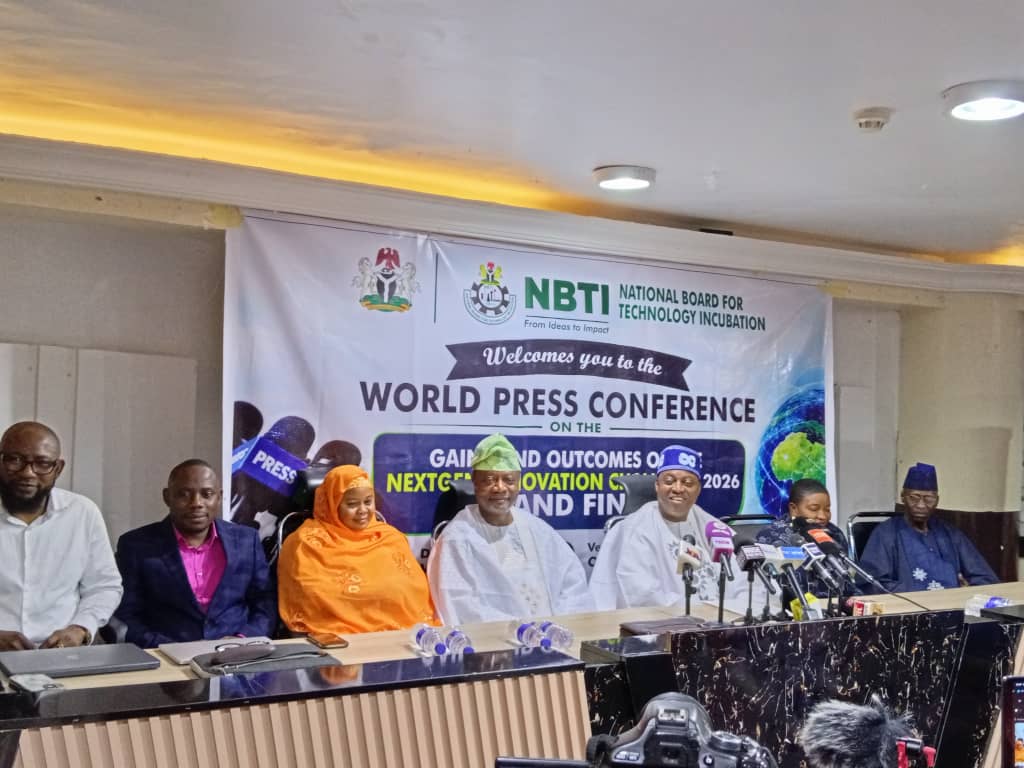
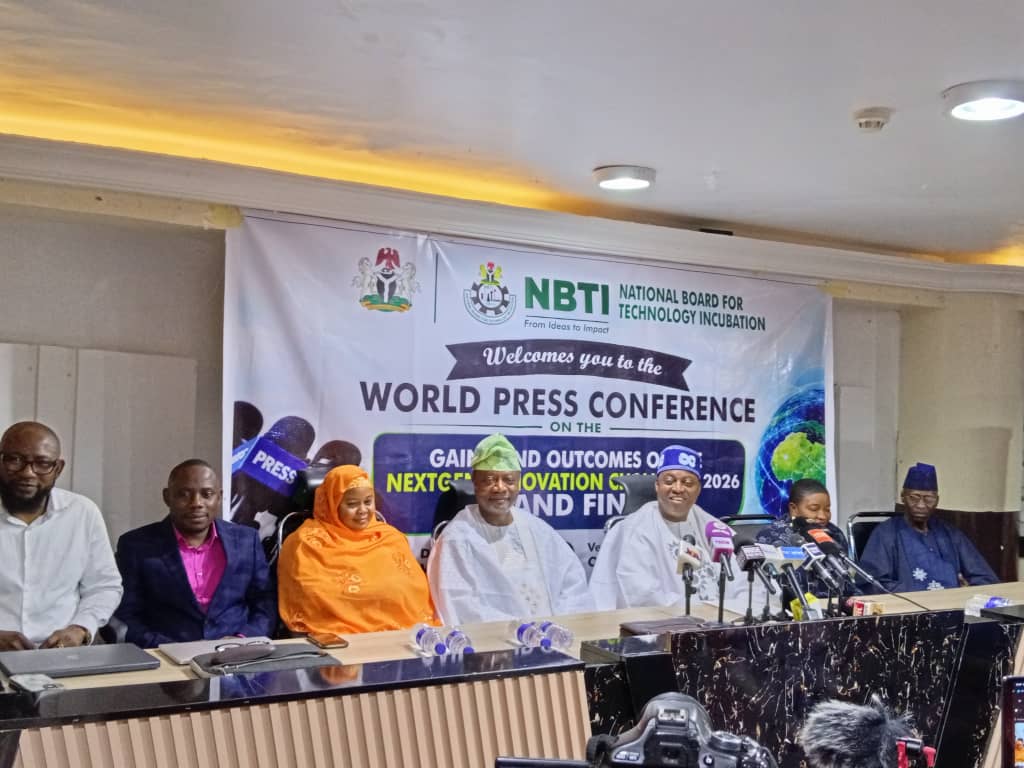
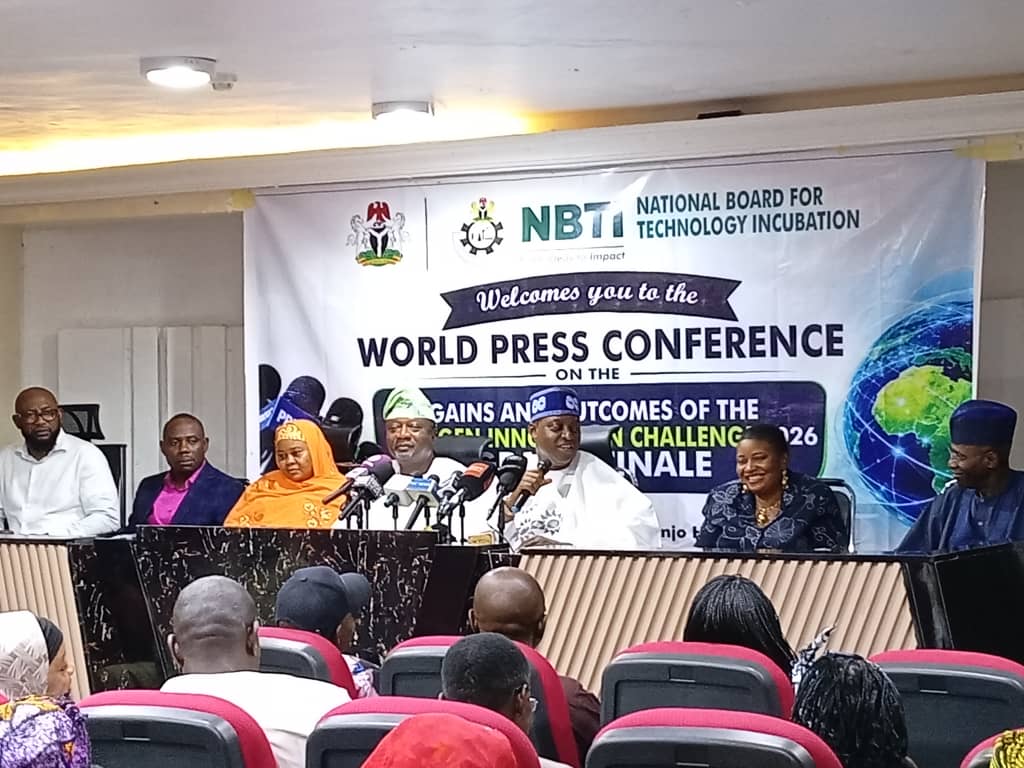
The Director-General and Chief Executive Officer of NBTI, Dr Kazeem Kolawole Raji, disclosed this at a world press conference in Abuja on Wednesday, October 21, 2026, while presenting the outcomes of the NextGen Innovation Challenge 2026 held in London, United Kingdom.
The challenge, organised by NBTI in partnership with UKALD, brought together Nigerian innovators, international investors, diplomats, business leaders and development partners at the Grand Finale held on October 9 at the Platinum Suite, ExCeL London.
Dr. Raji said the programme showcased 298 Nigerian innovators from all 36 states and the Federal Capital Territory, representing a significant increase from 105 participants in 2025.
He said the initiative was designed to expose homegrown technologies to international markets, attract investment and strengthen the commercialisation of indigenous innovations.
“Our message is straightforward: Nigeria’s innovators deserve visibility, our enterprises deserve opportunities to grow, and our technologies deserve pathways to the marketplace,” the NBTI chief executive said.
The innovations showcased covered artificial intelligence, robotics, agriculture, healthcare, education, renewable energy, telecommunications, digital technology, enterprise software, 3D printing and advanced manufacturing.
Dr. Raji said the next phase would focus on transforming innovative ideas into viable businesses capable of generating employment, improving productivity and addressing national development challenges.
The NBTI director-general identified two major opportunities underpinning the proposed investment portfolio of more than $600 million.
These include a proposed $500 million solar-energy investment programme being discussed with Gigawatt Global to develop solar farms across Nigerian universities and polytechnics under Power Purchase Agreements.
The second is a $100 million financing opportunity linked to the Tinubu Light Initiative, supported by a Memorandum of Understanding between NBTI and Financial Innovation for Impact, UK, also known as Cambridge Investors.
According to Dr. Raji, the proposed investments could support renewable-energy infrastructure, improve electricity access in participating tertiary institutions and advance national clean-energy objectives.
He, however, clarified that the figures represent proposed investment and financing opportunities and not funds already received or disbursed.
“Their realisation will depend on the applicable due diligence, financing arrangements, contractual commitments, approvals and implementation requirements,” he said.
Dr. Raji stressed that NBTI’s responsibility was to help transform the opportunities into viable projects with transparent implementation processes and measurable outcomes.
The NBTI chief executive also highlighted the Tinubu Light Initiative, a proposed national solar-inclusion programme designed to provide energy solutions to one million micro and small businesses across the country.
The initiative targets 10,000 field marketers for training and deployment, 50,000 direct youth employment opportunities and ₦30 billion in blended financing for its first phase.
It also projects approximately ₦12 billion in annual economic benefits, subject to the assumptions underpinning the programme and its eventual implementation.
Dr. Raji said the initiative was intended to address the high cost of energy and unreliable electricity supply confronting small businesses, many of which depend on petrol and diesel generators to operate.
Potential beneficiaries include tailors, barbers, hairdressers, pharmacies, restaurants, food vendors, printing businesses, retailers, point-of-sale operators, women-owned enterprises and youth-led businesses.
He explained that access to appropriate solar solutions could help businesses reduce operating costs, extend working hours and improve productivity.
Beyond energy access, the initiative envisages support for business formalisation and financial inclusion, including the development of credit histories for informal enterprises where appropriate arrangements can be established.
Dr. Raji emphasised that the proposed programme’s success would depend on sound financing, transparent beneficiary selection, reliable equipment, maintenance and effective monitoring.
He said NBTI would work with relevant public institutions, financial partners, private-sector operators and development organisations to advance the initiative.
Raji disclosed that Dubai-based investor Erin Grover had announced a $100,000 investment commitment to support three women innovators.
He said the commitment presented an opportunity to strengthen women-led enterprises by improving access to finance, mentorship, professional networks and business-development support.
The NBTI chief executive noted that the priority would be to translate the announcement into documented investment arrangements, appropriate support for beneficiaries and measurable business outcomes.
The NextGen Innovation Challenge also featured international accelerator opportunities for 16 selected innovators to undertake training in Finland, Estonia, Poland and Abu Dhabi.
The opportunities, announced by Dr Mazin Gadir, were valued at approximately $10,000 per innovator, representing a stated aggregate value of $160,000.
The selected projects include SAMA GOLD, Vellas Global Nutrition, Dunnally Fiber, ALINGA, CellGuard, Euler, Quad K PalmTech One, MTH SUNPOD, ACAD AI, AI Explorer for Kids, Gistoneer, Projavi, VoicePilot, Web3tribe University, GreenBook and 9ja Farm.
The projects span agriculture, healthcare, artificial intelligence, education, clean energy, digital technology and enterprise solutions.
Dr. Raji said the acceleration opportunities could help the innovators strengthen their business models, improve investor readiness, gain international exposure and explore new markets.
He added that international exposure would be most valuable when it translated into stronger products, commercial partnerships, improved business governance and sustainable revenue.
The Learning and Development Bureau UK, represented by Professor Langley and Dr Obe, also offered scholarships to the 16 selected innovators for a Pre-MBA Level 7 Award in Strategic Leadership and Management.
Each scholarship was stated to be worth more than £5,000, bringing the combined value to over £80,000.
The bureau also pledged assistance with applications for the United Kingdom’s Global Talent Visa, subject to individual eligibility and applicable immigration requirements.
Dr. Raji said leadership and management training were essential to helping innovators build sustainable enterprises, manage finances, develop teams, protect intellectual property and attract investment.
He noted that technological innovation required complementary business skills and effective organisational structures to achieve lasting economic impact.
The NBTI director-general called on Nigerian and international investors, financial institutions, corporate organisations, universities, research institutions and development partners to deepen their engagement with the country’s innovation ecosystem.
He said innovators needed more than public recognition, highlighting the importance of investment, technical mentorship, manufacturing capacity, market access, distribution networks and intellectual-property support.
Dr. Raji urged prospective investors to assess opportunities on their individual merits and undertake appropriate due diligence before committing resources.
He also called on the media to continue reporting on Nigerian innovation while scrutinising implementation, accountability and measurable results.
“Constructive public scrutiny is essential. It helps institutions improve, partnerships mature and public confidence grow,” he said.
Dr. Raji said NBTI would focus on advancing investment opportunities, supporting the commercialisation of innovations, tracking employment outcomes and ensuring that international partnerships deliver practical benefits.
He identified transparency, national inclusion and accountability as important priorities, noting that institutional performance should be assessed by the number of sustainable businesses created, capital mobilised, jobs generated and products brought to market.
The director-general said the achievements associated with NextGen 2026 demonstrated the potential of technology incubation to support youth entrepreneurship, small-business growth, renewable energy, technology transfer and economic diversification.
However, he stressed that the next phase must move beyond announcements and international visibility to implementation and verifiable outcomes.
“We must turn exposure into market access, partnerships into implementation, innovation into enterprise, enterprise into employment, and investment opportunities into productive economic activity,” Raji said.
He reaffirmed NBTI’s commitment to working with the Federal Government, private-sector organisations and development partners to strengthen technology incubation and enterprise development across Nigeria.
Dr. Raji said the ultimate objective was to ensure that Nigerian ingenuity translated into sustainable businesses, employment opportunities and lasting national prosperity.