
By Media360Impact (Opinion)
For many Nigerians, the water problem begins before the first meal of the day.
It can mean searching for a functioning borehole, waiting for a water vendor, carrying containers over long distances or spending part of a household’s income buying water that should ideally be available through a reliable public service.
But Nigeria’s water challenge is bigger than the absence of running water.
It is also about toilets, drainage, hygiene, wastewater, public health, schools, markets, flooding and the ability of communities to maintain the infrastructure that governments and development partners provide.
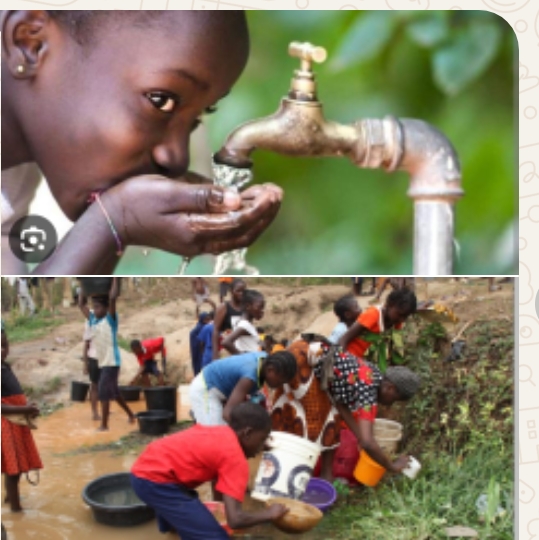
This is why water and sanitation remain among the country’s most important public-interest issues.
The numbers tell only part of the story
The latest UNICEF data show that about 82 per cent of Nigeria’s population uses at least basic drinking-water services, while only 30 per cent has access to safely managed drinking-water services.
For sanitation, 48 per cent use at least basic sanitation services, while 32 per cent have access to safely managed sanitation services.
The distinction is important.
Having access to a water source does not automatically mean that the water is safely managed.
Likewise, having a toilet does not necessarily mean that human waste is safely contained, transported, treated and disposed of.
This is where the real challenge begins.
Water, sanitation and hygiene are connected
Water is often discussed separately from sanitation.
In reality, the two are closely connected.
A community may have a borehole but still face serious public-health problems if wastewater is poorly managed, toilets are inadequate or residents have no reliable facilities for handwashing.
UNICEF says poor access to adequate water, sanitation and hygiene contributes to vulnerability to water-borne diseases and disproportionately affects poorer children.
The consequences can extend beyond illness.
Children who repeatedly fall sick may miss school. Families may spend money treating preventable diseases. Workers may lose productive hours. Women and girls may carry a disproportionate burden of collecting water and managing household sanitation.
The water crisis therefore becomes an economic and social problem.
Women and girls carry part of the burden
Water scarcity is not gender-neutral.
Data cited by UNICEF from Nigeria’s Multiple Indicator Cluster Survey show that women and girls aged 15 and above are more likely than men and boys to be primarily responsible for collecting drinking water.
The figures cited in UNICEF’s 2026 analysis put the proportion at 40 per cent for females compared with 30 per cent for males.
This means that when water infrastructure fails, the cost is not simply measured in naira.
It can also be measured in hours.
Time that could have been spent in school, at work, running a business or caring for family can instead be spent looking for water.
The sanitation problem is equally serious
Nigeria has made efforts to reduce open defecation and improve sanitation, but the challenge remains significant.
The country’s 2021 WASH National Outcome Routine Mapping survey found that about 48 million Nigerians were still practising open defecation, while only about 10 per cent of the population had access to basic water, sanitation and hygiene services combined.
Although newer international estimates show progress in individual components of WASH, the figures demonstrate why sanitation cannot be treated as a secondary issue.
A functioning sanitation system requires more than constructing toilets.
It requires behaviour change, reliable water, waste management, enforcement of standards, functioning drainage and systems for safely managing human waste.
Why government plans matter
The Federal Government has continued to pursue reforms and programmes aimed at improving water supply and sanitation.
In September 2026, the Federal Ministry of Water Resources and Sanitation called on Nigeria’s 36 states and the Federal Capital Territory to take greater ownership of the Nigeria National Water Compact 2026–2030, describing state and FCT participation as critical to strengthening water security.
The ministry has also continued to highlight water security, climate resilience, sanitation and investment as interconnected priorities.
That direction is important because water delivery ultimately happens where people live.
A federal policy may provide the framework, but the quality of a water service is experienced at community level.
The question is not only: How much money is spent?
Nigeria has seen numerous water projects over the years.
The harder question is:
How many of those projects continue working years after they are commissioned?
A new borehole can produce an impressive commissioning photograph.
But what happens six months later when the pump breaks?
Who repairs it?
Who pays for maintenance?
Is there a local management structure?
Was the project designed around the actual needs of the community?
Is the water source protected from contamination?
These questions are crucial because sustainability can be more important than the number of projects officially completed.
A water project that stops working becomes another abandoned public asset.
Climate change is making the challenge harder
Water security is also becoming increasingly connected to climate change.
Floods can contaminate water sources, damage sanitation infrastructure and displace communities.
Drought and changing rainfall patterns can put pressure on water supplies.
The Federal Government has recently increased its focus on water security, climate resilience and regional cooperation around major river basins, including the Niger and Lake Chad basins.
This means Nigeria cannot treat water management simply as a matter of constructing more boreholes.
The country also needs stronger planning around rivers, groundwater, drainage, floods, forests, urban growth and agricultural demand.
Urban Nigeria has a different problem
In rapidly growing cities, the challenge can look different.
A city may have water vendors, private boreholes and commercial water suppliers while still lacking a reliable public water network.
At the same time, population growth puts pressure on drainage and sanitation systems.
The Federal Government and development partners have therefore increasingly focused on urban sanitation reforms and private-sector investment. In July 2026, the Federal Ministry of Water Resources and Sanitation said stakeholders had launched a Nigeria Urban Sanitation Sector Diagnostic Report aimed at strengthening reforms and attracting greater private-sector investment.
But investment must ultimately be judged by the services people receive.
What should success look like?
Success should not simply be the number of water projects announced.
It should be measured by questions ordinary Nigerians can answer:
Does the water work?
Is it safe?
Is it affordable?
Is it available throughout the year?
Does the toilet system safely manage human waste?
Can schools provide children with water and sanitation?
Can health facilities maintain adequate hygiene?
Does the infrastructure survive beyond the launch ceremony?
These are the questions that turn water policy into measurable public service.
The bigger picture
Nigeria’s water and sanitation challenge is not a problem that can be solved by one ministry, one government or one development organisation.
Federal institutions have responsibilities. State governments and the FCT have critical roles. Local governments and communities matter. Private operators and development partners also have a part to play.
But citizens should not have to treat access to basic water and sanitation as a privilege.
Clean water, safe sanitation and proper hygiene are fundamental to public health, education, dignity and economic productivity.
The country therefore needs to move beyond celebrating the construction of water infrastructure to measuring whether that infrastructure remains functional and reaches the people it was designed to serve.
Because at the end of the day, the real test of Nigeria’s water policy is not what is written in a government document.
It is what happens when an ordinary Nigerian turns on the tap.