
By Sharon Akuboh,
I’m Sharon Akuboh, I hail from Ecewu, Bassa Local government Area in Kogi State, while my mother, Princess Joy Omagha Idam, is from Amasiri, Afikpo LGA of Ebonyi state. My grandfather the legend Ichie Chukwu Idam Chukwu was from Amasiri. He was my Hero and I just want all of this attacks on his people to end already so he can rest in Peace.

The unfortunate, unfolding, situation in Amasiri, a historically rooted community in Ebonyi State, has raised urgent questions about governance, justice, and the limits of state power. Since late January 2026, a series of sweeping government actions have transformed the narrative from what was initially framed as a security response into a broader national conversation about constitutional rights and collective punishment.
At the centre of the controversy is the Ebonyi State Government’s decision to impose far-reaching measures on the community following an alleged security incident. However, critics argue that what has been implemented goes beyond law enforcement. Instead, they describe a pattern of actions that appear to punish an entire population without clear evidence, due process, or publicly identified suspects.
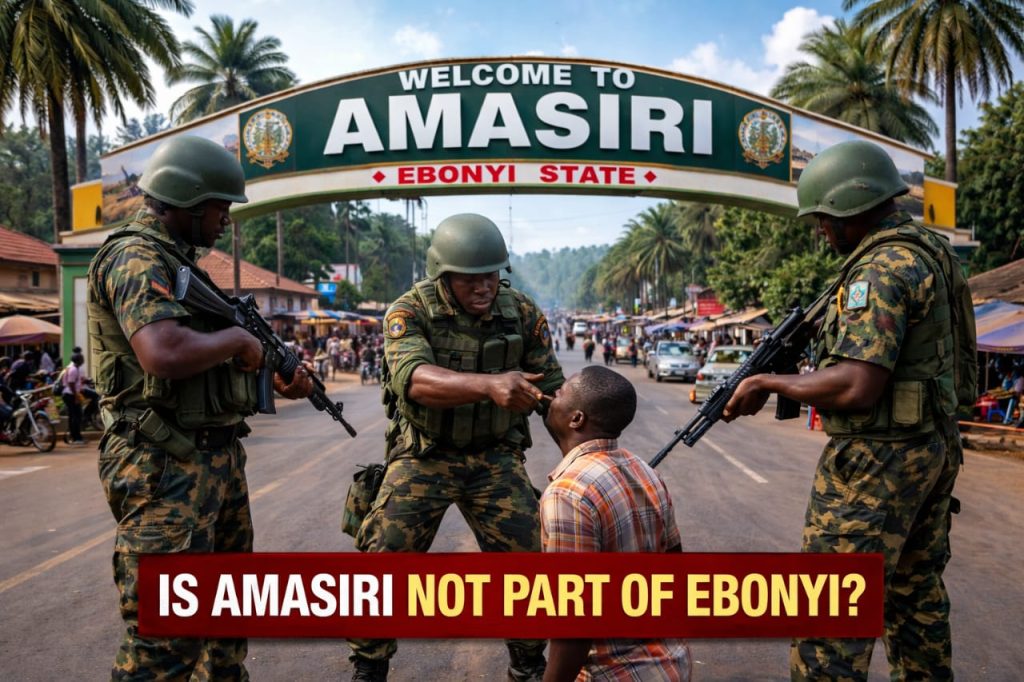
Observers point to a troubling inversion of justice. In systems guided by the rule of law, punishment is expected to follow investigation and conviction. In Amasiri’s case, sanctions came first—affecting traditional leadership, political appointees, and everyday citizens—raising concerns about whether due process has been sidelined in favour of executive action.
The scope of these measures has been extensive. Reports indicate that community leadership structures were dismantled, public institutions disrupted, and daily life severely restricted through prolonged curfews. Schools and healthcare services have been affected, while economic activities, particularly farming and small businesses, have slowed to a halt. For many residents, the impact has been both immediate and deeply personal.


Adding to the complexity are statements attributed to Francis Ogbonna Nwifuru, which some analysts say raise further questions about the justification for the crackdown. If, as suggested, those accused were not directly linked to the scene of the alleged crime, the rationale for imposing community-wide sanctions becomes increasingly difficult to defend within legal and ethical frameworks.
Eyewitness accounts and local narratives also describe a heavy security presence in Amasiri, with allegations of property damage and confrontations between residents and security personnel. While the government maintains that these measures are necessary to maintain order, critics argue that the intensity of enforcement appears disproportionate, especially in the absence of a declared conflict.
Cultural context has also emerged as a critical dimension of the debate. Community members have questioned aspects of the official narrative, citing traditional practices—particularly those related to mourning periods and burial customs—as factors that may contradict some of the allegations. These perspectives, however, have yet to be fully explored through any transparent investigative process.
Another point of contention is the emergence of reports suggesting wider inter-community tensions involving Amasiri. While such claims have circulated in some quarters, many residents insist these narratives are unfamiliar and lack verifiable evidence. This has fueled suspicions that broader conflict stories may be shaping public perception without sufficient factual grounding.
Meanwhile, the government has defended its actions as necessary for the protection of lives, citing intelligence reports of possible retaliatory attacks. Yet, this justification has sparked debate: should preventive security measures target alleged perpetrators, or should they restrict the freedoms of those they are meant to protect? The question remains central to understanding the legitimacy of the state’s approach.
The issue of representation has further complicated matters. With key leadership structures in Amasiri reportedly dissolved or inactive, concerns have been raised about who speaks for the community in ongoing discussions, including those related to boundary and conflict resolution. Without inclusive representation, any long-term solution risks being viewed as incomplete or imposed.
Beyond the immediate crisis lies a deeper question about resources, identity, and the politics of land. Amasiri is widely regarded as an agriculturally rich and strategically located area, factors that inevitably shape its significance within the state. For some observers, these underlying dynamics cannot be separated from the current tensions.
As the situation continues to evolve, the Amasiri case stands as a critical test for Nigeria’s democratic institutions. It challenges the balance between security and civil liberties, between executive authority and constitutional safeguards. Ultimately, the resolution of this crisis will not only determine the future of one community but also signal how justice is understood and applied in moments of tension.
In the end, Amasiri’s story is not just about a local dispute. It is about the enduring question of whether the rule of law can withstand the pressures of power—and whether communities can rely on the institutions meant to protect them when it matters most.
All I seek for my Mother’s people is for normalcy to be restored. Governor Nwifuru, reopen Schools, markets, hospitals, places of worship at Amasiri, release the Ezeogos, coordinators and youths currently being detained.
Set up a panel to investigate the killings. Look into the Petitions by Amasiri over the killings of Amasiri people by Edda let justice be served those who deserve it. Investigate the unlawful barricade at Some Federal Highway. Hear Amasiri Out on all their pains.
Finally all those having their Eyes on Amasiri’s common wealth’s should look elsewhere. Amasiri deserves justice and fair treatment. Not the kind of mayhem unleashed on her.