
Dear Senator Umahi,
ANOTHER ONE-WEEK ULTIMATUM TO PRODUCE VICTIMS’ HEADS, BODIES, AND NAMES OF SUSPECTS IN THE OSO ATTACK AS A CONDITION FOR NORMALCY IN AMASIRI—MY HONEST BUT UNTOLD TRUTH ABOUT THE IMPLICATIONS OF THE STATE’S ACTIONS ON AMASIRI COMMUNITIES AND THE GENERAL MOOD OF THE AVERAGE INNOCENT INDIGENE
The mediatory meeting, summoned by His Excellency, the former Governor of Ebonyi State, the Minister for Works, and attended by the delegates of the Amasiri communities on 2nd February 2026, regarding the Edda/Amasiri crisis, concluded with yet another wave of tension, anxiety, and hostility following his new ultimatum: produce the decapitated heads, submit the names of those responsible, and issue a public press statement expressing gratitude to the Governor for his actions against your community—within one week.

Deep disappointment or profound humiliation—either, or indeed both—aptly captures the disposition of many Amasiri indigenes following the footage of the purportedly mediatory meeting chaired by the Minister for Works regarding the Edda/Amasiri crisis, which is currently circulating in the media.

Conversely, I am neither disappointed nor humiliated by the Minister’s disposition in this regard, as his position—bereft of justice, fairness, or empathy—aligns entirely, though most regrettably, with my expectations of him, given his political alignment and interest.
Perhaps it is because I recognize that any departure from his present position would likely occasion a crack in, or shift from, his solidarity with his protégé and the people of Edda, to whom he evidently—judging from available indices—owes a measure of loyalty either in action or in decision.
Here is why: the current Minister for Works is the immediate past Governor of Ebonyi State, who successfully installed his successor as the present Governor. The successor has remained firmly within his political influence, and the duo have consistently—and predictably—defended each other’s actions for mutual political benefit. Not even moral correctness or general public policy would alter that alignment; much less would the interests of a politically less advantageous community such as Amasiri suffice to fracture it.

Thus, for the moment, Amasiri appears in the meeting with the Minister to be cast in the unfortunate role of John the Baptist—a sacrificial figure presented to satisfy political expectations, much like the head demanded at the pleasure of a king’s court.
Were that not the case, it would have been far easier—if not more reasonable—to agree, without hesitation, that; the state should not take action purportedly to protect innocent citizens from attack, only to enable or sponsor aggression against them through the instrumentalities of the state, the restrictions in Amasiri affecting pupils, students, hospitals, and the economic life of the community ought to be lifted while comprehensive investigations into every killing arising from the boundary disputes between the two communities are conducted, with a clear commitment that all parties must be held accountable for any wrongdoing once found guilty.
Howbeit, and that, if, as claimed, the presence of officers and men of the Armed Forces is necessary to secure lives and prevent reprisal attacks, such security measures would be more appropriately stationed at the boundary between the two rival communities—which is approximately nine to ten kilometers away from the residential areas of Amasiri—rather than at the heart of Amasiri community.
Quite perversely, or dangerously biased in his judgment, the Minister feigns lack of interest or appears unconcerned that it would have been proper to mandate all parties, on an equal basis, to produce the bodies of those killed and taken or abducted throughout the period of this unfortunate struggle—if indeed that were truly of interest to the state—rather than targeting only the alleged 29th January attack, as if no other attacks had occurred in or against both communities in recent times, noting that such a measure would hold every party accountable and serve as a deterrent against similarly condemnable actions in the future.
Perhaps no one among the delegates has had the courage to inform the Minister that the so-called “peace model” of his protégé may have, in fact, resulted in more deaths and inflicted greater generational loss than any reprisal mission could have caused the community. Indeed, I believe that not every Edda man would have willingly participated in an attack on Amasiri based merely on suspicion of actions committed by a few individuals—actions which the Amasiri community has consistently denied any knowledge of and would never have rightly gathered together to participate in.
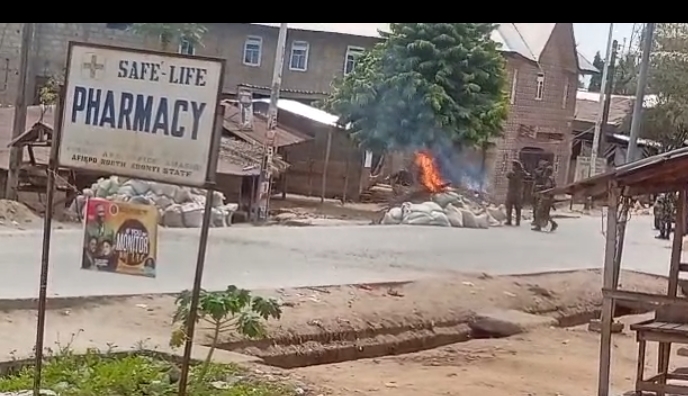
Methinks no reprisal attack from any aggrieved community could have simultaneously destroyed all the ancestral homes (Ulogo) and numerous other valuable properties, including farm produce, in Amasiri; disrupted an academic year for pupils and students; sacked and dethroned all traditional rulers and political appointees; incarcerated them alongside over 40 other youths; taken the lives of numerous indigenes—some killed instantly, others tortured incrementally to death—both old and young, caused several stillbirths and maternal deaths due to lack of access to medical facilities; delisted the community’s development center; and displaced a significant portion of the population—as the military actions in Amasiri have; except, of course, when such actions are sponsored by the state, as we are witnessing today.
While these incidents represent an already excessive loss in Amasiri, purportedly or disguisedly carried out to prevent a reprisal attack following the Oso incident—which has yet to be properly investigated or resulted in anyone being lawfully implicated to date—the Minister should have been more humane by at least acknowledging the excessive use of force against innocent people in Amasiri and prompting a withdrawal, while insisting that investigations continue—if fairness, compassion, and humanity were allowed a place in politics.
I think the Minister may need to be reminded that the numerous deaths and extensive damages already enabled or caused and still been caused by the state in Amasiri should have been sufficient to serve as a deterrent—if state-sponsored retribution or the use of violent force against innocent people were considered a lawful remedy for criminal actions.
The Minister may need to reconsider his mediatory position and adopt the most fatherly and humane approach—one that restores lives in Amasiri, recognizing that they too matter, and fosters a lasting, peaceful relationship between Amasiri and her neighboring communities, without casting any community as a sacrificial lamb for another.
Maduabuchi O. Idam