
By Joy Omagha Idam
For decades, women journalists in Nigeria have played a critical role in informing the public, shaping conversations and giving visibility to issues that affect communities. Yet, as the nature of national security continues to evolve, the need for deeper engagement between the media and security institutions has become increasingly important.
It was against this backdrop that the Nigeria Association of Women Journalists (NAWOJ) recently took its engagement with the Nigerian Army a step further, seeking a stronger partnership that would equip women journalists with the knowledge and skills required to report security issues responsibly and effectively.
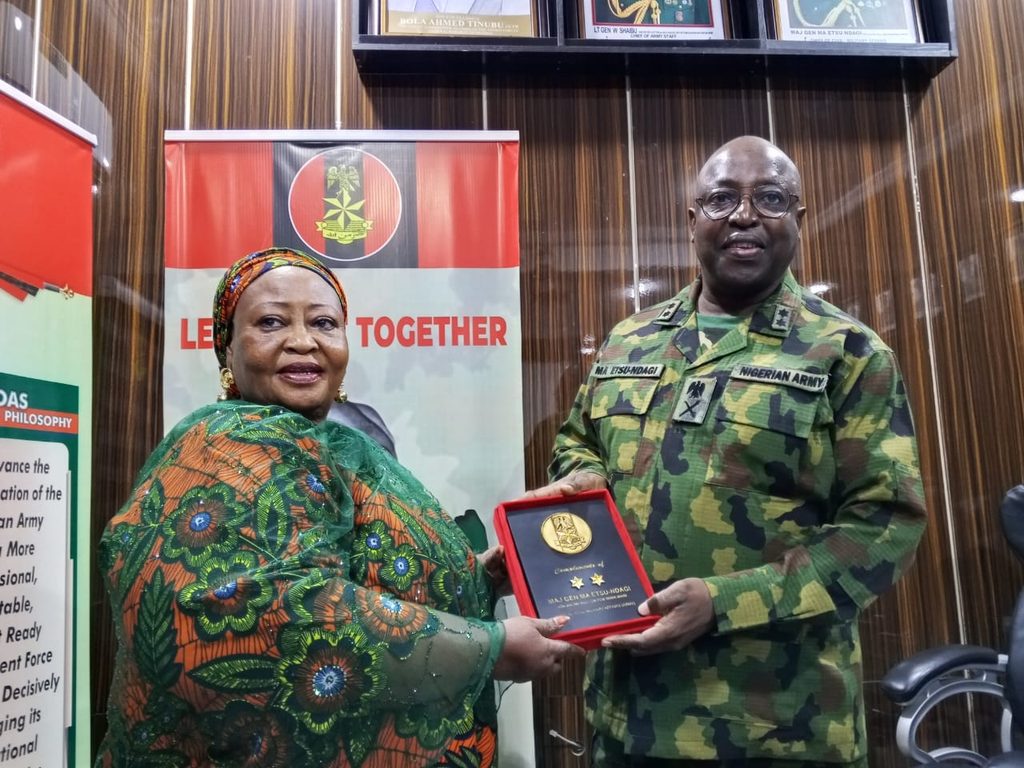
Led by the NAWOJ National Chairperson, Hajia Aisha Ibrahim, the association’s leadership paid a courtesy visit to the Nigerian Army, where it presented the outcome of the maiden Women in Security, Peace Building and Conflict Resolution Summit and Awards (WINSEC).
The visit was more than a courtesy call. It represented an opportunity to explore new areas of collaboration between women journalists and the military, particularly at a time when security reporting demands greater professionalism, accuracy and sensitivity.
WINSEC: A Platform with a Purpose
The maiden WINSEC Summit and Awards was conceived as a platform to place women at the centre of national conversations on security, peace building and conflict resolution.
For NAWOJ, the objective goes beyond organising an annual event. It is about creating a sustainable platform where women journalists, security professionals, policymakers and other stakeholders can exchange ideas and develop practical approaches to some of the country’s most pressing security challenges.
Presenting the outcome of the inaugural summit, Ibrahim made it clear that WINSEC is not intended to be a one-off initiative.
“WINSEC is here to stay,” she declared.
She explained that NAWOJ wants the Nigerian Army, particularly the Directorate of Civil-Military Affairs, to become a strategic partner in future editions of the programme.
Training for Better Security Reporting
One of the major areas of interest highlighted by NAWOJ is capacity building.
The association is seeking collaboration with the Nigerian Army to train women journalists on specialised areas of security reporting, including countering misinformation, civil-military relations and peace building.
Such training could provide journalists with a better understanding of military operations, security terminology and the complexities surrounding conflict reporting.
For the public, the benefits could be equally significant.
When journalists are better equipped to understand security situations, their reports can contribute to informed public discourse while reducing the possibility of misinformation, sensationalism or misunderstanding of military operations.
The proposed collaboration therefore has the potential to strengthen not only the relationship between the media and the military but also the quality of information available to Nigerians.
A Permanent Home for NAWOJ
Another major issue raised during the engagement was the association’s acquisition of land for the construction of its National Secretariat Complex.
After 38 years of existence, the acquisition represents an important milestone in NAWOJ’s history.
Ibrahim appealed for support towards the development of the proposed secretariat, which is expected to provide a permanent institutional home for the association and serve as a centre for its national activities.
The project is significant not only because of the physical structure it represents, but also because of what it could mean for the future of women journalists in Nigeria.
A permanent national secretariat could strengthen NAWOJ’s institutional capacity, provide space for training and meetings, and serve as a platform for developing programmes that advance the professional interests of women journalists.
Army Signals Support
Responding to the NAWOJ delegation, the Chief of Civil-Military Affairs, Major General Musa Etsu-Ndagi, expressed delight over the association’s achievements and described the acquisition of land for its national secretariat as a significant development.
He assured NAWOJ of the Nigerian Army’s readiness to collaborate with and support the association.
The assurance could open the door to a more structured relationship between the Army and NAWOJ, particularly in areas of professional training, security communication and civil-military engagement.
Beyond a Courtesy Visit
The significance of the NAWOJ-Army engagement lies in what it could become.
At a time when security challenges require cooperation among institutions, the media and security agencies have complementary responsibilities. The military protects the nation, while the media informs the public and provides a channel through which citizens can better understand national developments.
For women journalists, acquiring specialised knowledge of security reporting can strengthen their ability to perform that responsibility effectively.
For the Nigerian Army, closer engagement with women journalists provides an opportunity to communicate more effectively with the public and promote a better understanding of its operations.
The partnership being envisioned by NAWOJ could therefore become a model for constructive civil-military-media relations.
Looking Ahead
The proposed collaboration between NAWOJ and the Nigerian Army is still at an early stage, but the direction is clear.
WINSEC is positioned to become an annual platform for dialogue on security, peace and conflict resolution, while the proposed NAWOJ National Secretariat Complex represents a long-term investment in the association’s institutional future.
Together, both initiatives reflect a broader ambition: to give women journalists a stronger voice in national security conversations and create lasting bridges between the media and Nigeria’s security establishment.
If sustained, the partnership could produce more than meetings and goodwill. It could translate into stronger professional capacity, better security reporting, greater public understanding and a more meaningful role for women journalists in Nigeria’s peace and security architecture.
For NAWOJ, the message is clear—women journalists are not merely observers of Nigeria’s security story; they are important participants in shaping the conversation.
Weekenders magazine hails the leadership of NAWOJ and the Nigerian Army. And pray for better synergy for the two organizations.