
By Joy Omagha Idam, Abuja
The Diplomatic Correspondents’ Association of Nigeria (DICAN) has raised serious concerns over the growing threat of information warfare, warning that the manipulation of information through artificial intelligence and coordinated disinformation campaigns now poses grave dangers to global security, democracy, trade, and investment.
This formed part of the communiqué issued at the end of the 2nd Diplomatic, Security, Trade and Investment International Conference organized by DICAN in collaboration with the Centre for Communication Development and Diplomacy in Africa (CCDDA), held at the Rotunda Hall of the Federal Ministry of Foreign Affairs, Abuja, on May 20, 2026.
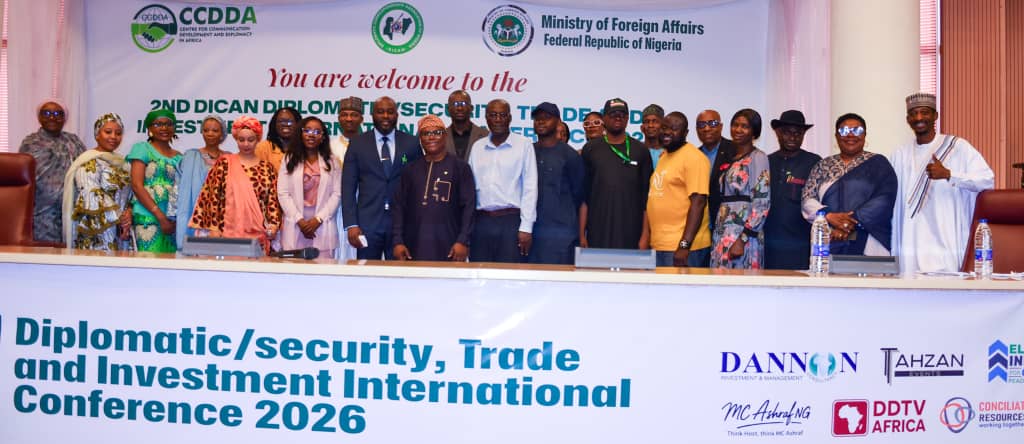
The conference, themed “Information Warfare: Strengthening Global Security, Trade and Investment Through Collaborative Truth – The Role of Diplomacy, Intelligence and the Media,” attracted diplomats, security experts, intelligence officials, civil society groups, academics, senior government officials, and media professionals from within and outside Nigeria.
Participants observed that information warfare has evolved beyond ordinary fake news into sophisticated Foreign Information Manipulation and Interference (FIMI), powered largely by generative artificial intelligence and deepfake technologies.
According to the communiqué, more than 70 percent of global disinformation campaigns in 2026 are now driven by advanced AI tools capable of simulating diplomatic crises, economic instability, and electoral confusion faster than conventional fact-checking systems can respond.
The conference further noted that information manipulation currently costs the global economy an estimated 100 billion dollars annually through lost investments, increased security spending, and market volatility.
Conferees warned that the spread of manipulated information has become a major instrument for undermining democratic processes, especially during elections held globally between 2024 and 2026. They stressed that hostile actors increasingly deploy digital propaganda to distort public perception and weaken trust in electoral institutions.
In the Nigerian and African context, the conference identified fake information and hostile propaganda as major threats fueling insurgency, disrupting regional trade cooperation, and straining diplomatic relationships among nations.
Despite these challenges, participants commended Nigeria’s progress in economic diplomacy and non-oil exports. The conference cited records from the Nigerian Export Promotion Council (NEPC), showing that Nigeria recorded over 6.1 billion dollars in non-oil exports in 2025, with value-added products accounting for 51 percent of exports.
The conference also acknowledged the 55th anniversary of diplomatic relations between China and Nigeria, while welcoming China’s newly introduced zero-tariff policy for 53 African nations. Participants emphasized that adherence to the One-China principle remains essential in sustaining mutual diplomatic trust.
One of the major highlights of the conference was the official launch of the Nigeria Fact-Check and Information Integrity Network (NFIIN), spearheaded by DICAN and CCDDA.
The newly established network, according to the communiqué, brings together 69 non-governmental organizations across Nigeria’s 36 states and has already established six regional Situation Rooms with dedicated Desk Officers to monitor, intercept, and analyse malicious digital content.
The network also unveiled national awareness campaigns with key public enlightenment slogans including: “Verify Before You Share,” “Truth Matters: Build a Stronger, Safer Society,” and “Think Before You Share,” translated into English, Hausa, Yoruba, and Igbo.
Awards of Excellence were presented to several distinguished personalities and institutions for their contributions to peacebuilding, information integrity, and democratic development.
Among the recipients were former President Goodluck Ebele Jonathan, the National Security Adviser Nuhu Ribadu, presidential spokesman Bayo Onanuga, the European Union Delegation to Nigeria, Executive Secretary of NEPC Nonye Ayeni, former Minority Leader of the House of Representatives Ndudi Elumelu, Registrar General of the Chartered Institute of Project Managers of Nigeria Henry Mbadiwe, and Director General of the Institute for Peace and Conflict Resolution Joseph Ochogwu.
The communiqué noted that Olubunmi Tunji-Ojo and Allen Onyema were absent during the award presentation.
The conference called on journalists and media organizations to uphold ethical standards of accuracy, fairness, and balance while integrating technological fact-checking systems into newsroom operations.
Participants also urged diplomatic missions and international partners to provide technical support, grants, and advanced tools to help African journalists combat AI-driven disinformation campaigns.
Security agencies were advised to strengthen collaboration with the media in protecting factual information spaces, while governments were encouraged to invest more in digital literacy, civic education, and transparency initiatives.
Corporate organizations and private sector leaders were equally urged to support public truth initiatives and sponsor platforms promoting information integrity.
The conference commended the Permanent Secretary of the Ministry of Foreign Affairs, Dunoma Umar Ahmed, for supporting the initiative and providing the venue for the conference.
Looking ahead, DICAN announced that its 2027 International Conference would focus on the interconnected challenges of security, migration, and human trafficking, with particular emphasis on how manipulated information contributes to the exploitation of vulnerable populations.
The communiqué was signed by the Chairman of DICAN, Idehai Frederick, on behalf of the Conference Secretariat and Communiqué Committee.