
As Bilateral Trade Climbs to $9bn, India Deepens Footprint in Nigeria’s Technology, Healthcare, Agriculture, Defence and Energy Sectors
By Joy Omagha Idam
For decades, the relationship between Nigeria and India was largely viewed through the familiar lenses of trade, crude oil, pharmaceuticals and commercial exchange. Today, however, a new story is emerging—one of a partnership steadily expanding into technology, healthcare, agriculture, energy, defence, manufacturing and human development.
The latest trade figures offer a compelling picture of this transformation.
Bilateral trade between Nigeria and India rose to approximately $9 billion in 2025–26, compared with $7.13 billion recorded in 2024–25.
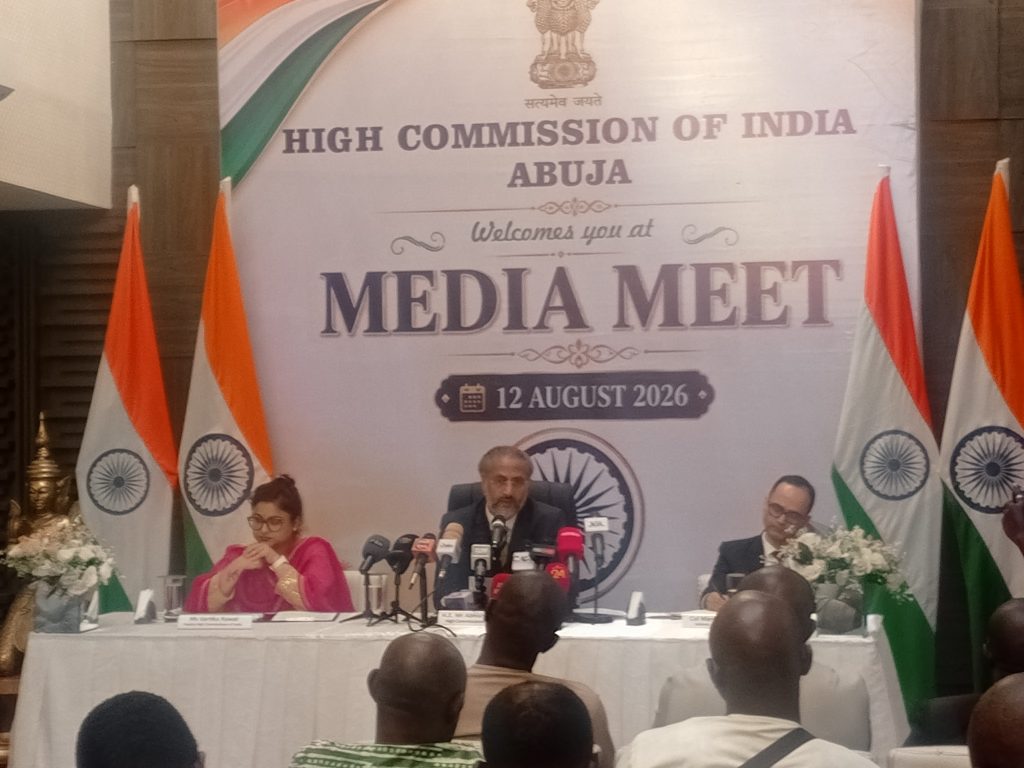
The figure was disclosed by the Indian High Commissioner to Nigeria, Abhishek Singh, during a media engagement with members of the Diplomatic Correspondents Association of Nigeria (DICAN) in Abuja.
For Singh, the figures are more than an economic milestone. They reflect the growing depth and diversity of relations between two major countries whose connections are increasingly extending beyond traditional commodities and into areas capable of shaping the future development of both nations.
MORE THAN 200 INDIAN COMPANIES, A GROWING ECONOMIC FOOTPRINT
Perhaps one of the clearest signs of India’s expanding presence in Nigeria is the number of Indian companies operating across the country.
More than 200 Indian companies are currently active in Nigeria, with investments spanning pharmaceuticals, manufacturing, power, construction, healthcare and consumer goods.
But the significance of these investments goes beyond the value of capital deployed.
Collectively, Indian companies operating in Nigeria employ nearly 100,000 Nigerians, placing Indian businesses among important contributors to employment generation and economic activity.
For a country seeking to create jobs for its rapidly growing population, such investments have implications far beyond corporate balance sheets.
Every factory, pharmaceutical facility, construction project, power investment and commercial enterprise creates opportunities for workers, suppliers, entrepreneurs and professionals.
The partnership is consequently becoming increasingly visible in the everyday lives of Nigerians.
HEALTHCARE: WHERE INDIA’S EXPERIENCE MEETS NIGERIA’S NEEDS
Healthcare is emerging as one of the most promising frontiers of Nigeria-India cooperation.
India has developed considerable capacity in affordable healthcare delivery, pharmaceutical production, medical services and health-related technology. These experiences are attracting increasing attention as Nigeria continues its efforts to expand access to quality and affordable healthcare.
India’s Deputy High Commissioner to Nigeria, Vertika Rawat, highlighted her country’s experience in areas including maternal healthcare, immunisation, nutrition, health insurance and women’s inclusion.
She also pointed to findings from India’s National Family Health Survey, emphasising lessons that could be relevant to Nigeria as it pursues stronger healthcare systems and broader coverage.
The potential is significant.
Nigeria faces persistent challenges in ensuring that quality healthcare is affordable and accessible to its citizens. India, meanwhile, has built a globally recognised pharmaceutical and healthcare industry capable of producing medicines and providing medical services at comparatively competitive costs.
The two countries therefore have an opportunity to transform existing cooperation into deeper partnerships involving healthcare investment, technology transfer, medical training, pharmaceutical production and knowledge exchange.
India’s pharmaceutical investment in Nigeria, reportedly exceeding $4 billion, underlines the scale of this relationship.
FROM TRADE STATISTICS TO HUMAN IMPACT
Behind every billion-dollar trade figure are people.
The nearly 100,000 Nigerians employed by Indian companies represent perhaps one of the most tangible dimensions of the bilateral relationship.
Employment provides income. Income supports families. Businesses create supply chains. Skills acquired in the workplace can be transferred to other sectors. Investments can stimulate local economic activity.
This is where the Nigeria-India partnership acquires a human face.
Indian investment in manufacturing, pharmaceuticals, power, construction and consumer goods is helping to connect international capital with Nigerian labour, markets and entrepreneurial opportunities.
The next stage of the relationship could therefore place even greater emphasis on local value creation—ensuring that investment produces not only profits, but also skills, technology, innovation and sustainable opportunities for Nigerians.
TECHNOLOGY AND THE FUTURE OF ECONOMIC COOPERATION
Technology represents another area where the relationship has significant room for expansion.
Nigeria’s young and dynamic population provides a vast market for digital services, technology-driven businesses and innovation, while India’s experience in information technology, digital services and technology-enabled public systems offers opportunities for knowledge sharing.
A deeper Nigeria-India technology partnership could support digital skills development, entrepreneurship, innovation hubs, technology transfer and the growth of Nigerian businesses.
The potential goes beyond importing technology.
The real opportunity lies in creating platforms where Nigerian and Indian entrepreneurs, technology companies, universities and institutions can develop solutions together.
AGRICULTURE, ENERGY AND DEFENCE
Agriculture and energy remain critical to Nigeria’s development ambitions, and both provide additional opportunities for cooperation.
Agriculture is central to food security, employment and rural development in Nigeria. India’s experience with agricultural technologies, processing, irrigation, value chains and smallholder-focused development could offer useful areas for collaboration.
Energy is equally strategic.
Nigeria possesses abundant energy resources but continues to face challenges around electricity generation, distribution and access. Indian companies already have experience in power and infrastructure, creating possibilities for deeper investment and technical cooperation.
Defence and security also remain important components of Nigeria’s engagement with India as both countries confront complex security environments and seek stronger institutional and technical capacity.
Together, these areas point towards a relationship that is becoming increasingly strategic rather than simply commercial.
DIPLOMACY, DIALOGUE AND THE ROLE OF THE MEDIA
The Abuja media engagement was also a demonstration of the importance of communication in strengthening diplomatic relations.
Diplomatic missions and journalists occupy different spaces, but both have a shared interest in ensuring that the public receives accurate and meaningful information about international relations.
Chairman of DICAN, Fredrick Idehai, expressed appreciation to the Indian High Commission for opening its doors to diplomatic correspondents and creating an avenue for closer engagement.
Such interactions, he noted, are important for improving journalists’ understanding of diplomatic activities and bilateral relations.
For Nigeria-India relations, sustained engagement with the media can help bring the broader story to Nigerians—moving public understanding beyond trade statistics to the investments, people, partnerships and opportunities behind them.
THE ROAD AHEAD
With bilateral trade now around $9 billion, more than 200 Indian companies operating in Nigeria and substantial investment in pharmaceuticals and other sectors, the foundation for a stronger partnership is already in place.
But the most important question is not how high the trade figure can rise.
It is what Nigeria and India can build together.
Can the relationship generate more jobs? Can it improve access to healthcare? Can Indian technology and Nigerian innovation combine to create new businesses? Can agricultural cooperation strengthen food security? Can investment in energy help address power challenges? Can greater knowledge exchange develop the skills required by the next generation?
These are the questions that will define the next chapter.
The Nigeria-India relationship is no longer simply a story of oil flowing one way and manufactured goods flowing another.
It is gradually becoming a story of investment, people, knowledge, technology and shared possibilities.
From oil to healthcare. From commerce to innovation. From investment to employment. From traditional diplomacy to strategic cooperation.
The future of Nigeria-India relations may ultimately be measured not only in billions of dollars, but in the lives transformed and opportunities created by what both nations choose to build together.
Nigerians look forward to a time when Bollywood and Nollywood would work together. Weekenders magazine Commends Singh.