
New leadership submits list of elected officers, outlines reconciliation process and promises renewed focus on parents, schools and education development
By Joy Omagha Idam
The National Parent Teacher Association of Nigeria (NAPTAN) has entered a new phase of leadership following a Quadrennial Delegates Congress held in Abuja on September 9, 2026, where Chief Uche Onyia emerged as President, according to a formal report submitted by the new leadership.
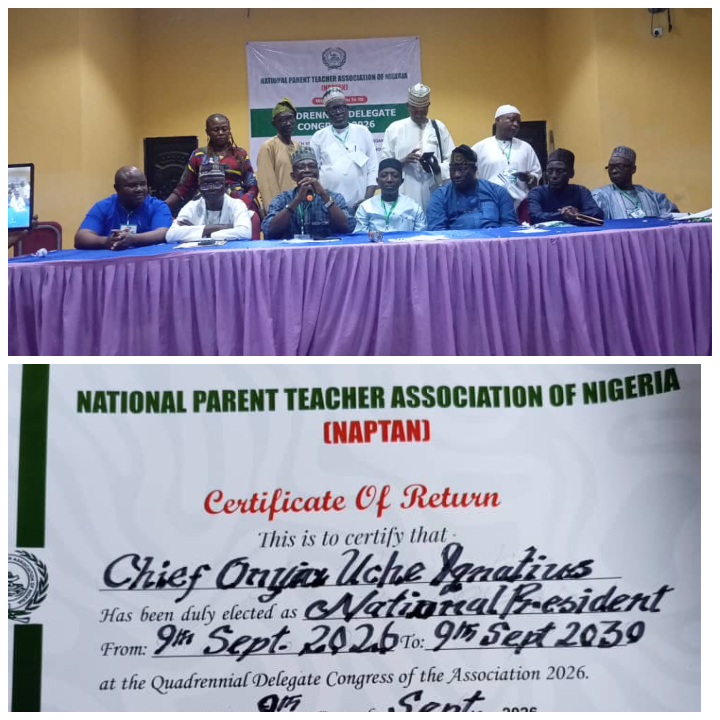
The report, presented on behalf of the National Executive Council, outlines the events leading to the congress, the reconciliation efforts preceding the election and the composition of the new national executive expected to steer the affairs of the association for the 2026–2030 period.
The development comes against the backdrop of a prolonged leadership disagreement within NAPTAN, with competing positions having emerged over the conduct and recognition of the association’s national leadership.
In a separate report published shortly after the September 9 proceedings, The PUNCH reported that the Federal Ministry of Education had halted the disputed election and that rival groups subsequently maintained different positions on whether the congress should proceed.
The Blueprint also reported that the ministry’s NAPTAN Desk Officer, Joseph Achede, said the election remained suspended pending reconciliation and compliance with the association’s constitutional provisions.
Against this backdrop, Chief Uche Onyia and his colleagues have submitted their own account of the congress and the processes that culminated in the emergence of the new officers.
FROM DISAGREEMENT TO RECONCILIATION
According to the report attributed to the new leadership, efforts to resolve the internal disagreement included intervention by the Federal Ministry of Education and the establishment of a 10-member Reconciliation Committee.
The committee, according to the report, comprised representatives of the two contending groups and was tasked with finding a pathway towards a fresh and broadly participatory national election.
The report states that the reconciliation process produced recommendations including the withdrawal of the two principal contenders from the immediate leadership process and the conduct of a fresh national congress.
It further states that the recommendations were subsequently presented to the National Executive Council and considered during an NEC meeting on July 2, 2026.
One of the central issues highlighted in the report was the desire to provide qualified members with an opportunity to contest for national offices.
According to the new leadership’s account, members associated with the different sides of the earlier disagreement obtained nomination forms and participated in the nomination process ahead of the September congress.
SEPTEMBER 9 CONGRESS
The September 9 congress became the decisive point in the leadership transition.
According to the report submitted by the new administration, delegates from more than 20 states and the Federal Capital Territory participated in the congress.
The report maintains that after accreditation and the commencement of proceedings, an issue arose concerning the continuation of the election.
The new leadership’s account states that delegates subsequently relied on Article 9(2)(d) of the NAPTAN Constitution, which it says provides a mechanism for the congress to appoint an electoral committee where the designated electoral officer is unable or unwilling to conduct the election.
Based on that interpretation, the report states that delegates proceeded with the electoral process.
However, this remains a contested account.
Public reports published immediately after the congress indicate that the Federal Ministry of Education considered the election suspended. The PUNCH reported that the ministry directed the contending parties to suspend the process and return to dialogue, while Blueprint quoted the ministry’s NAPTAN Desk Officer as saying that an election conducted outside the ministry’s supervision would not be recognised.
The competing accounts underscore the need for the relevant authorities and the association’s constitutional organs to clarify the status of the September 9 proceedings.
ONYIA EMERGES
In the account presented by the new administration, Chief Uche Onyia emerged as National President after the presidential election.
The report states that Prof. Boniface Odeh, who also contested the presidential position, received nine votes, while Chief Uche Onyia secured 31 votes.
The report further states that Onyia was declared winner, sworn in and issued a Certificate of Return.
These figures and the reported outcome form part of the new administration’s submission and have not been independently verified by Weekenders.
Chief Onyia now faces the task of leading an association whose members have experienced a period of internal disagreement and competing claims over leadership.
His emergence therefore places considerable emphasis on reconciliation, institutional stability and the restoration of confidence among members and stakeholders.
NEW NATIONAL EXECUTIVE
The report submitted by the new administration lists the following persons as elected national officers for the 2026–2030 tenure:
National President: Chief Uche Onyia
Deputy National President: Alhaji Abubakar Usman
Vice President, North West: Mr. Dalhatu Salihu
Vice President, South South: Mr. Nwankwo Goodlive Iyke
Vice President, North East: Dr. Abba Kale
Vice President, South West: Sir Dr. Ekundayo Ademola Abiodun KJW
Vice President, North Central: Mr. Ayubaga David Habila
Vice President, South East: Dr. Kachi Nwoga
National Secretary: Mr. Ibrahim Ya’u Nabayi
Assistant Secretary: Mrs. Lilian Avoaga Mercy
Treasurer: Mr. Ayodeji
Financial Secretary: Alhaji Lawan Abubakar Kanuri
Organising Secretary: Mr. Audu Usman Gana
Internal Auditor: Dr. Nura Usman Nakazalle
Publicity Secretary: Chief Olatunbosun Rotimi
A NEW RESPONSIBILITY
Beyond the election itself, the new administration inherits an association with an important role in Nigeria’s education ecosystem.
Parent-teacher associations provide a platform through which parents and schools can engage on issues affecting children’s learning, welfare and educational development.
NAPTAN’s national leadership therefore has responsibilities extending beyond internal administration. Its engagement with government, schools, teachers and parents can influence discussions around education policy, school infrastructure, teacher welfare, learning environments and parental participation.
The Federal Government’s recent commencement of the recruitment of Parent-Teacher Association teachers into the formal teaching system has also placed renewed attention on issues concerning PTA participation in education. NAPTAN’s then-president, Prof. Boniface Odeh, publicly welcomed the initiative on September 9, describing it as an issue the association had advocated for over time.
For the incoming administration, such developments present an opportunity to refocus attention on the practical concerns of parents and learners.
LOOKING AHEAD
The formal report submitted by Chief Uche Onyia’s administration asks the Federal Ministry of Education to recognise and place on record the names of the officers presented as having emerged from the September 9 congress.
At the same time, the competing accounts surrounding the congress mean that questions about recognition and constitutional compliance remain part of the wider NAPTAN story.
For members of the association, the larger expectation is that the leadership question will ultimately give way to a period of stability in which attention can return to the core purpose of the organisation: strengthening the voice and participation of parents in Nigeria’s education system.
Chief Uche Onyia’s reported emergence therefore marks not simply a change of names at the top of NAPTAN, but a potentially important transition for an organisation seeking to move beyond a period of internal disagreement.
The new leadership’s immediate challenge will be to build confidence across the association, engage stakeholders constructively and demonstrate that the next chapter of NAPTAN can be defined by greater cohesion, transparency and attention to the educational interests of Nigerian children.
Weekenders Magazine has presented the leadership transition based on the formal report supplied by the new administration and contemporaneous media reports. The status of the September 9 election remains subject to the position of the competent authorities and the applicable NAPTAN constitutional processes.