
By Joy Omagha Idam
In a bid to strengthen women inclusion, the Philippine Ambassador to Nigeria, Amb. Mersole Mellejor, has called for stronger institutional mechanisms, legislative frameworks and accountability measures to promote gender equality and ensure meaningful inclusion of women in governance, diplomacy and national development.
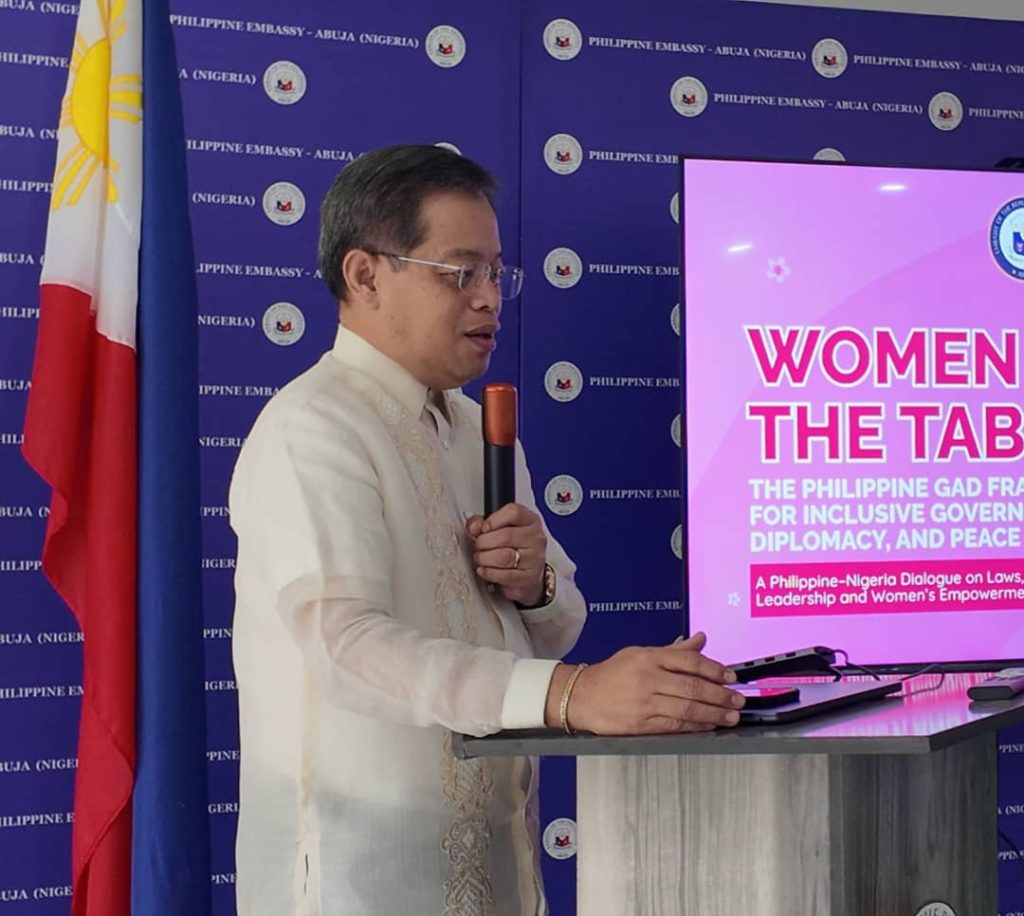
Mellejor made the call during a high-level dialogue session organised under the Female Legislative Mentorship Initiative on Parliamentary Affairs and Diplomacy at the Philippine Embassy in Abuja.
The engagement, which brought together officials from the Directorate of Parliamentary Affairs, the Ministry of Foreign Affairs, diplomatic representatives and legislative mentees, featured a presentation titled “Women at the Table: The Philippine Gender and Development (GAD) Framework for Inclusive Governance, Diplomacy, and Peace.”
The Ambassador described gender mainstreaming as an ongoing process that requires deliberate policies, institutional commitment and practical mechanisms capable of ensuring compliance.
According to him, the Philippines has developed a system in which government agencies are required to integrate gender considerations into their programmes, with budgetary implications serving as an important accountability mechanism.
“In the Philippines, we have parameters in place that carry direct budget implications for government agencies. Failure to implement gender mainstreaming directly impacts an agency’s budgetary allocation, serving as a firm measure to force compliance,” he explained.
Mellejor also drew attention to the Philippines’ Safe Spaces Act, which provides legal protection against gender-based sexual harassment and other forms of abuse in public spaces and workplaces.
He noted that the framework demonstrates how legislation can be deployed not only to protect victims but also to create a culture of accountability, stressing the importance of translating gender policies into enforceable actions.
Nigeria on the Right Path
While reflecting on Nigeria’s own efforts toward gender inclusion, the Philippine envoy commended the country for making progress despite its complex cultural and demographic realities.
“As an outsider, I am very encouraged by where Nigeria is in terms of gender mainstreaming. You are on the right path,” Mellejor said.
He urged Nigerian policymakers to view the country’s diversity and large population as assets rather than challenges, drawing lessons from the Philippine experience.
According to him, Nigeria’s population of more than 230 million people, combined with its youthful and increasingly technology-driven population, provides enormous opportunities for economic transformation.
He particularly identified the creative and technology sectors as areas where young Nigerians can contribute significantly to national development.
Diversity as a Strength
Mellejor further emphasised the importance of diversity in building national unity, arguing that differences in culture, ethnicity, gender and other social identities should be harnessed as instruments of strength.
“Based on the Philippine experience, diversity should not be a source of weakness; it is a vital generator of unity,” he noted.
The Ambassador’s remarks underscored the potential for Nigeria and the Philippines, both democratic nations with youthful populations and diverse societies, to strengthen cooperation in areas including gender equality, governance, diplomacy, peacebuilding, technology and the creative economy.
Building Bridges Through Mentorship
The mentorship dialogue also provided participants with an opportunity to exchange perspectives on gender-responsive legislation, women’s participation in leadership, parliamentary affairs, diplomacy and peacebuilding.
Members of the Philippine diplomatic team, including Vice-Consul Norman and Vice-Consul Yate, shared insights into the Embassy’s domestic and external Gender and Development (GAD) programmes.
The engagement highlighted the importance of mentorship in preparing women for leadership roles while strengthening institutional understanding of gender-responsive governance.
Mellejor expressed optimism that the dialogue would pave the way for stronger partnerships between the Philippine Embassy, the Nigerian National Assembly and relevant civil society organisations.
Such partnerships, he said, could further promote legislative engagement, diplomatic cooperation and practical initiatives aimed at advancing gender equality and inclusive governance.
For Nigeria and the Philippines, the dialogue represents more than an exchange of ideas; it offers an opportunity to deepen bilateral relations through shared democratic values and a common commitment to ensuring that women have a meaningful place at the decision-making table.