
By Sharon Akuboh
For generations, the dream of returning home remained a quiet prayer in many Igbo families scattered across the world.
Today, that dream is taking on a new meaning.
From the United States, Canada, the United Kingdom, Germany, South Africa and different parts of Nigeria, people of Igbo heritage are increasingly reconnecting with the land, culture and history of their ancestors.
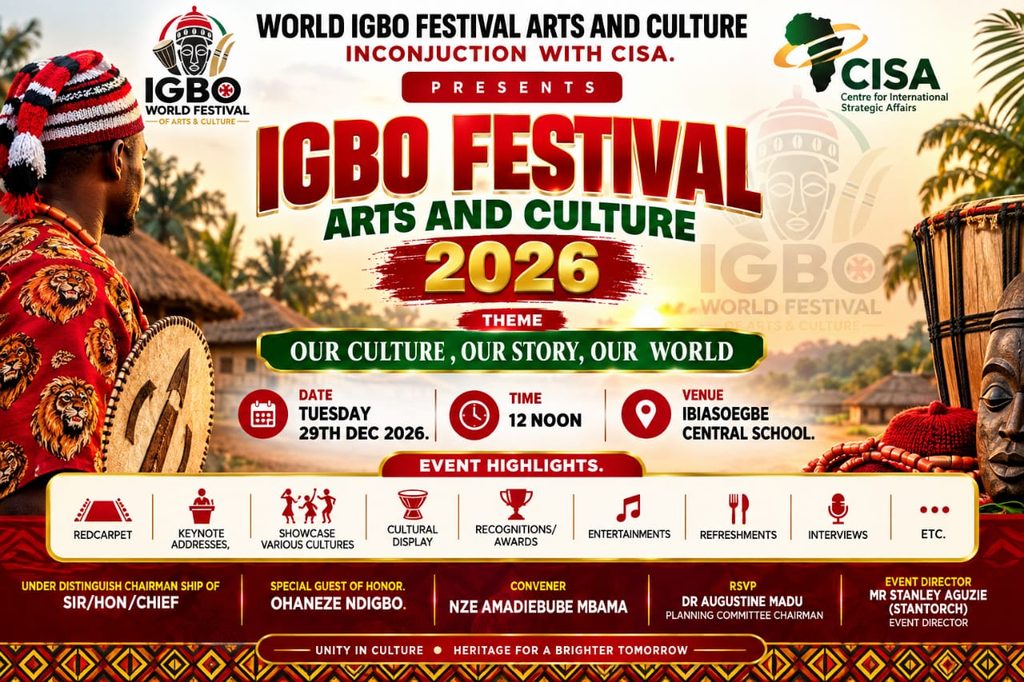
It is a homecoming that transcends geography.
It is about identity, memory and the enduring desire to know where one comes from.
For Ndigbo, whose history has been shaped by migration, commerce, conflict and the devastating legacy of the transatlantic slave trade, the idea of returning to Alaigbo carries a particularly deep emotional significance.
The modern movement is also reaching beyond those who left southeastern Nigeria in recent generations.
Across the Caribbean and parts of Latin America, communities whose ancestors were taken from West Africa during the slave trade have, through genealogical research, oral histories and DNA ancestry projects, explored possible connections to different African ethnic groups, including the Igbo.
In Jamaica, Brazil, Trinidad and Tobago, Barbados, Haiti, Cuba, The Bahamas, the Dominican Republic and other parts of the Americas, interest in African ancestry has continued to grow.
For some descendants of enslaved Africans, the search is deeply personal.
The transatlantic slave trade separated millions of Africans from their families, communities, languages and traditional identities. Many were given new names and forced to adopt unfamiliar cultures and languages.
Yet, across generations, elements of African heritage survived—in music, food, spirituality, oral traditions, family memories and cultural practices.
For descendants who discover an Igbo connection, that discovery can become the beginning of a remarkable journey of cultural reconnection.
It is important, however, to recognise that ancestry is complex. DNA testing can provide evidence of genetic connections to regions and populations, but it does not always establish a precise ethnic identity or a direct ancestral link to a particular modern community.
For many involved in the search, nevertheless, the significance goes beyond scientific percentages.
It is the emotional experience of discovering a possible connection to a people and a homeland that history once made distant.
That is why the emerging homecoming carries such powerful symbolism.
Those who were once separated from Africa through circumstances beyond their control are now able to travel in the opposite direction—this time freely, intentionally and in search of connection.
The journey is therefore not simply about returning to a geographical location.
It is about reclaiming stories.
It is about learning names that history erased, understanding traditions that were interrupted and meeting communities with whom a shared heritage may exist.
For Alaigbo, such a movement presents both an opportunity and a responsibility.
The region can become not merely a destination for ancestral tourism, but a centre for cultural exchange, historical research, investment, education and people-to-people relationships between communities in southeastern Nigeria and Africans in the diaspora.
Traditional rulers, cultural institutions, community organisations and bodies representing Ndigbo in Nigeria and abroad all have roles to play in ensuring that such reconnection is properly organised and sustained.
The homecoming should also create space for honest conversations about history.
The story of the transatlantic slave trade cannot be separated from the African societies and coastal trading networks through which enslaved people were transported. Nor should the painful history be simplified into a story of blame directed at one people or community.
Instead, it should encourage deeper research, reconciliation and a shared determination to ensure that future generations understand what happened.
For the descendants of Africans in the diaspora who believe they have discovered Igbo ancestry, the journey back can be profoundly moving.
They are not returning to recreate a past that can never be fully recovered.
They are coming to encounter a living culture.
They are meeting contemporary communities whose languages, traditions and institutions have evolved over centuries.
And they are creating new relationships.
That distinction matters.
The descendants of those who were taken away generations ago cannot simply step into the past. But they can build meaningful connections with the present.
Their return can therefore become a bridge between history and the future.
Alaigbo can offer that bridge.
The great homecoming should not be viewed as a single ceremony or a one-time event. It can become a sustained movement for cultural rediscovery, responsible tourism, academic collaboration, investment and reconciliation.
It is a story of people searching for belonging.
It is a story of a continent reconnecting with people whose ancestors were forcibly removed from it.
And it is a reminder that even when history scatters people across oceans, memory can continue to search for a way home.
The scattered children may have travelled far.
Their descendants may speak different languages, carry different names and live under different flags.
But the search for roots remains universal.
And whenever that search brings them to Igbo land, the moment becomes more than a journey.
It becomes a meeting between history and identity—a chance to look across the centuries and say:
We have found our way home.