
Kaduna, Plateau, Benue, Nasarawa, Imo set for policy dialogues to drive gender-responsive governance, budgeting and institutional accountability
By Raymond Enoch
Nigeria’s efforts to advance gender equality and women’s participation in governance are set to enter a more practical phase as five states move to confront one of the country’s most persistent challenges—the widening gap between gender policy commitments and their implementation in institutions.
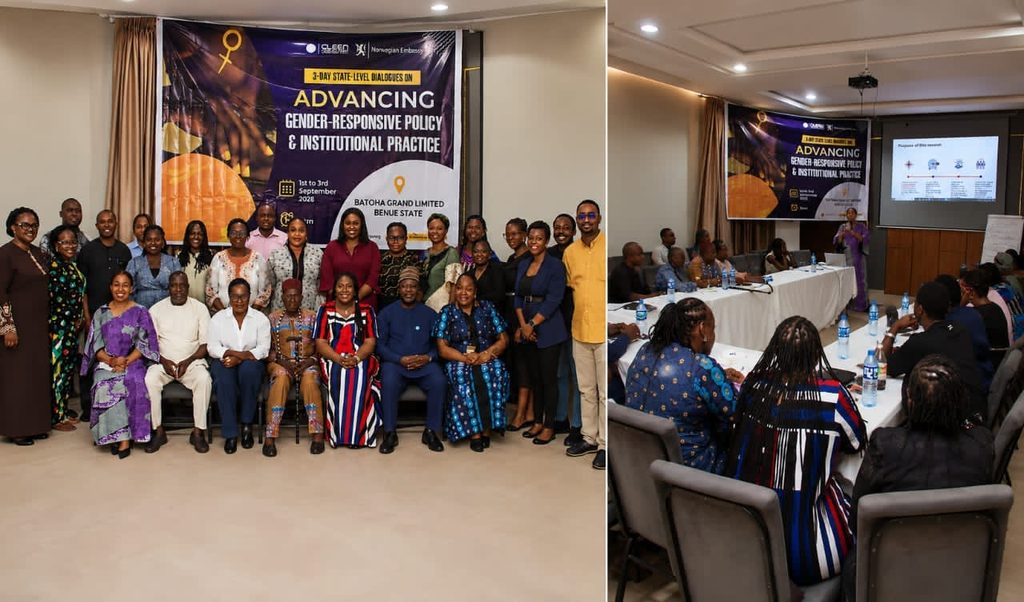
Kaduna, Plateau, Benue, Nasarawa and Imo States are being targeted for State-Level Policy Dialogues designed to turn existing gender laws, policies and institutional commitments into measurable action across governance, budgeting, peace and security, justice, economic development and public decision-making.
The programme is being implemented by the CLEEN Foundation with support from the Norwegian Embassy, with the Executive Director, Mr. Peter Maduoma, represented by Chigozirim Okoro, Programme Manager, in advancing the initiative aimed at strengthening gender-responsive policy and institutional practice across the five states.
The initiative is premised on the recognition that Nigeria already has a substantial legal and policy architecture for advancing gender equality, including the National Gender Policy, National Action Plan on Women, Peace and Security, Violence Against Persons (Prohibition) Act and the Child Rights Act, alongside various state-level frameworks.
Yet, the concept note underpinning the dialogues identifies a critical weakness: the existence of policies and laws has not consistently translated into gender-responsive institutional practice.
Weak institutional ownership, inadequate funding, fragmented coordination, limited gender-disaggregated data, insufficient accountability mechanisms and uneven capacity among government and non-government actors continue to undermine implementation.
The proposed dialogues therefore seek to move the gender conversation beyond declarations and awareness campaigns towards institutional responsibility, practical reforms and measurable results.
The first phase of the engagement is scheduled for September 1–3 in Nasarawa, Benue and Imo States, while Plateau and Kaduna States are scheduled for September 8–10 under a second phase.
Rather than adopting the conventional conference model, the initiative will use a policy-to-practice and evidence-to-action approach built around four critical questions: what commitments already exist, what is being implemented, where are the institutional gaps, and what practical actions can close those gaps?
Participants are expected to examine existing policies, programmes, budgets and operational practices while identifying specific institutional barriers preventing gender commitments from producing tangible outcomes.
The dialogues will bring together approximately 40 strategically selected stakeholders in each state, with emphasis on institutions that have direct policy, implementation or accountability responsibilities.
The proposed participants include the Ministries of Women Affairs, Justice, Budget and Planning, Finance, Information, Local Government and Chieftaincy Affairs, Internal or Homeland Security, state planning and statistics institutions, members of the State Houses of Assembly and representatives of local governments.
Security and justice institutions, including the Nigeria Police Force, Nigeria Security and Civil Defence Corps, Department of State Services, correctional institutions and the Legal Aid Council, are also expected to feature prominently.
Civil society organisations, women-led organisations, women mediators, traditional institutions, academia, development partners and the media are equally identified as important stakeholders in the process.
The emphasis on security and justice is particularly significant given the realities confronting several of the targeted states.
In Kaduna, Plateau, Benue and parts of Nasarawa, insecurity, displacement, livelihood disruption, gender-based violence and barriers to justice have created heightened vulnerabilities for women and girls.
In Imo, the gender agenda intersects with insecurity, youth vulnerability, economic pressures and institutional constraints, requiring responses that are sensitive to the state’s specific realities.
The concept note argues that the challenge is consequently not simply the absence of gender frameworks, but the failure to systematically institutionalise gender responsiveness across planning, budgeting, service delivery, monitoring and accountability.
A major component of the initiative will be institutional advocacy and follow-up.
On the first day of the engagements, teams are expected to visit high-impact institutions, including Governors’ Wives’ Offices, State Houses of Assembly and their relevant committees, Ministries of Women Affairs, Justice, Budget and Planning, Finance, security leadership and relevant local government authorities.
The visits are designed to secure institutional ownership of selected recommendations and identify opportunities for incorporating them into existing government policies, plans and budgets.
This element could prove crucial in determining whether the dialogues produce lasting institutional changes rather than becoming another series of stakeholder meetings without follow-through.
At the end of the process, the initiative is expected to produce five State-Level Gender Policy and Institutional Practice Dialogues, five State Gender-Responsive Governance Action Matrices and a consolidated Cross-State Policy and Practice Synthesis Report.
The anticipated outcomes include stronger institutional ownership of gender commitments, improved coordination among state actors, increased integration of gender considerations into planning and budgeting, stronger attention to gender in peace, security and justice programming and greater participation of women and women-led organisations in policy processes.
The initiative also seeks to strengthen the use of evidence and gender-disaggregated data in government decision-making while establishing stronger accountability for the implementation of gender-responsive policies.
At its core, the five-state intervention represents an attempt to shift Nigeria’s gender discourse from policy existence to policy delivery.
For CLEEN Foundation and its partners, the real measure of progress will not be the number of policies on paper, but whether those commitments are reflected in government budgets, institutional procedures, public services, security responses and decisions that improve the lives and participation of women and girls.
With the dialogues beginning across Nasarawa, Benue and Imo and moving subsequently to Plateau and Kaduna, the initiative places institutional action and accountability at the centre of Nigeria’s continuing quest for gender-responsive governance.