
By Edem Ekpo
The Cross River State Government has rolled out a Tractor Subsidy Programme alongside a two-day training for beneficiaries, in a major push to modernise farming, reduce production costs, and strengthen food security across the state.
The initiative, championed by Governor Bassey Edet Otu, is a key pillar of his administration’s agricultural transformation agenda, designed to position the sector as a catalyst for inclusive economic growth. The unveiling of the scheme reflects the governor’s pledge to prioritise agriculture as a foundation of the state’s economy.
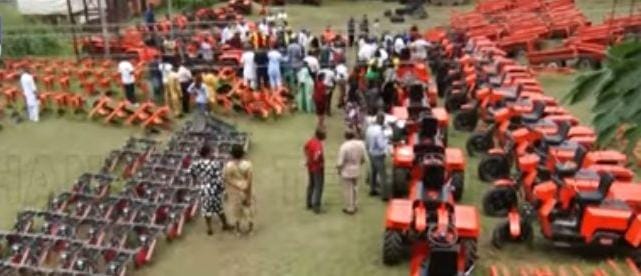
Speaking at the event in Monty Suites, Calabar, the Commissioner for Agriculture and Irrigation Development, Johnson A. Ebokpo, described the governor as the architect of Cross River’s agricultural revolution. He explained that the subsidy would reduce the burden on smallholder farmers, particularly the high cost of land preparation, which accounts for more than 70 percent of farming inputs.
Under the programme, 108 fuel-efficient mini-medium tractors will be distributed through cooperatives using a service-provider model. Farmers will make an initial deposit of ₦1.1 million and repay ₦300,000 monthly over three years, bringing the total to ₦10 million. Ebokpo noted that the smaller tractors were carefully selected to suit the state’s diverse terrain and to lower the steep hiring fees charged for larger machines.
“With tractors, farmers can expand their cultivated area from one hectare to as much as three. This will boost yields, enhance food and feed security, and lower food prices. Agriculture is business, and this programme provides farmers with the tools to be more productive,” the commissioner stated.
He further explained that subsequent phases of the scheme would introduce implements such as rotary tillers and gauge wheels to support rice farmers in flood-prone areas, where recent flooding had destroyed large portions of farmland. Ebokpo urged cooperatives to manage the tractors with integrity, stressing that they are for communal use rather than private ownership.
Declaring the training open, Elder Dr. Odey Ikongha, Permanent Secretary of the ministry and Chairman of the Tractor Committee, said capacity building was essential for sustaining the scheme. “This training demonstrates the joint commitment of government and stakeholders to advance mechanised farming. Participants should seize this opportunity and return ready to improve agricultural output in their communities,” Ikongha remarked.
Chairman of the State House of Assembly Committee on Agriculture, Hon. Bette Obi, commended the ministry’s technical team, particularly Engr. (Mrs) Justina Ulafor, Director of Mechanisation and Irrigation Development. He stressed that mechanisation remains central to transforming agriculture. “What one tractor can accomplish, fifty people cannot,” Obi said.
Technical sessions featured presentations by Engr. Ulafor on tractor handling, maintenance, and fuel efficiency; Elder Dr. Nicolas Dan on cooperative accountability; and Mr. Denis Ikpali, Coordinator of Project Grow, who described the programme as a turning point for agriculture in Cross River.
Beneficiaries, drawn from all 18 local government areas, were urged to share their new knowledge with other farmers in their communities to expand the scheme’s impact. The training continues today, with renewed calls for transparency, collaboration, and capacity building to make Cross River a model of sustainable mechanised agriculture in Nigeria.